

Nguyen Thi Minh Khai - a shining example of revolutionary spirit.
(Baonghean.vn) - Comrade Nguyen Thi Minh Khai, whose real name was Nguyen Thi Vinh, was born on September 30, 1910, into a family of minor civil servants in Vinh Yen commune, Vinh town (now Vinh city), Nghe An province. Her father was Mr. Nguyen Huy Binh, from Moc village, Nhan Chinh, Hanoi, who worked as a railway station secretary in Vinh from 1907. Her mother was Mrs. Dau Thi Thu, from Duc Tung, Duc Tho, Ha Tinh, who was a small trader at Vinh market. Her father was gentle and quiet, while her mother was resourceful, capable, and strict.
In 1919, at the age of 9, Nguyen Thi Vinh was enrolled in Vietnamese language classes by her family, and later transferred to the second grade at Nguyen Truong To Girls' School in Vinh City. In 1924, Nguyen Thi Vinh transferred to the first grade at Cao Xuan Duc Primary School, where she was influenced by patriotic ideas from teachers such as Tran Phu and Ha Huy Tap.
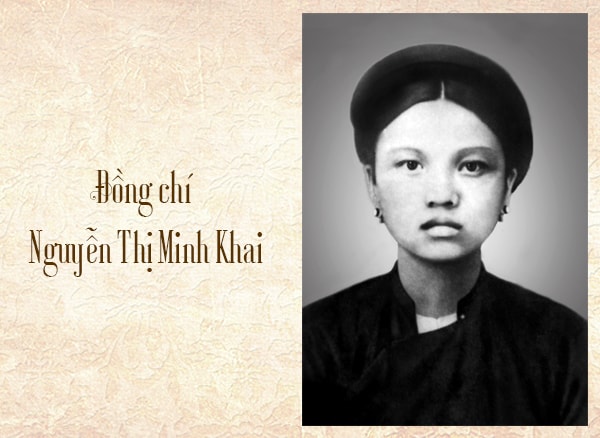 |
From 1925 to 1927, she participated in the Viet Restoration Society and then the Vietnam Revolutionary Comrades' Association in Vinh, founded by patriots such as Tran Phu, Ha Huy Tap, Ton Quang Phiệt, etc. To maintain secrecy, she changed her name from Nguyen Thi Vinh to Nguyen Thi Minh Khai - a name full of meaning that stayed with her throughout her life of unwavering revolutionary activity; she was just 17 years old at the time.
In early 1929, with the organization's approval, Nguyen Thi Minh Khai secretly left her family to engage in revolutionary activities. On February 3, 1930, when the Communist Party of Vietnam was founded, Nguyen Thi Minh Khai was admitted to the Party. She was in charge of propaganda work, training worker Party members in the Truong Thi and Ben Thuy areas, and organizing many training courses for Party cadres, who formed the core force that fought fiercely during the Nghe Tinh Soviet Uprising of 1930-1931.
In the summer of 1930, with the trust and recommendation of the Central Committee of Vietnam, headed by Comrade Nguyen Phong Sac, Comrade Nguyen Thi Minh Khai was sent abroad via Hai Phong to Hong Kong, China. She changed her name to A Vay and worked in the Eastern branch office of the Communist International, alongside Comrades Nguyen Ai Quoc and Ho Tung Mau. Nguyen Thi Minh Khai received direct instruction from Comrade Nguyen Ai Quoc on the fundamental theoretical issues of Marxism-Leninism and the experience of clandestine activities.
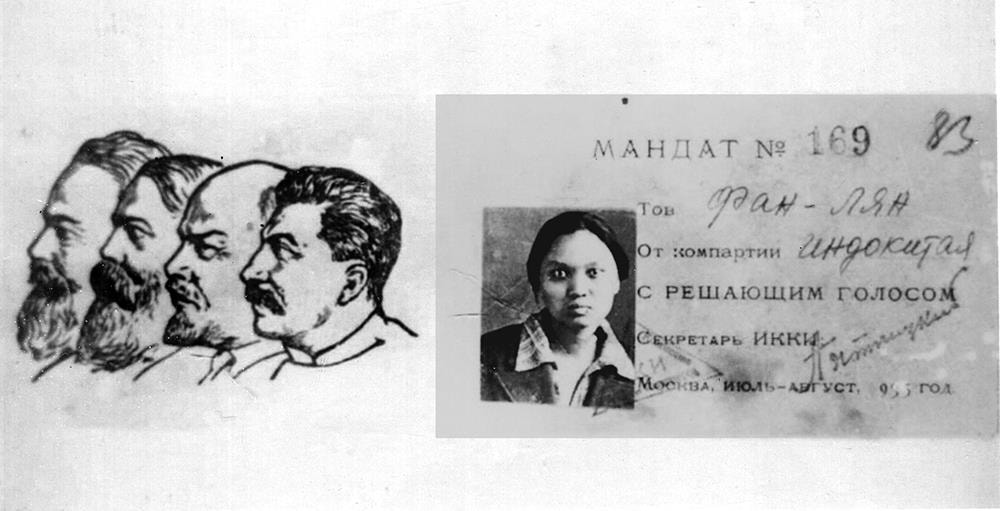 |
| Delegate card of Comrade Nguyen Thi Minh Khai attending the 7th Congress of the Communist International in 1935. Archival photo. |
In April 1931, the Party's headquarters in Hong Kong were exposed, and Comrade Nguyen Thi Minh Khai was arrested along with 20 other comrades. In 1933, Nguyen Thi Minh Khai was released thanks to the efforts of the Red Cross International. After her release, she changed her name to Vai and worked as a seamstress on the streets of Shanghai to try to re-establish contact with the Party. Eventually, she managed to reconnect with comrades Le Hong Son, Tran Ngoc Danh, Le Thiet Hung, Ha Huy Tap, Le Hong Phong, Hoang Van Non, and others. During this period of shared hardship, Comrade Nguyen Thi Minh Khai developed feelings for and married Comrade Le Hong Phong.
In September 1934, Nguyen Thi Minh Khai had the honor of being the first Vietnamese woman to be selected to participate in the Party delegation attending the 7th Congress of the Communist International in Moscow, along with Le Hong Phong (Head of the delegation) and Hoang Van Non. While awaiting the Congress, Comrade Nguyen Thi Minh Khai was admitted to study and hone her revolutionary theory at the University of the East (January 1935).
At the Congress, Comrade Minh Khai met and had a cordial conversation with Comrade NK Crupskaya, a veteran Bolshevik party member and the life partner of V.L. Lenin.
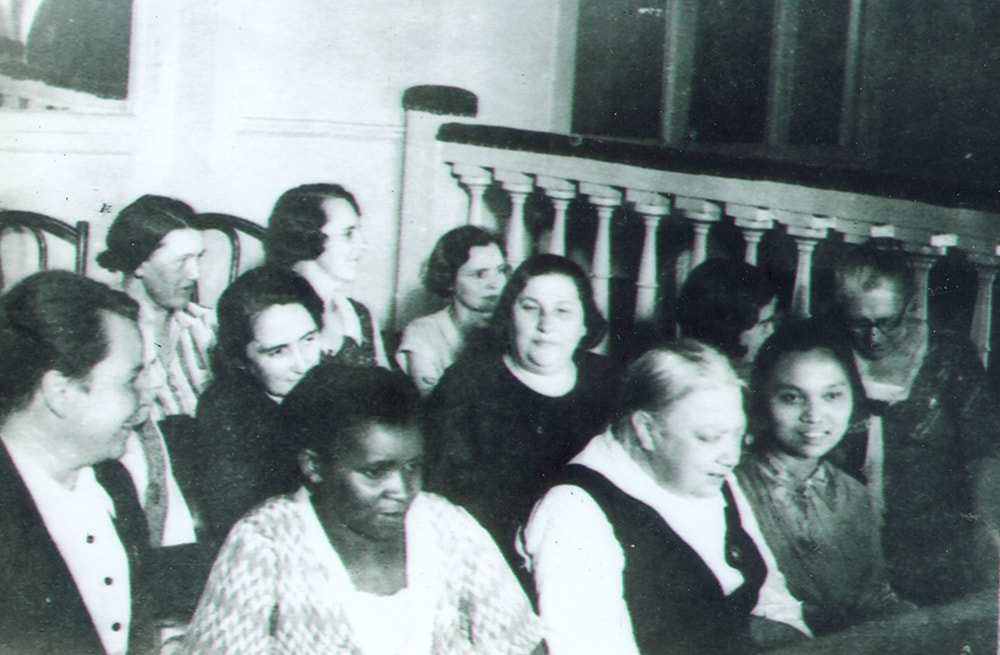 |
| Comrade Nguyen Thi Minh Khai and Comrade NK Krupskaya at the 7th Congress of the Communist International, July 1935. (Archival photo) |
After graduating from the University of the East, at the end of 1936, Comrade Nguyen Thi Minh Khai was sent back to Vietnam by the Communist International to convey important instructions given by the Communist International to the leaders of the Indochinese Communist Party.
In late 1937, Comrade Nguyen Thi Minh Khai was assigned to work in Saigon. She adopted the pseudonyms "Bay Khai" and "Nam Bac," was elected to the Southern Regional Party Committee, and served as Secretary of the Saigon-Chợ Lớn City Party Committee.
On June 22, 1939, amidst overwhelming work and numerous difficulties, and pregnant with her first child, Comrade Nguyen Thi Minh Khai was shocked to receive news that Comrade Le Hong Phong had been tracked down and arrested by the French secret police. Suppressing her grief and worry for her husband, she continued to fulfill her duties leading the revolution in Saigon-Chợ Lớn. In early 1940, Minh Khai gave birth to a baby girl named Le Nguyen Hong Minh, a combination of Minh Khai and Hong Phong's names.
In mid-1940, Japan invaded Indochina, and a fierce struggle erupted in Saigon-Gia Dinh and the rural areas of Southern Vietnam. Faced with this situation, the Southern Vietnam Regional Party Committee decided to launch an uprising to seize power. On July 30, 1940, the Party's base was exposed, and Nguyen Thi Minh Khai was arrested by the French colonial authorities at Nga Sau, Binh Dong, after attending a meeting of the Southern Vietnam Regional Party Committee.
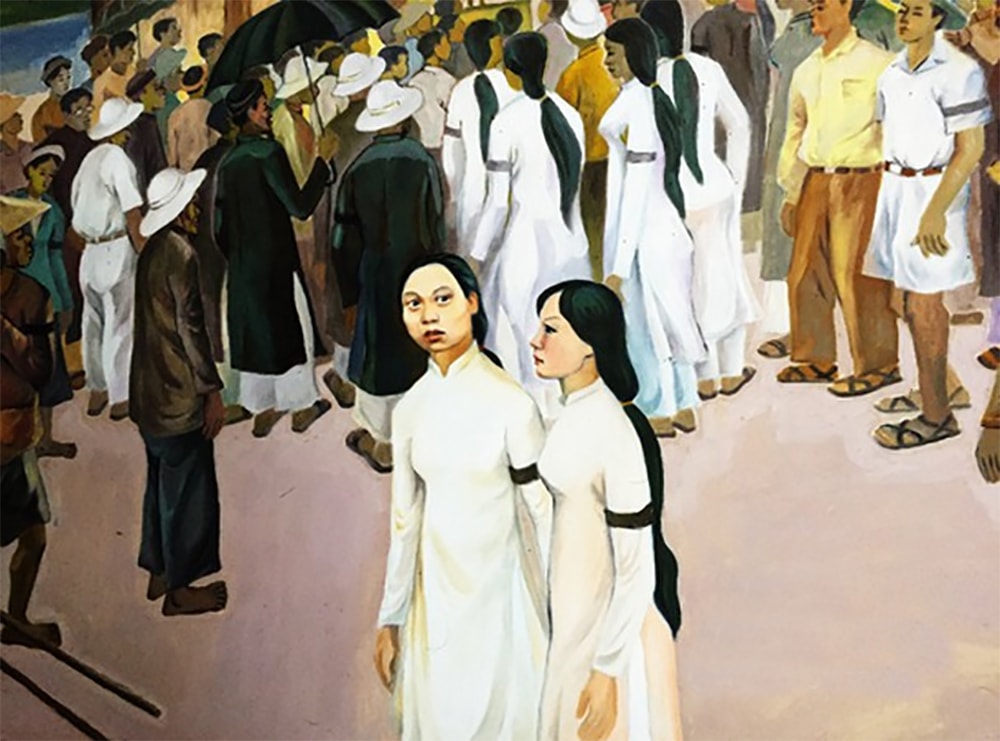 |
| The painting depicts Nguyen Thi Minh Khai (left) and her comrades participating in revolutionary propaganda at Diec Pagoda (Vinh City). Photo: Quoc Son (taken at the Nguyen Thi Minh Khai Memorial House) |
Knowing that Nguyen Thi Minh Khai was the Secretary of the Saigon-Chợ Lớn City Party Committee and held an important role in the Southern Regional Party Committee, the French colonialists imprisoned her in the Saigon Central Prison and subjected her to all kinds of brutal torture, such as electrocuting her, hanging her upside down from a beam, and nailing nails into her fingertips. But she gritted her teeth and endured, resolutely refusing to reveal her organization or comrades. Realizing that torture was ineffective, the enemy, after learning that Minh Khai and Le Hong Phong were husband and wife, tried to imprison them together to undermine their morale. However, the enemy failed against a steadfast communist family. All the French colonialists received was the resolute answer: "I do not know this person."
Despite being imprisoned and tortured in French prisons, as Secretary of the Saigon-Chợ Lớn City Party Committee and member of the Southern Regional Party Committee, Nguyễn Thị Minh Khai still found ways to contact her comrades to lead the revolutionary movement in Southern Vietnam. In Circular No. 7709-S from Chief of Security P. Arnoux in 1940 to the Governor of Southern Vietnam, the Inspector General of Security mentioned: “…During the search of Nguyễn Thị Minh Khai's belongings, two handwritten documents were found in her clothing. The first was an appeal to soldiers, workers, and farmers in Indochina to unite to launch a revolution and fight for liberation with the support of the Soviet Union. The second was a letter signed by Hồ Thị Duc, a political prisoner, addressed to her comrades, containing a passage implicitly requesting readers to intensify communist propaganda. The discovery of this letter in Nguyễn Thị Minh Khai's possession proves that she was responsible for communication with the outside world.”
On March 25, 1941, and April 3, 1941, the Saigon Military Court sentenced her to 12 prison terms: 2 death sentences, 2 life sentences, 2 sentences of 20 years imprisonment, 1 sentence of 15 years imprisonment, and 5 sentences of 5 years imprisonment. In the enemy's court, she not only refused to submit but boldly questioned them: "In my country, saving the country is a crime, but seizing the country is not a crime?"
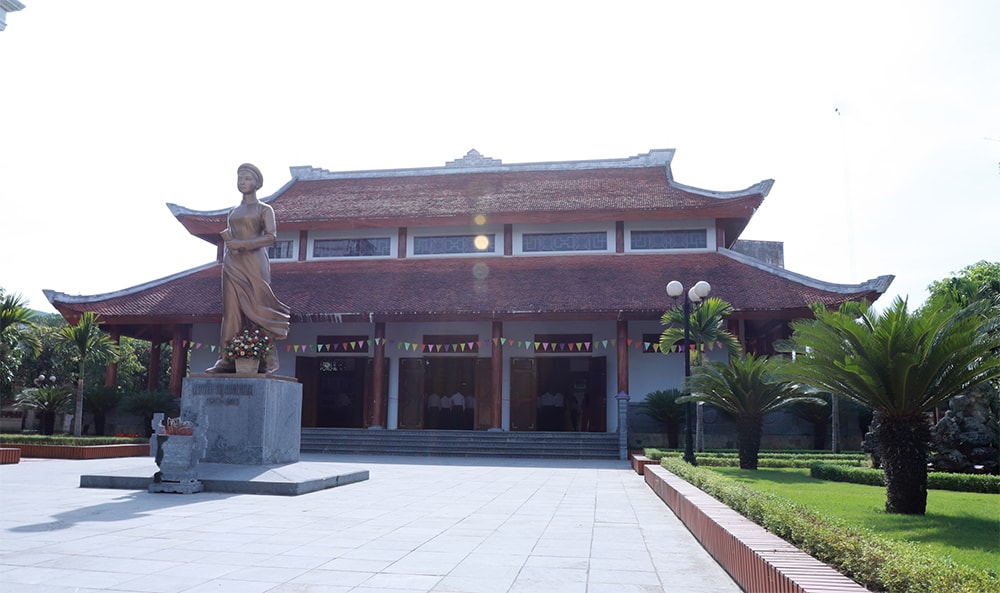 |
| The memorial house of Comrade Nguyen Thi Minh Khai in Quang Trung ward, Vinh city. Photo: Thanh Duy |
Nguyen Thi Minh Khai used her last moments to accomplish three important things: She secretly wrote on a small piece of paper rolled up inside a cigarette, sending it to her comrade and life partner, Le Hong Phong, who was imprisoned on Con Dao Island: "Even if I die, I promise you, I will remain faithful to the revolution and loyal to the Party. I promise to always be a staunch communist. I hope you will too." Finally, she tore up pieces of her prison clothes and knitted a pillowcase to send to her mother – a small token of filial piety, an apology for not fulfilling her duty to care for her elderly mother, and a message to her younger siblings: "Strive to study hard and become worthy individuals to make your parents proud."
On August 28, 1941, the French colonialists executed Comrade Nguyen Thi Minh Khai and comrades Ha Huy Tap, Nguyen Van Cu, and others at Nga Ba Giong, Hoc Mon district (Saigon). Nguyen Thi Minh Khai bravely sacrificed her life at the young age of 31, when her youth and revolutionary spirit were still overflowing.