

Lessons from the battle to defend the northern border.
(Baonghean.vn) - Baonghean.vn had an interview with Associate Professor, Doctor, Major General Le Van Cuong - former Director of the Institute of Strategy and Science, Ministry of Public Security, on the occasion of the 43rd anniversary of the battle to protect the northern border (February 17, 1979 - February 17, 2022).
PV:General, could you explain why China launched its war of aggression against Vietnam on February 17, 1979?
Major General Le Van Cuong:From a political standpoint, there are two main causes, the fundamental, overarching, and long-term one stemming from China's expansionist and hegemonic ambitions. Chinese leader Mao Zedong once declared, "We must conquer the Earth" (1959), "We must seize Southeast Asia, including South Vietnam, Thailand, Burma, Malaysia, and Singapore. Southeast Asia is a very rich region, with many mineral resources, worthy of being seized..." (1965). China believed that before becoming a world hegemon, it had to control and conquer Southeast Asia.
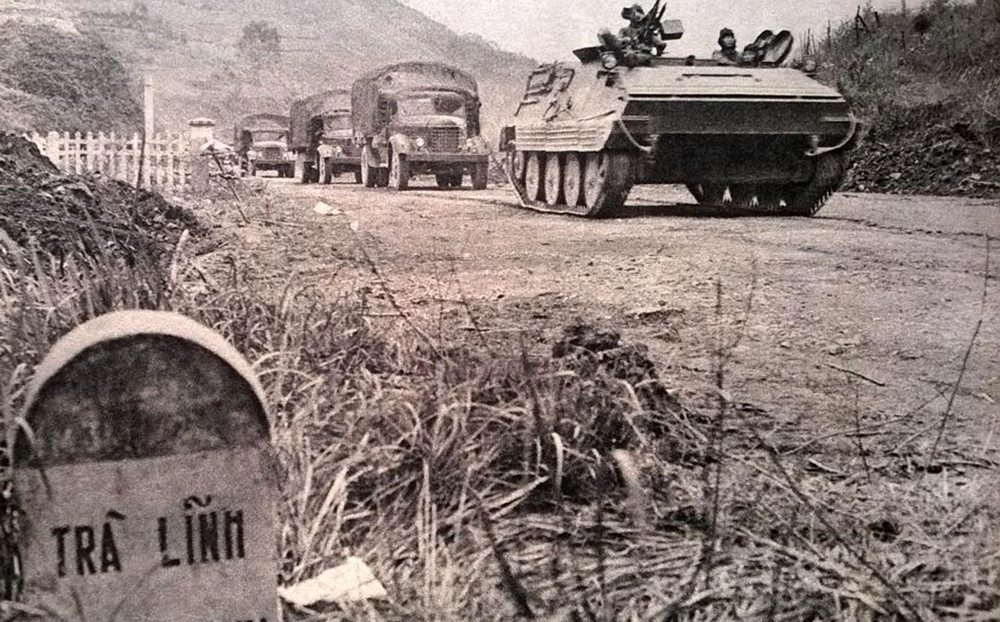 |
| On February 17, 1979, Chinese soldiers crossed the border into our country. Photo: Archival material. |
The second reason is that after Vietnam's victory over the US on April 30, 1975, from China's perspective, Vietnam became an "obstacle" on their expansionist path into Southeast Asia. Therefore, they had to weaken Vietnam, falsely accusing Vietnam of invading Cambodia, turning Cambodia into a vassal state, and establishing an Indochinese Federation, etc.
The immediate cause was that on February 7, 1979, at the request of the Cambodian people, Vietnam sent troops to rescue 13 million Cambodians from the Khmer Rouge genocide. It should be noted that the Khmer Rouge were an army equipped with weapons, ammunition, and clothing by China. Believing that Vietnam's "frontal attack" had damaged China's prestige, Beijing fabricated a pretext to launch a war of aggression against Vietnam.
PV:So, what preparations did China make for the invasion, General?
Major General Le Van Cuong:Warning against Vietnam was no simple task, so China had to prepare very carefully. Domestically, in addition to material preparations and troop deployments to the Sino-Vietnamese border, China, over two years (1977 and 1978), instilled in nearly a billion of its citizens the idea that Vietnam was an aggressor and a belligerent nation. China's massive broadcasting system released nearly 100,000 articles distorting the truth, portraying Vietnam as ungrateful, claiming that Vietnam, having received Chinese assistance, was now seeking to cooperate with the Soviet Union and preparing to invade China...
Abroad, while preparing public opinion for the war, China sought to garner support. In late 1978, Deng Xiaoping traveled to Singapore, Malaysia, and Thailand. Notably, during talks with Lee Kuan Yew, Deng Xiaoping told the Singaporean Prime Minister that Vietnam, united with the Soviet Union, would encircle and attack China, and then attack all of Southeast Asia, hoping to persuade ASEAN countries to support China's war against Vietnam.
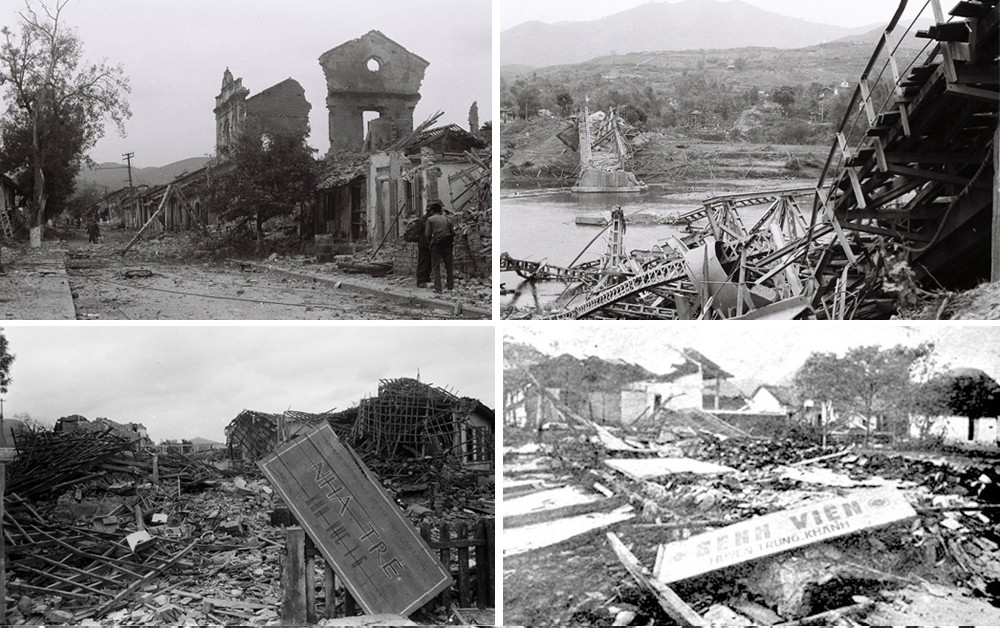 |
| Chinese troops destroyed houses, schools, hospitals, and bridges in the northern provinces. (Archival photo) |
From January 29 to February 4, 1979, Deng Xiaoping traveled to the United States to negotiate with President Jimmy Carter, persuading the American leader that the Soviet Union was the instigator of World War III and would certainly launch a nuclear war to destroy the United States and China. Deng Xiaoping requested Carter's cooperation, asserting that China was ready to assume the role of an "Eastern NATO," cooperating closely with the United States, Europe, and Japan to defeat the "great hegemon" Russia-Soviet Union and the "small hegemon" Vietnam.
From February 6-8, 1979, Deng Xiaoping also visited Japan, signing a peace and friendship treaty and persuading Japan to cooperate against the Soviet Union and Vietnam. It can be said that China had prepared very carefully both domestically and internationally, in terms of both material resources and public opinion.
PV:During the invasion of Vietnam, how did China mobilize its forces, General?
Major General Le Van Cuong:At 4:30 AM on February 17, 1979, China mobilized 600,000 troops, comprising 9 main army corps, 13 independent infantry divisions, 6 regiments with 550 tanks and armored vehicles, and 4 artillery divisions and regiments with thousands of artillery pieces of various types, to launch a lightning attack on Vietnam. China deployed its Guangxi wing, commanded by Xu Shiyou, consisting of the 41st, 42nd, 43rd, and 53rd Army Corps; and its Yunnan wing, commanded by Yang Dezhi, with the 11th, 13th, and 14th Army Corps and the 149th Division. In this battle, China used 1.06 million artillery shells, 23,800 tons of ammunition, and 55 million projectiles.
600,000 troops is the largest invading army ever against Vietnam, counting from the first invasion by the An invaders during the reign of the 6th Hung King to the US invasion from 1955-1975.
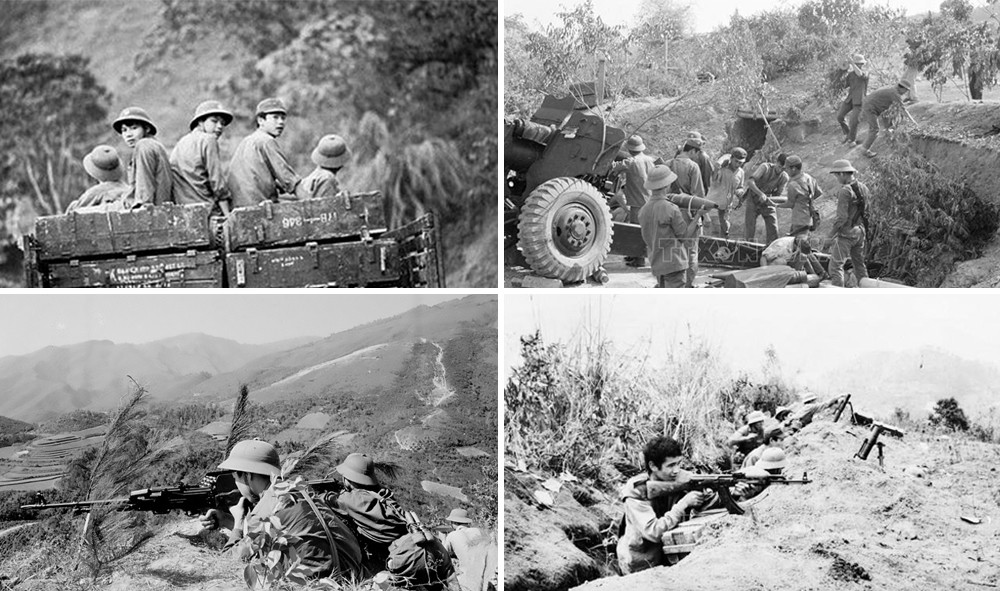 |
| Vietnamese armed forces fighting on the northern fronts. Photo: Archival material. |
PV:What losses and casualties did Vietnam suffer during this war?
Major General Le Van Cuong:In one month and one day (from February 17th to March 18th, 1979), 600,000 Chinese troops devastated the towns of Lang Son, Cao Bang, Lao Cai, and Cam Duong; six border provinces were leveled and completely destroyed by the invading Chinese army. 330 villages, 735 schools, 428 hospitals and clinics, 41 farms, 38 forestry farms, 81 factories and mines, and 800,000 hectares of crops were completely destroyed. Approximately half of the 3.5 million people in the six border provinces lost their homes. The Chinese army invaded Vietnam according to the motto "burn everything, kill everything, destroy everything."
I would like to cite two incidents to illustrate my point. In Tong Chup, Hung Dao commune, Hoa An district (Cao Bang province), 43 people, mostly women and children, were murdered by the enemy, their bodies thrown into a well and covered with stones. In Lang Son town, 100 people, all elderly, women, and children, were also killed. Chinese soldiers even planted mines in Pac Bo cave – a sacred historical and cultural site of the Vietnamese people.
PV:Sir, why did China announce its troop withdrawal on March 5, 1979? Public opinion suggests that China has failed; what is your assessment of this?
Major General Le Van Cuong:It cannot be said otherwise: China completely failed in its invasion of Vietnam in 1979. In terms of material losses, preliminary figures show that by March 18, 1979, 62,500 Chinese soldiers had been killed in action, 260 infantry were captured, 9 main army corps were heavily damaged, 280 tanks and 270 military vehicles were destroyed, and 115 Chinese mortars and rockets were destroyed.
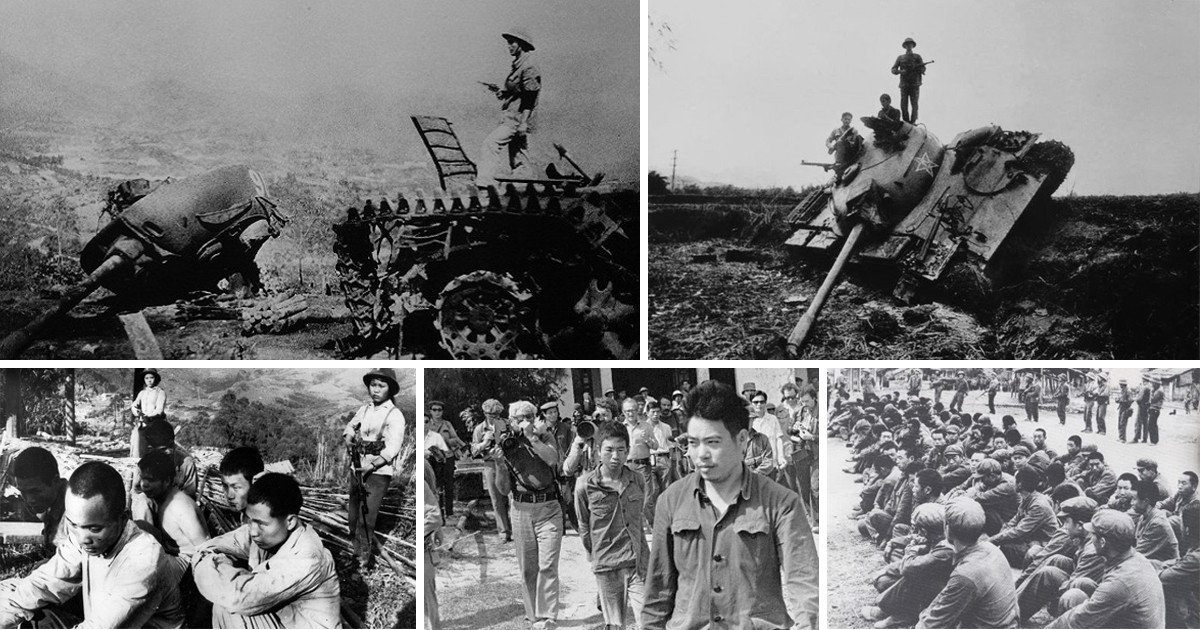 |
| Chinese tanks were destroyed by Vietnamese troops during the border war, and Chinese prisoners of war were captured. (Photo: Archival material) |
But the greatest damage was that China was condemned by the whole world. The Soviet government, numerous countries around the world, and the Helsinki International Conference issued statements calling on the international community to condemn and stop China's bloody hand.
Facing global opposition, China had never suffered such a major diplomatic defeat. They had to retreat, because prolonging the war would only increase the danger, not to mention the Soviet Union's readiness to retaliate as needed on the Sino-Soviet border to support Vietnam.
PV:According to him, what lessons can we learn from the struggle against the Chinese invaders?
Major General Le Van Cuong:First and foremost is the lesson in awareness: it is necessary to clearly understand the true nature of China and its policies towards Vietnam, which are based on great-power chauvinism, not Marxist-Leninist proletarian internationalism. Therefore, in 2003, in the strategy for national defense in the new situation, the Party's Resolution for the first time introduced the concept of "partner - adversary." For example, with China, economically we cooperate with them - they are partners, but in the South China Sea, they are the adversary of Vietnam's struggle.
With an important neighbor like China, we strive to establish friendly and cooperative relations, making the most of their enormous market of 1.41 billion people, but this must be absolutely based on the paramount principle of protecting Vietnam's independence, sovereignty, unity, territorial integrity, and interests.
 |
The third lesson is that, in parallel with strengthening friendship with China, we must strengthen and expand relations with the United States, Europe, Japan, India, ASEAN, etc., creating a "combination" of interests, resolutely combining national strength and the strength of the times, creating greater strength to protect the Fatherland, and preventing the country from falling into isolation.
Fourth, there must be socio-economic development policies that make the people prosperous and the country strong, consolidating close unity under the leadership of the Party to create invincible strength so that no force dares to covet it.
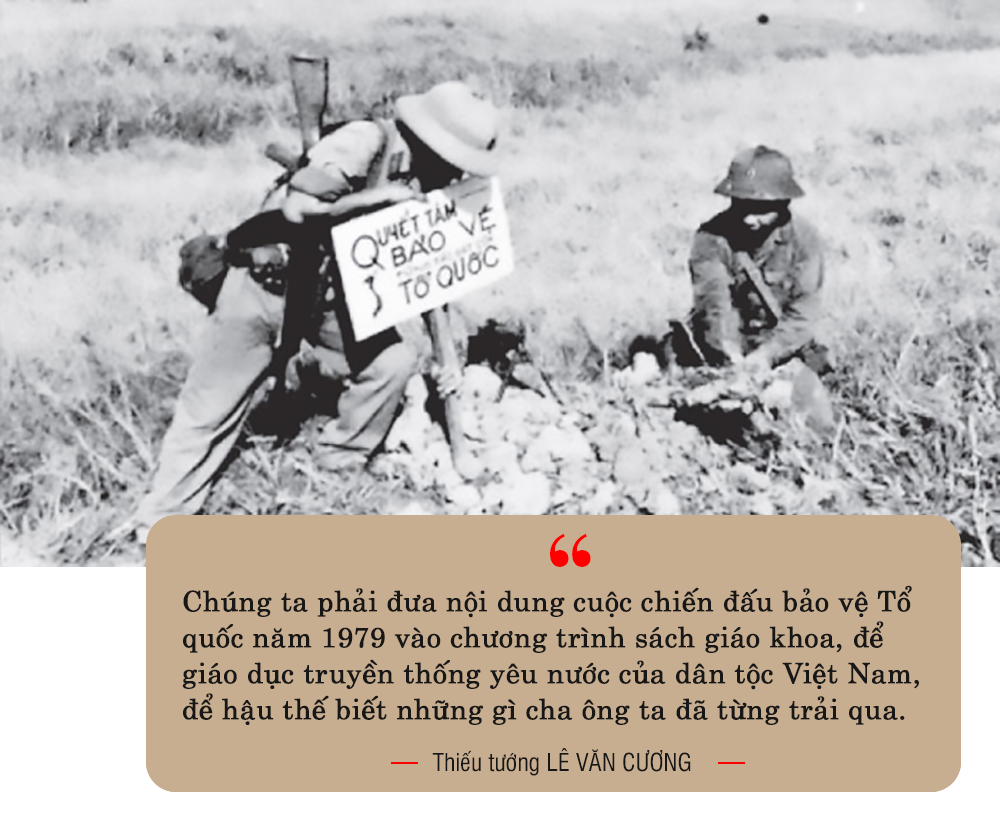
Furthermore, we must include the content of the 1979 war to defend the Fatherland in textbooks to educate about the patriotic traditions of the Vietnamese people, so that future generations will know what our ancestors went through. We must not equate or justify this as inciting nationalism or damaging Vietnam-China relations. Ultimately, Vietnam-China relations are especially important, and every Vietnamese person needs to contribute to strengthening this friendship for the benefit of the nation and for world stability and peace.