

Public-private partnerships viewed from the football field.
The recent images of the deteriorating pitch and outdated equipment at My Dinh Stadium have saddened many and raised the question: how can a national-level stadium always maintain its beauty?
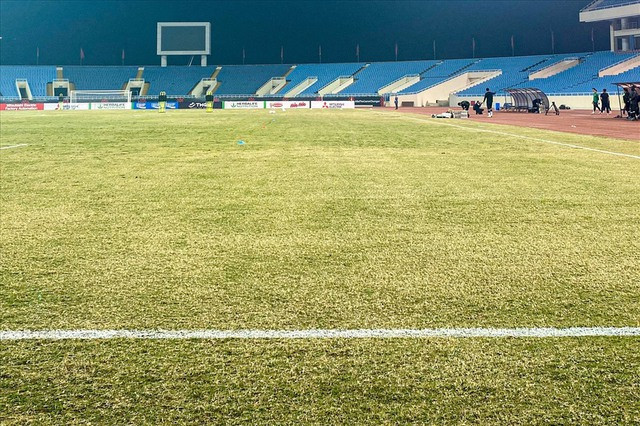 |
The pitch at My Dinh Stadium during the match between the Vietnam national team and Malaysia. |
At a recent conference, Prime Minister Pham Minh Chinh mentioned the story of My Dinh Stadium as well as other projects such as Thong Nhat Park, and raised the issue of public-private partnerships, stating that not only in the transportation sector, but also in the management of parks, offices, stadiums, guesthouses, or other infrastructure facilities, public-private partnerships need to be expanded. All levels and sectors need to think broadly.
The story, closely related to current events, about the operation of the My Dinh National Stadium and other cultural and sports facilities can be seen as a key to innovation in mobilizing resources, managing, and operating such facilities.
The Prime Minister has consistently stated that the State should allow the private sector to do what it does well and effectively. More specifically, the head of government has outlined three models to promote public-private partnerships: public leadership and private governance; public investment and private management; and private investment and public use. These are models that have proven effective in practice.
Indeed, with My Dinh Stadium, if private investors and the community were involved, its operation would achieve better results. Looking broadly at other countries around the world, most stadiums are managed and operated by clubs or private individuals under the State's management. When granted this right, the clubs or private individuals always have plans to utilize the stadium's full potential effectively.
Many argue that trusting in the private sector and expanding the participation of private enterprises in socio-economic fields is the most effective way to mobilize social resources. Relying solely on the state budget is always difficult, while private investment offers many channels for raising and utilizing capital efficiently.
Of course, such management and exploitation rights are bound by legal regulations. The challenge is how to harmonize the interests of the State, businesses, and the people—"harmonious interests, shared risks"—so that public-private partnerships can be sustainable.
We understand that when investing money, entrepreneurs and businesses are always concerned about how to best utilize resources to generate revenue, cover costs, and gradually recoup their investment, because "money is closely tied to one's livelihood." However, if only profits are pursued, neglecting the interests of the community, then private sector management will go off track. A clear and harmonious balance between the common good and private interests is necessary; only then will public-private partnerships flourish and be sustainable.
Returning to the story of My Dinh Stadium, it is necessary to promptly study and implement a cooperation mechanism as suggested by the Prime Minister. A good mechanism would be like bright sunshine, helping the grass of My Dinh Stadium to quickly turn green again.
Prospects for the private sector and opportunities for businesses in Nghe An.
30/09/2022