

Limitations of ChatGPT that users need to know
(Baonghean.vn) - Although ChatGPT has outstanding advantages that have been highly appreciated by the user community, like any artificial intelligence (AI) technology, ChatGPT also has certain weaknesses and challenges that can affect its performance and accuracy.
Since its launch in late November last year, ChatGPT – an AI-powered chatbot developed by OpenAI (USA) – has become a phenomenon, attracting increasing attention from users worldwide. ChatGPT reached 100 million users by the end of January 2023, just two months after its launch. According to a study by the multinational investment bank UBS (Switzerland), ChatGPT has become the fastest-growing consumer application in history.
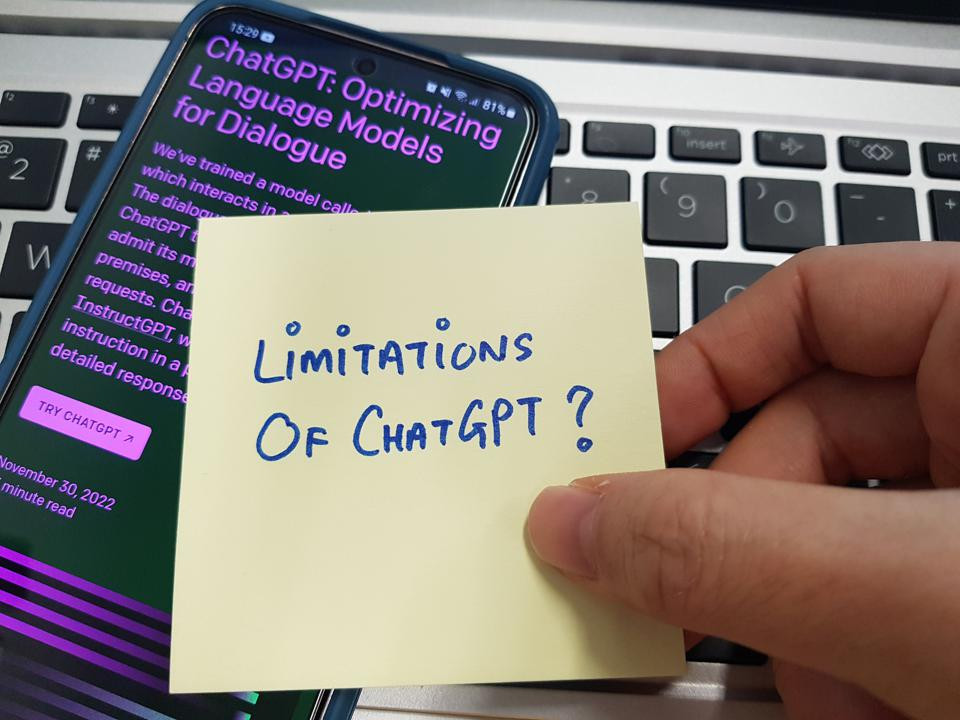 |
Illustrative image. |
With its impressive capabilities, ChatGPT has quickly become a popular tool for many different applications such as creating content for websites, answering customer questions, providing suggestions, creating automated chatbots, detecting or even fixing programming errors.
Despite its outstanding advantages, ChatGPT also has several limitations, such as a lack of expressive nuances, critical thinking skills, or the ability to make ethical decisions.
Regarding data sources, the current version of ChatGPT is trained on a massive dataset dating back to 2021 or earlier, so it cannot provide the most up-to-date information, rendering some queries and searches useless.
Even ChatGPT can sometimes give completely wrong answers, sometimes "answers that sound plausible but are inaccurate or nonsensical," as OpenAI itself has admitted. This is a problem OpenAI considers difficult to overcome.
Through the following points outlining the drawbacks of ChatGPT, users can gain a better understanding of the limitations and potential challenges of using AI language models in various contexts.
1. Lack of awareness:Although ChatGPT can generate human-like responses and has access to a vast amount of information, it lacks the consciousness and background knowledge of humans. This means that ChatGPT can sometimes provide nonsensical or inaccurate answers to certain questions or situations.
2. Lack of emotional intelligence:Although ChatGPT can generate seemingly empathetic responses, it doesn't possess true emotional intelligence. It can't detect subtle emotional cues or respond appropriately to complex emotional situations.
3. Limitations in understanding context:ChatGPT struggles with understanding context, particularly sarcasm and humor. While ChatGPT is proficient in language processing, it can have difficulty grasping the subtle nuances of human communication. For example, if a user employs sarcasm or humor in their message, ChatGPT might not understand the intended meaning and instead provide an inappropriate or irrelevant response.
4. Limitations when creating long, structured articles:At this time, ChatGPT encounters some issues when generating long, structured articles. While the model is capable of producing coherent and grammatically correct sentences, it may struggle to create lengthy articles that adhere to a specific structure, format, or narrative. Therefore, ChatGPT is currently best suited for generating short articles such as summaries or brief explanations.
5. Limitations in handling multiple tasks simultaneously:ChatGPT performs optimally when assigned a single task or objective. If a user asks ChatGPT to perform multiple tasks simultaneously, it will struggle to prioritize them, leading to reduced efficiency and accuracy.
6. ChatGPT responses may contain biases or prejudices:ChatGPT is trained on a large dataset of text data, and that data may contain biases or prejudices. This means that ChatGPT can sometimes deliver biased or discriminatory responses that are not intended for the user.
7. Limited knowledge:Although ChatGPT has access to a vast amount of information, it cannot keep up-to-date with all the knowledge that humans possess. It may not be able to answer questions on very specific topics and may also be unaware of recent developments or changes in certain fields.
8. Limitations regarding information accuracy and grammatical structure:ChatGPT's sensitivity to handling spelling and grammatical errors is limited. While it can generate technically correct responses, it may not be entirely accurate in specific contexts. This limitation makes it difficult for ChatGPT to handle complex or highly specialized information where accuracy is crucial. Therefore, users should always perform checks to verify the information provided by ChatGPT.
9. Adjustments may be needed for specific use cases:If ChatGPT needs to be used for very specific use cases, users may need to tailor the application to achieve the desired results. This tailoring involves training the application on a specific dataset to optimize its performance for a particular task or goal, and can be time-consuming and resource-intensive.
10. Requires significant costs and powerful data processing capabilities:ChatGPT is a highly complex AI language model that requires a significant amount of computing resources to function effectively. This means that running this application can be expensive and may require access to specialized hardware and software systems. Furthermore, running ChatGPT on low-end systems or hardware with limited computing power can lead to slower processing times, reduced accuracy, and other performance issues. Organizations should carefully consider their resources and computing capabilities before using ChatGPT.