

Building a strong intellectual workforce in terms of both quantity and quality.
Building a strong intellectual workforce, both in quantity and quality, with a rational structure, and fostering the role, responsibilities, and capabilities of intellectuals in implementing the goals, tasks, and strategies of socio-economic development... is the responsibility of the Party, the State, the political system, and the entire society.
After 15 years of implementing Resolution 27 of the 10th Central Committee on "Building a team of intellectuals in the period of accelerating industrialization and modernization of the country," many important results have been achieved, especially in policies to attract, reward, and honor intellectuals.
However, the work of intellectuals and scientists, who provide scientific arguments to the Party and the State, is also facing many difficulties and challenges that require comprehensive solutions in terms of policies and mechanisms to promote creativity and enable the intellectual workforce to fully develop their abilities and capabilities.
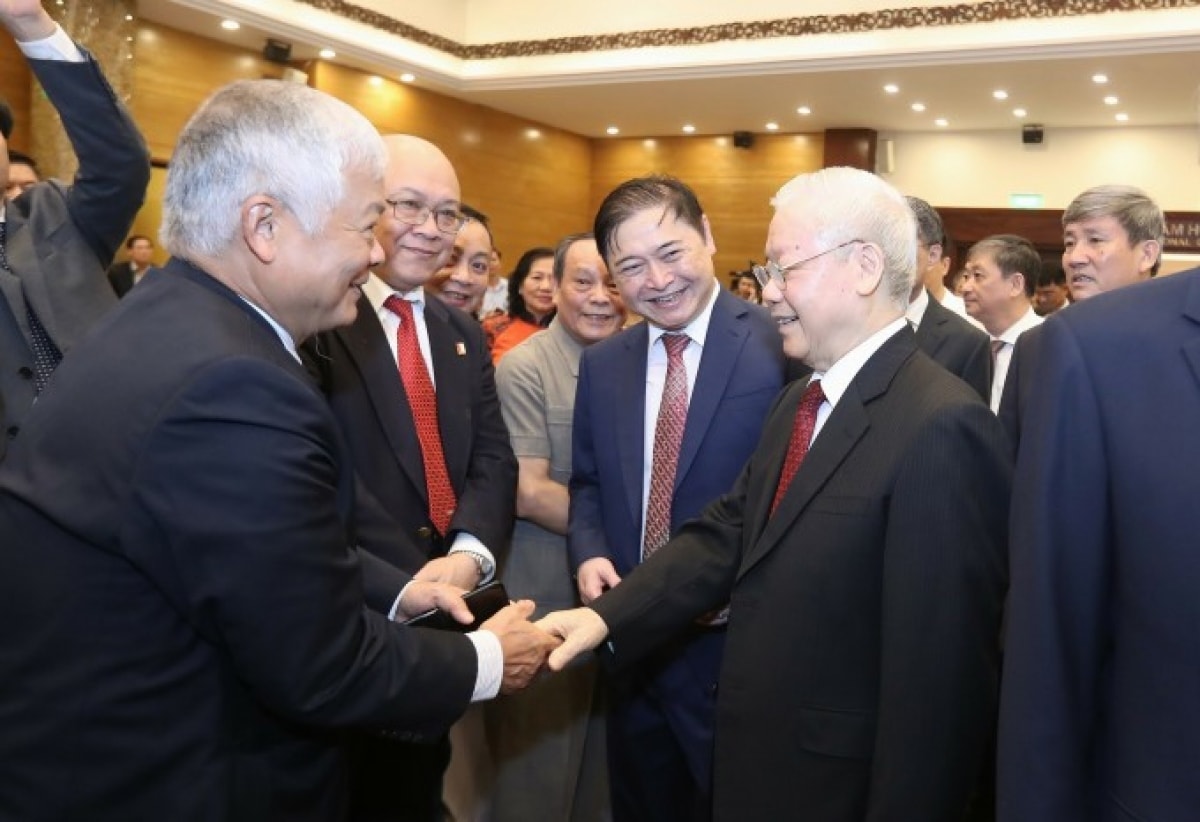 |
General Secretary Nguyen Phu Trong met with delegates and intellectuals attending the ceremony commemorating the 60th anniversary of President Ho Chi Minh's meeting with intellectuals and the 40th anniversary of the founding of the Vietnam Union of Science and Technology Associations on the morning of March 24 in Hanoi. |
With over 40 years of scientific research, Associate Professor Dr. Le Tat Khuong, Director of the Institute for Regional Research and Development under the Ministry of Science and Technology, can't remember how many regions he's visited or how many farmers he's met. Each time he undertakes a scientific project in a locality, he carries with him the hope of helping the people there escape poverty. Recently, he led the projects: “Developing several high-quality orange and pomelo varieties in Bac Son district, Lang Son province”; “Building a model for experimental cultivation of several avocado varieties in Bac Giang province”; and “Researching a closed-loop production model following organic farming for some strong agricultural products in the North Central region… The results of these projects provide an important basis for people to research, select, and apply to practical production. He was honored to be one of 112 outstanding intellectuals recognized in 2019.
Associate Professor Dr. Le Tat Khuong recalled: “We studied the agriculture of each region and identified their key agricultural products, helping them develop plans and research programs for the sustainable development of these agricultural products. Secondly, we researched and selected crops to supplement the crop structure for each region.”
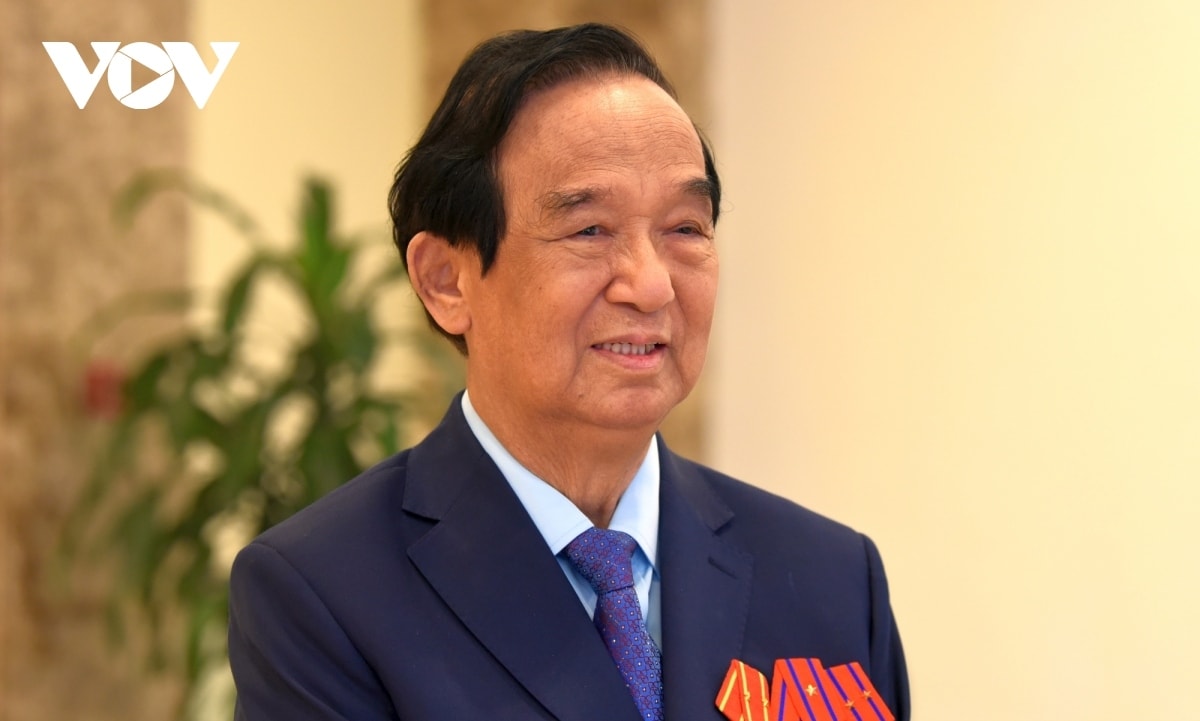 |
Professor Nguyen Lan Dung - Member of the National Council for Education and Human Resource Development. |
Not only Associate Professor Dr. Le Tat Khuong, but over the past period, thousands of intellectuals have actively participated in research, application, and innovation in science and technology, becoming an important force in promoting the realization of goals, tasks, strategies, and plans for rapid and sustainable national development. Since implementing Resolution No. 27 of the 10th Central Committee, after 15 years, the Vietnamese intellectual workforce has grown rapidly in number, continuously improved in quality, and is leading the way in the Fourth Industrial Revolution.
Professor Nguyen Lan Dung - Member of the National Council for Education and Human Resource Development - affirmed: "Talent is a precious resource of the nation. President Ho Chi Minh always emphasized the importance of valuing talent. In the era of the 4.0 industrial revolution, we desperately need this revolution. They are intellectuals, prominent figures, who have made significant contributions in the digital age. Policies are needed to ensure they have a place, contribute to the country, and receive support in line with the Party and State's guidelines."
However, recently, in commenting on the draft report summarizing 15 years of implementing Resolution No. 27 on "Building a team of intellectuals in the period of accelerating industrialization and modernization of the country," the Politburo also pointed out many shortcomings, including attracting, rewarding, and honoring intellectuals both domestically and internationally, especially elite intellectuals and leading scientists. At the Vietnam Academy of Social Sciences - a center for leading social scientists - the research results there serve as scientific arguments to help the Party and State formulate policies. However, in recent years, this activity has faced many difficulties and challenges.
Dr. Phan Chi Hieu, President of the Vietnam Academy of Social Sciences, stated: “Our team of scientific researchers is dwindling. Many renowned scientists with high academic ranks and degrees have reached retirement age. In addition, many talented scientists are requesting transfers to other institutions for various reasons, including the simple fact that the guarantees for research activities and the provision of benefits and policies are not as good as those offered by institutions outside the country. We are witnessing a ‘brain drain’ phenomenon.”
To enable intellectuals and scientists to contribute more to the country's development, groundbreaking mechanisms and policies are needed, especially policies to mobilize resources, attract, reward, and honor intellectuals, particularly elite intellectuals and leading scientists. This has been emphasized by General Secretary Nguyen Phu Trong: “Building a strong intellectual workforce directly elevates the nation's intellectual level, strengthens the country, enhances the Party's leadership capacity, and improves the quality of the political system's operations. Investing in building an intellectual workforce is investing in sustainable development.”
 |
General Secretary Nguyen Phu Trong. |
Building a strong intellectual workforce, both in quantity and quality, with a rational structure, and fostering the role, responsibilities, and capabilities of intellectuals in implementing socio-economic development goals, tasks, and strategies... is the responsibility of the Party, the State, the political system, and the entire society. Identifying the need to focus on accelerating institutional reforms, mobilizing social resources; respecting and practicing democracy in research and innovation; and having special mechanisms and policies to value talented individuals, elite intellectuals, and leading scientists, is the fundamental way to create the environment, conditions, and impetus for the development and promotion of the intellectual workforce.
Professor Phan Xuan Dung, President of the Vietnam Union of Science and Technology Associations, stated: “All countries in the world that want to develop must consider science and technology as a top national priority. This is a major policy, and this policy must be concretized into policies and solutions for application. This means respecting intellectuals, utilizing intellectuals, honoring intellectuals, and creating conditions for intellectuals to work. It's not just about salary, but also about working conditions, respecting them, assigning them tasks, and most importantly, applying the products they create.”
Over the 15 years since the implementation of Resolution 27, the number of Vietnamese intellectuals has increased rapidly, directly contributing to enhancing Vietnam's position and prestige in the region and the world. However, to promote their creativity in research and application of science and technology, policy mechanisms and incentives are still needed to enable intellectuals to fully utilize their abilities and potential.