

The origins and names of some districts in Nghe An and Ha Tinh provinces.
On August 10, 2024, Thanh Chuong district will solemnly celebrate the 555th anniversary of the name Thanh Chuong. Interestingly, many localities in the two provinces of Nghe An and Ha Tinh also have a founding date from 1469 – associated with the largest-scale administrative reform in our country during the feudal era.
.png)
On August 10, 2024, Thanh Chuong district will solemnly celebrate the 555th anniversary of the name Thanh Chuong. Interestingly, many localities in the two provinces of Nghe An and Ha Tinh also have a founding date from 1469 - associated with the largest-scale administrative reform in our country during the feudal era.
Tran Manh Cuong • August 9, 2024

Historically, the division of administrative units and the naming of places have been crucial for any nation. Throughout our country's history, from its founding to the present day, the division of administrative units and changes in naming conventions have varied, but all stemmed from the need to manage, protect, and build the state apparatus representing a sovereign nation, leaving a profound mark on the nation's history and culture. Therefore, understanding and determining the "birth year" of place names is a fervent desire of many localities across the country.
During the Tran Dynasty, some localities in Nghe An and Ha Tinh had the following names:
Nha Nghi, which is now Nghi Xuan
Phi Loc, which is now known as Can Loc
Do Gia, which is now Huong Son
Chi La, which is now Duc Tho.
Thổ Du, which is now Thanh Chương
Kệ Giang, part of present-day Thanh Chương
Thổ Hoàng, which is now Hương Khê
Ha Hoang, which is part of present-day Thach Ha.
Ban Thach, which is part of present-day Thach Ha
Ha Hoa, now known as Ky Anh
Ky La, part of present-day Ky Anh
Thach Duong, part of present-day Nam Dan
Dong Ngan, Dong Thanh today
Lo Binh, Hung Nguyen today
Sa Nam, part of present-day Nam Dan
Later, the names used during the Tran Dynasty were changed and renamed after King Le Thanh Tong established the national map in the 10th year of Quang Thuan (1469). To commemorate this significant event, in the year of Canh Dan, King Le Thanh Tong also changed the reign name from Quang Thuan to Hong Duc.
Reforming the local government system has always been a matter of concern for the feudal dynasties of Vietnam. In our history, the reforms of the local government system under King Le Thanh Tong (Le Dynasty) and King Minh Menh (Nguyen Dynasty) are considered the most extensive and successful, and have largely survived to this day.
Unfortunately, the Đại Việt sử ký toàn thư (Complete History of Đại Việt) – the oldest and most important surviving official history of Vietnam, compiled by many generations of historians in the Later Lê Dynasty's Historical Bureau – only records general information about that event and does not specifically mention the localities whose names changed. Fortunately, this event is mentioned in the official history compiled by the Nguyễn Dynasty's National Historical Bureau, the Khâm định Việt sử Thông giám cương mục (Imperial-approved Comprehensive History of Vietnam).
This national history book was compiled relatively late, around the end of the 19th century, but its reference system comprises over 200 sources, including unofficial histories, poetry, and works by Le Quy Don, Phan Huy Chu, and others. Notably, the Cuong Muc also referenced and relied on many other historical works such as Dai Viet Su Ky Toan Thu and Dai Viet Su Ky Tuc Bien, and also consulted Chinese and Vietnamese historical texts.
This book is written in the "summary" style of Zhu Xi during the Song Dynasty, divided into "summary" (a concise and clear summary) and "section" (a more detailed and specific account), recording historical events in chronological order (year, month, day), biographies of figures, expert opinions on certain events, figures, and dates based on research of historical books and documents from Vietnam and China, annotations on names of people and places, examination systems, administrative organization, and scattered comments by Emperor Tu Duc.
Therefore, the Imperial Annotated Comprehensive History of Vietnam is the second largest historical work of Vietnam, incorporating many achievements of previous historians while also making valuable contributions to historiography. Modern researchers consider the Complete Chronicle of Dai Viet and the Imperial Annotated Comprehensive History of Vietnam as two important historical works serving as starting points for studying related issues in Vietnamese history. The Comprehensive History meticulously chronicles many major and minor events in history that were either not recorded or recorded incorrectly in previous historical works.
For example, regarding the event of Emperor Emeritus Tran Minh Tong personally leading an expedition against Laos, the Complete History records the location as "Kiem Chau," but the "Ma Nhai Ky Cong Bi Van" stele states that location as "Mat Chau"; the Complete History records the time as the year Giap Tuat, but the "Ma Nhai Ky Cong Bi Van" stele records it as the year At Hoi. The data written in the Cuong Muc are consistent with the stele at the actual site, so the cautionary note from the Cuong Muc is completely accurate. We believe that the event of King Le Thanh Tong mapping the entire country in the 10th year of Quang Thuan (1469) as stated in the Cuong Muc is entirely scientifically sound and reliable.
.jpg)
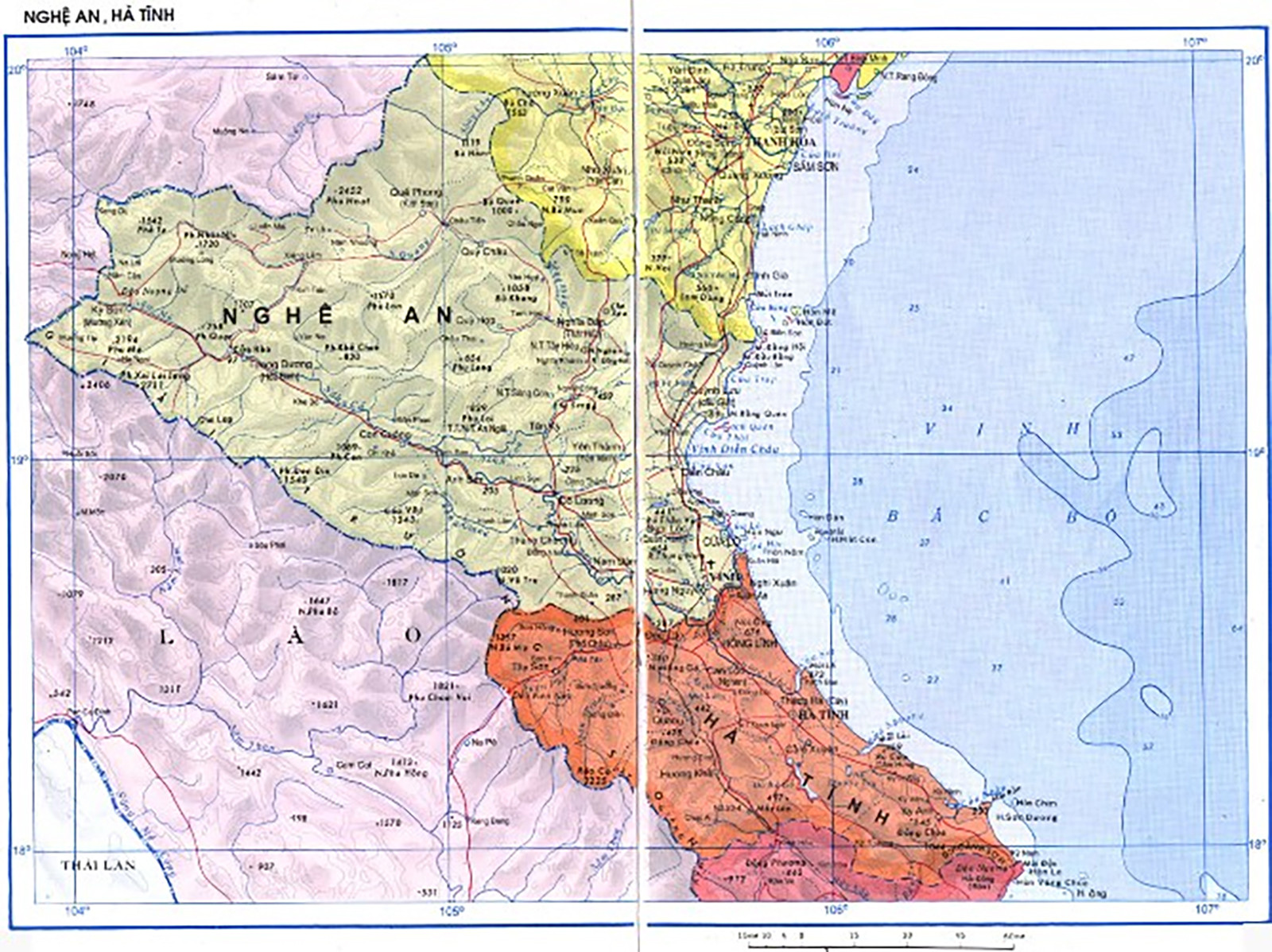
The historical records clearly state that in March of the year Ky Suu, the 10th year of the Quang Thuan reign (1469), King Le Thanh Tong established the national map and set up 12 provinces. Among them, the Nghe An province governed a total of 8 prefectures, 18 districts, and 2 sub-districts. Specifically as follows:
1. Duc Quang Prefecture governed 6 districts: Thien Loc, La Son, Chan Phuc, Thanh Chuong, Huong Son and Nghi Xuan;
2. Dien Chau Prefecture administered two districts: Dong Thanh and Quynh Luu;
3. The Anh Do Prefecture administered two districts: Hung Nguyen and Nam Duong;
4. The Ha Hoa Prefecture administered two districts: Thach Ha and Ky Hoa;
5. Tra Lan Prefecture governed four districts: Ky Son, Tuong Duong, Vinh Khang, and Hoi Ninh;
6. Quy Chau Prefecture administered two districts: Trung Son and Thuy Van;
7. The Ngoc Ma Prefecture governed one province: Trinh Cao;
8. The Lam An Prefecture governed one province: Quy Hop.
Most notably, a piece of information that few people pay attention to but is crucial in confirming the founding date of some localities is that almost all the names of districts in Nghe An and Ha Tinh provinces, such as Ky Son, Tuong Duong, Quynh Luu, Nam Duong (Nam Dan), Thanh Chuong, Hung Nguyen, Quy Hop, Nghi Xuan, Huong Son, Thach Ha, and Ky Hoa (Ky Anh), were established in 1469.

For a long time, many people have agreed that the name Thanh Chương originated after 1729 due to a taboo against using the name of Lord Trịnh Giang, and was changed from Thanh Giang to Thanh Chương. As researcher Hồ Sỹ Hùy noted (published in the Journal of Social Sciences and Humanities of Nghe An, August 2021):It is no coincidence that there are six documents recording the renaming of Thanh Giang to Thanh Chuong. The elaborate research work "laying the foundation for the study of Vietnamese taboo names," according to Professor Ha Van Tan's assessment of Ngo Duc Tho's research on Vietnamese taboo names through the dynasties (Culture Publishing House, 1997), in the section on taboo name changes during the Le Trung Hung period, states: "Thanh Giang 青江 is the name of a district in Nghe An province, after the year...""In 1729, it was renamed Thanh Chuong. Today it is Thanh Chuong district, Nghe An province." As mentioned above, we believe that the name Thanh Chuong only appeared in 1729 or later. As for works recording the place name Thanh Chuong before this date, they were later corrections by later generations, as Professor Ha Van Tan noted."
Because it is cited from the meticulous and valuable research of two leading figures in the academic world, this viewpoint is easily accepted and spread. However, we believe that the above statements are not sufficiently substantiated and inaccurate. Based on existing original documents, including administrative texts from the Le and Nguyen dynasties such as stelae, royal decrees, certificates, orders, edicts, family decrees, and deputy decrees... which are preserved in families in what is now Thanh Chuong, the name "Thanh Chuong" was clearly recorded before 1729. Here are some specific examples:
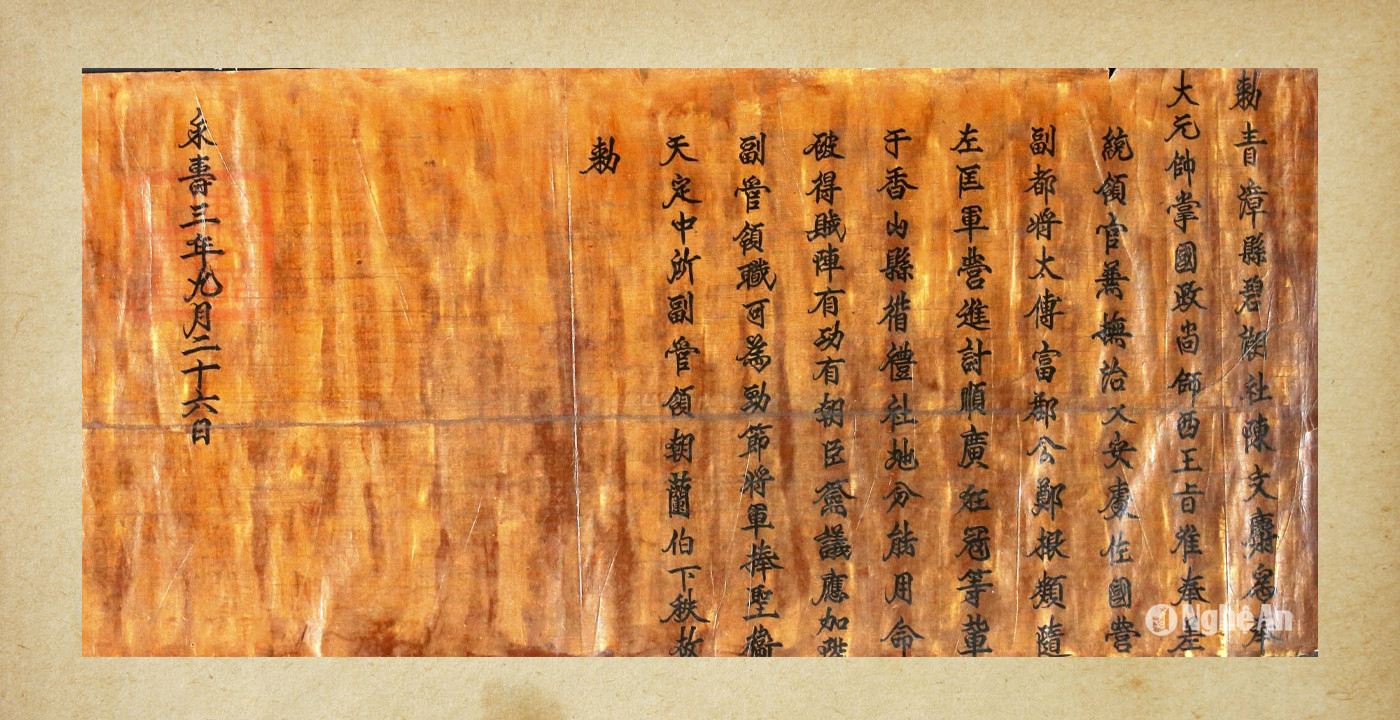
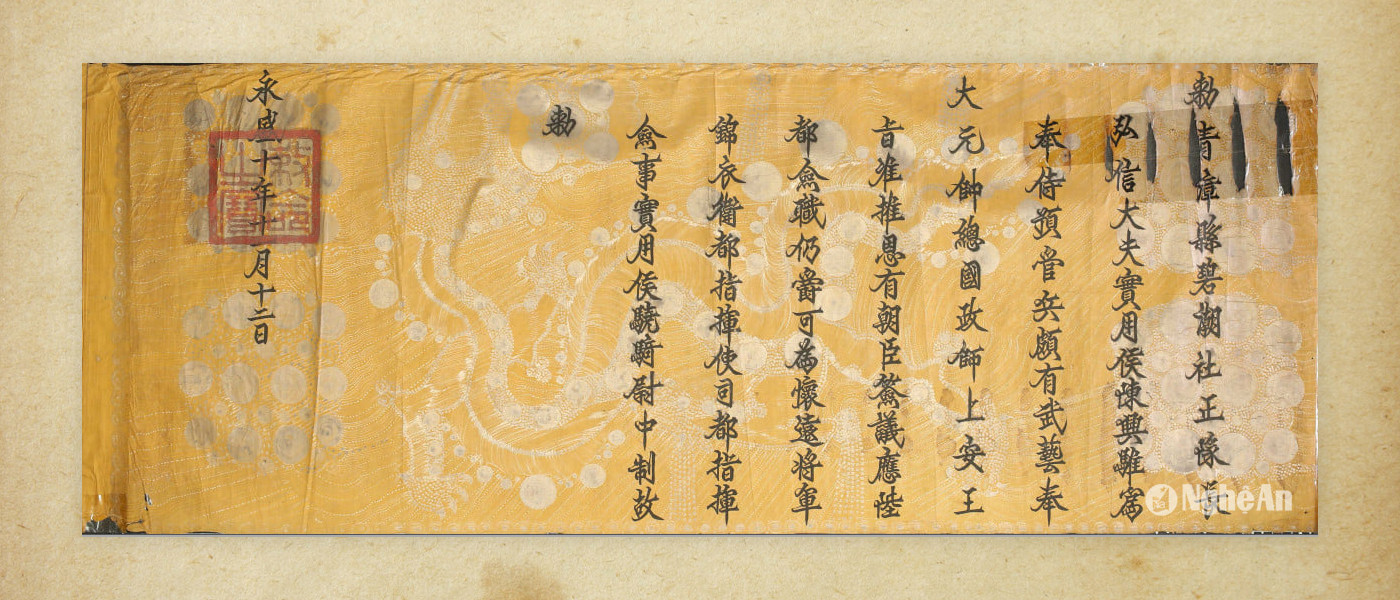
At the National Historical and Cultural Site: the tombs and temples of Tran Hung Hoc and Tran Hung Nhuong in Thanh Xuan commune, there is a royal decree bestowing the title of Kim Nghia Marquis upon Tran Van Xa for his service in following Phu Quan Cong Trinh Can to suppress the Thuan Quang army. This decree, bearing the year of Vinh Tho (3rd year, 1660), clearly states: "Decree on Thanh Chuong district, Bich Trieu commune, Tran Van Xa..."; and a royal decree bestowing the title of Kim Nghia Marquis upon Tran Van Lam, bearing the year of Chinh Hoa (8th year, 1687), clearly states: "Decree on Thanh Chuong district, Bich Trieu commune, Tran Van Lam..."; and a royal decree promoting Tran Hung Chuy to the rank of Do Thiem, bearing the year of Vinh Thinh (10th year, 1714), clearly states: "Decree on Thanh Chuong district, Bich Trieu commune, Chief Commander of Hoang Tin Dai Phu Thuc Dung Marquis Tran Hung Chuy...".
Besides written documents, local stone inscriptions also record similar content. The Kien Nghia stele, currently located at the temple of the famous general Tran Hung Hoc in Thanh Xuan commune, Thanh Chuong district, recounts the martial achievements of two generals, Tran Hung Hoc and Tran Hung Nhượng, in the 5th Trinh-Nguyen War (1655-1660). This stele was erected on "Hoang Trieu Chinh Hoa van van nien chi thap cuu Mau Dan trong ha coc nhat" (A propitious day in the middle of summer of the Mau Dan year, the 19th year of the Chinh Hoa reign), which is 1698, and includes the sentence: "...In the sixth month of the year Dinh Dau, bandits invaded Thanh Chuong...". The year Dinh Dau mentioned here corresponds to the Gregorian year 1657.
The stele "Hậu thần bi" (Stele of the Ancestor) is currently located at the temple of the famous general Trần Hưng Nhượng in Thanh Xuân commune, Thanh Chương district. It was erected on "the auspicious day at the end of the summer of the year Mậu Dần, the 19th year of the Chính Hòa reign," which is 1698. The stele contains the following sentence: "...Mậu Thành hầu, surnamed Trần, given name Văn Cảnh, was a person from Bích Triều, Thanh Chương..."

Based on these original documents, it is confirmed that the name "Thanh Chương" existed before 1729. Therefore, the assertion that "the name Thanh Chương only appeared in 1729 or later" is completely inaccurate.
History is about the past, so no one can see or hear firsthand what happened in the past. Therefore, if we want to know what history was like, we can only rely on reliable documents and evidence through original evidence and primary documents. "Original" means that the document has never been copied or rewritten. More importantly, the document must have directly participated in the event being discussed. All the historical evidence in the six books confirming the existence of Thanh Chuong since 1729 mentioned above did not directly participate in the events they refer to. Thus, their reliability is much lower than that of original evidence and primary documents.
Based on the evidence we have presented above, all are original written documents recorded at the time they appeared. These are truly original pieces of evidence, never copied or rewritten by later generations. Therefore, historical science, like forensic science, must prioritize evidence over testimony. Only then can we gain a correct understanding of historical events.

Thanh Chuong is one of the regions deeply rooted in the thousand-year-old cultural heritage of Nghe An province, a land rich in cultural, historical, and revolutionary traditions. It is the Dung-Rang area, where traces of the glorious Son Vi culture from the dawn of human history are still preserved. Throughout national history, Thanh Chuong has always been a crucial area, a "frontier" of the country, a region of "spiritual land and outstanding people, where the essence of talent converges," the birthplace of many talented individuals in various fields and famous families such as Nguyen Duy, Nguyen Sy, and the Dang family…
Thanh Chuong is blessed with many beautiful landscapes and picturesque mountains and rivers, but it is also a land known for its poverty. The people living there have become kind, honest, and talented. Perhaps because "poverty breeds heroes," it's difficult to list all the outstanding sons and daughters of Thanh Chuong, who, from the past to the present, have made significant contributions to the glory of Vietnam.
.jpg)