Preserving the spirit of filial piety of the Vu Lan festival.
Minh Quân (Editor)•August 18, 2024 06:46
On the occasion of the Vu Lan Festival in 2024, Nghe An Newspaper had an interview with folk culture researcher Nguyen Hung Vi - former lecturer in the Literature Department, Faculty of Social Sciences and Humanities (Vietnam National University, Hanoi).
On the occasion of the Vu Lan Festival in 2024, Nghe An Newspaper had an interview with folk culture researcher Nguyen Hung Vi - former lecturer in the Literature Department, Faculty of Social Sciences and Humanities (Vietnam National University, Hanoi).
Minh Quan(Perform)• August 18, 2024, 7:30 AM *****
PV:Today, the Vu Lan Festival is not simply a sacred religious event, but also holds a particularly profound meaning, guiding each person back to their national roots and the principle of "drinking water, remembering the source" of their ancestors. Could you please tell us about the origins of the Vu Lan Festival?
Researcher Nguyen Hung Vi:"Vu Lan" or "Vu Lan Bon" is an ancient cultural belief of India, predating even Buddhism. The three words "Vu Lan Bon" are a transliteration of the Sanskrit word Ullambana, which is then pronounced in Sino-Vietnamese as "Vu Lan Bon" (meaning "hanging upside down") to allude to the suffering of those condemned to the realm of hungry ghosts in Jambudvipa, enduring pain similar to being hung upside down.
In the ancient epic Mahabharata, the Ullambana festival is mentioned numerous times. Thus, Buddhism adopted this belief system, formalized it into a religious ceremony, and recorded it as a legend in its Buddhist scriptures. Once included in the Buddhist canon, it is often recounted as the legend of "Maudgalyayana rescuing his mother."
Maudgalyayana was the Buddha's foremost disciple, who accompanied the Buddha in preaching and practicing to attain the rank of Great Arhat. Using his divine vision, Maudgalyayana saw that his mother, due to sins committed during her lifetime, had been banished to the Jambudvipa realm as a hungry ghost, suffering from hunger and thirst. Out of compassion for his mother, he offered her food, but it turned to fire upon reaching her mouth. He begged the Buddha for guidance on how to save her. The Buddha instructed him that on the fifteenth day of the seventh lunar month, the time when monks conclude their summer retreat, he should prepare five hundred trays of food, primarily consisting of five kinds of fruit, and offer them to the ten directions. He did this, and his mother was freed from her ten sins committed during her lifetime, allowing her to ascend to the heavenly realm. This is how the Ullambana festival originated.
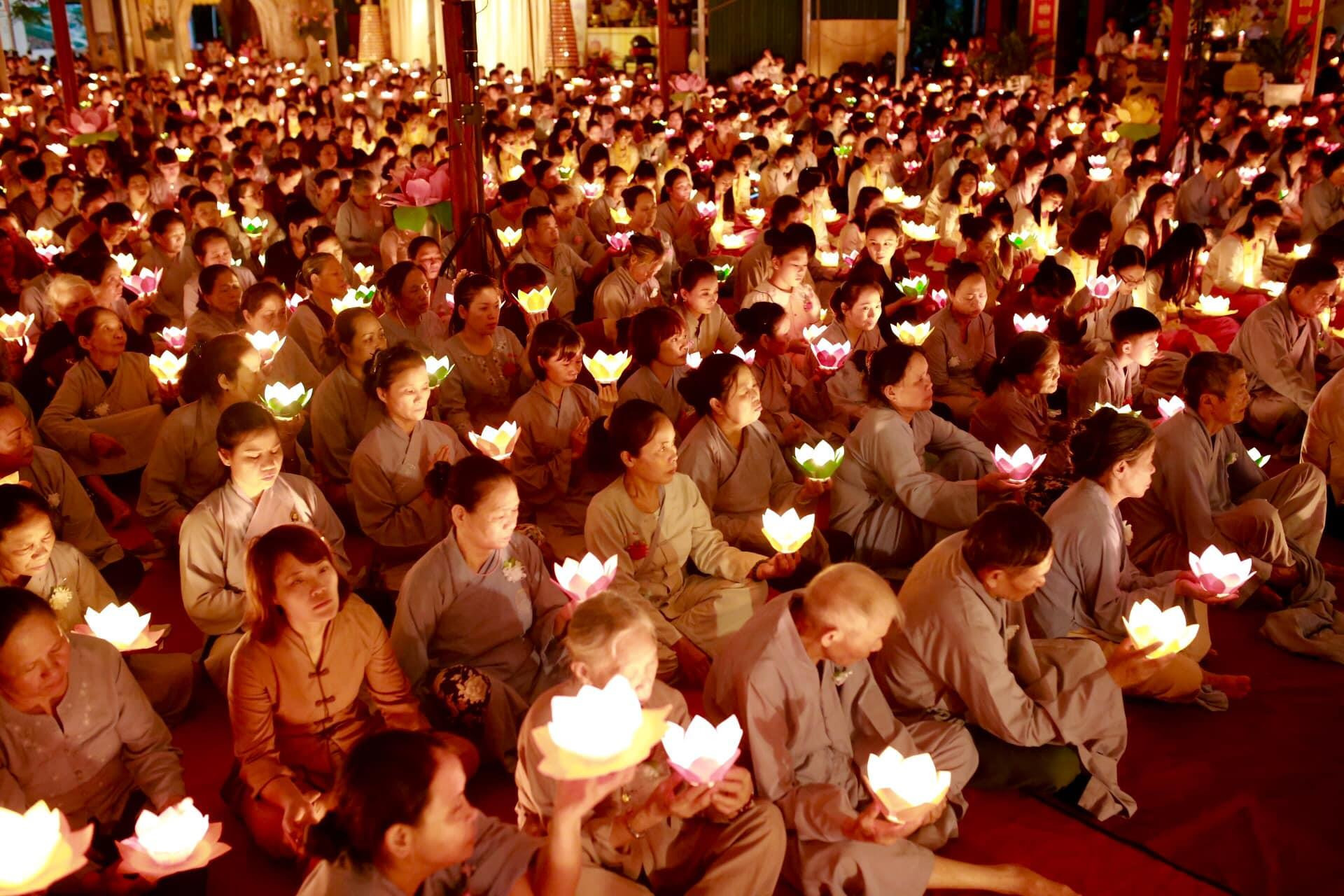
A large number of people sincerely participated in the Vu Lan festival at Diec Pagoda (Vinh City). Photo: Hai Vuong
"
The Vu Lan Festival is a major festival observed by all Buddhist sects because it is associated with filial piety (the supreme virtue of Buddhism), with the practice of meditation (the summer retreat for monks), and with Buddhist scriptures (the Vu Lan Sutra).
PV:So, how did the Vu Lan festival tradition come into our country, sir?
Researcher Nguyen Hung Vi:In China, according to legend, the Ullambana Festival was held during the Liang Dynasty to express gratitude to parents and ancestors, and later, during the Tang Dynasty, it flourished among the common people. In Vietnam, during the period of Chinese rule, along with the spread of Buddhism to ancient Giao Chi (2nd century AD), this ritual was certainly practiced in Vietnam. However, records from that time are unclear.
The clearest documented record of the Vu Lan festival in Vietnam is found on a rare stele at Doi Pagoda (Ha Nam province) called "Dai Viet Quoc Ly Gia De Tu De Sung Thien Dien Linh Thap Bi," composed by Nguyen Cong Bat in 1121 during the reign of Ly Nhan Tong. The stele contains a 396-character passage describing a religious ceremony presided over by King Ly Nhan Tong himself, established out of filial piety towards his parents.
According to the "Complete Chronicle of Dai Viet," on the 15th day of the seventh lunar month in 1118, King Ly Nhan Tong held the Vu Lan Festival to commemorate his mother, Empress Dowager Y Lan, who had passed away a year earlier, in 1117. Perhaps from then on, the Vu Lan Festival moved beyond the confines of the temple, becoming widespread among the people, to promote the value of filial piety in each citizen, and to honor the Buddhist virtue of compassion.
Photo: Ho Dinh Chien
PV:The Vu Lan Festival is centered around filial piety, which, when practiced, is called filial devotion. So, what is the spirit of filial devotion in Buddhism, sir?
Researcher Nguyen Hung Vi:In Buddhism, filial piety is paramount to all other rituals. To show gratitude to one's parents, people practice two types of filial piety as taught by the Buddha: "worldly filial piety" and "transcendental filial piety." "Worldly filial piety" involves offering parents food, drink, shelter, medical care, and other necessities. "Transcendental filial piety" involves guiding parents through religious rituals, visiting temples, abandoning evil deeds, and doing good so that they may be reborn in the Pure Land after death. When parents from seven generations have passed away, offerings are made to atone for their sins so that they may be reborn in the Pure Land.
The Buddhist concept of filial piety is not only profound but also extremely broad. To understand it, we must compare it to the Confucian concept of filial piety. Both are philosophies of life, but Confucianism defines the "Three Unfilial Acts" as follows:
- To follow one's parents' wishes and commit unrighteous acts (To follow one's parents' wishes and commit unrighteous acts - that is the first form of filial impiety).
- "To be poor and have elderly parents and not become an official to gain wealth" (The second act of filial impiety is to be poor and have elderly parents and not become an official to receive a salary).
- Not having a wife and children means the lineage of ancestor worship is broken (this is the third form of filial impiety).
"
Filial piety in Buddhism is not limited to the family but extends to all sentient beings... We must be grateful to everyone and wish for the well-being of all.
Thus, Confucianism, which primarily teaches men to become officials, places a rather restrictive concept of filial piety. In contrast, Buddhist filial piety extends from obedience and obedience to the love of life for all things in the universe. The Buddhist concept of filial piety is not confined to the family but encompasses all living beings, including plants, the environment, and the ecosystem. According to the cycle of reincarnation, humans are the offspring of many different rebirths in past lives, so everyone, every species, is our parent and ancestor. We should be grateful to all and pray for the well-being of all.
PV:As a folklore researcher, how do you view the changes in the Vu Lan festival in recent years?
Researcher Nguyen Hung Vi:Traditional religious practices during the Vu Lan festival were observed both in temples and at home. Temples organized solemn ceremonies with banners and flags, and monks gathered to perform "self-reflection" (self-examination and repentance after the three-month retreat). Afterward, they welcomed devotees to pay respects and listen to scriptures; the monks chanted and lectured on Buddhist teachings. In private homes, people prepared vegetarian offerings to their ancestors for seven generations, chanted scriptures, prayed, and repented; this was accompanied by the custom of offering paper money to their parents, grandparents, and ancestors.
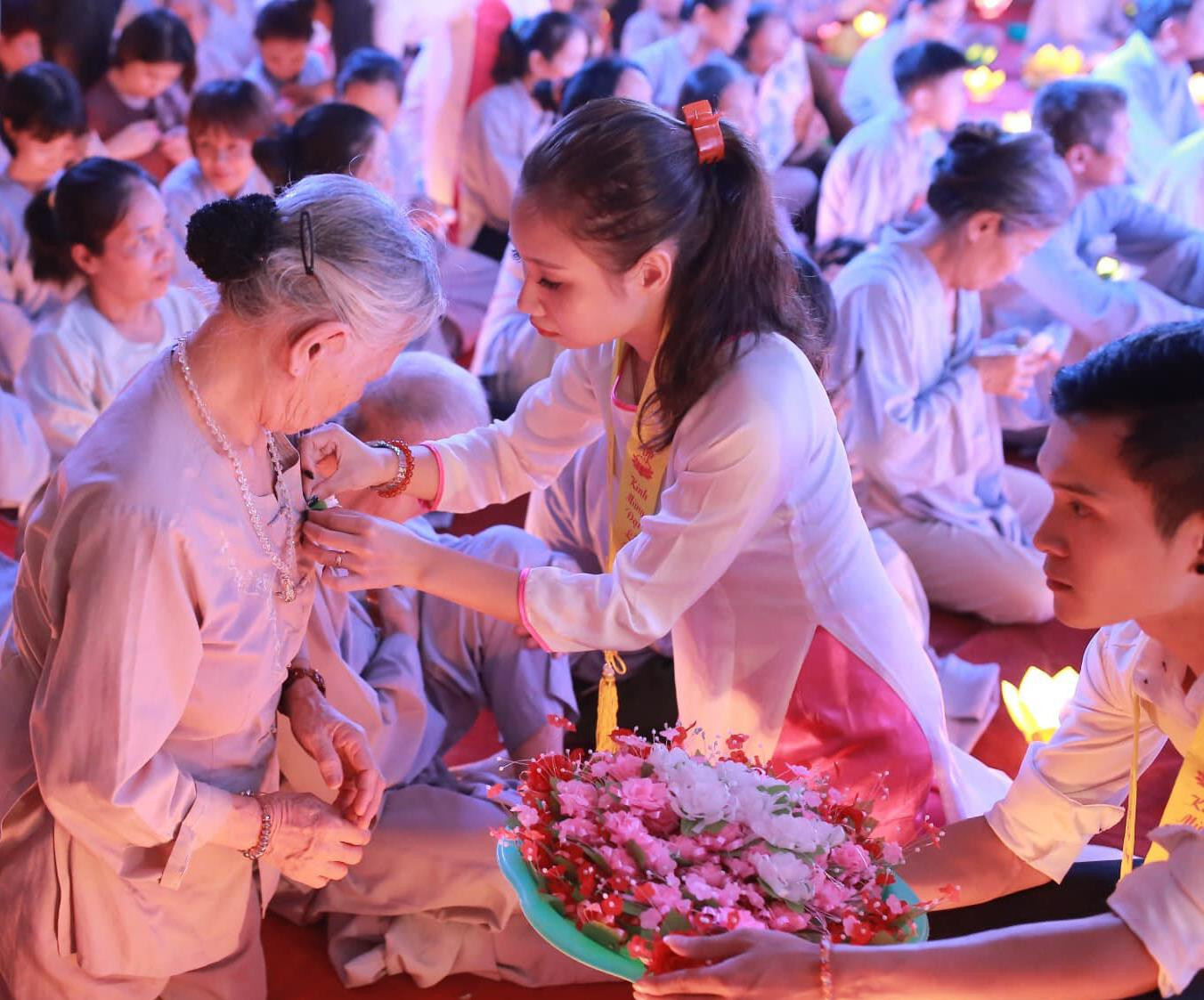
The ritual of pinning roses on clothing during the Vu Lan festival. Photo: Hai Vuong
However, during wartime, due to scarcity and chaotic circumstances, each household usually prepared the offerings individually on a small scale and in a rather simple manner. At temples, people also did not gather in large numbers to listen to the teachings of Mục Liên. On the other hand, the five-fruit offering, which originated from this custom, became popular during Tet (Lunar New Year) or other fruit offerings.
However, since the reunification of the country, the Vu Lan festival has become richer and more meaningful. Notably, the "rose pinned to the lapel" movement on Vu Lan Day, a time for showing filial piety, has only recently been introduced to Vietnam. This movement, initiated by Zen Master Thich Nhat Hanh after a missionary trip to Japan, has spread the beauty of filial piety throughout society and has been widely embraced, becoming a prominent activity every Vu Lan season.
Recently, leading up to the Vu Lan Festival, many temples have organized retreats and filial piety classes during the summer break for students of all levels to enlighten them about the gratitude owed to their parents, the importance of loving humanity, and their responsibility to tradition and the country. During the Vu Lan Festival, in addition to the rituals, temples also focus on organizing artistic programs. These changes occur depending on the circumstances and needs of people in different periods, but ultimately they do not diminish the core values of the festival; in fact, they sometimes enrich the forms of practice.
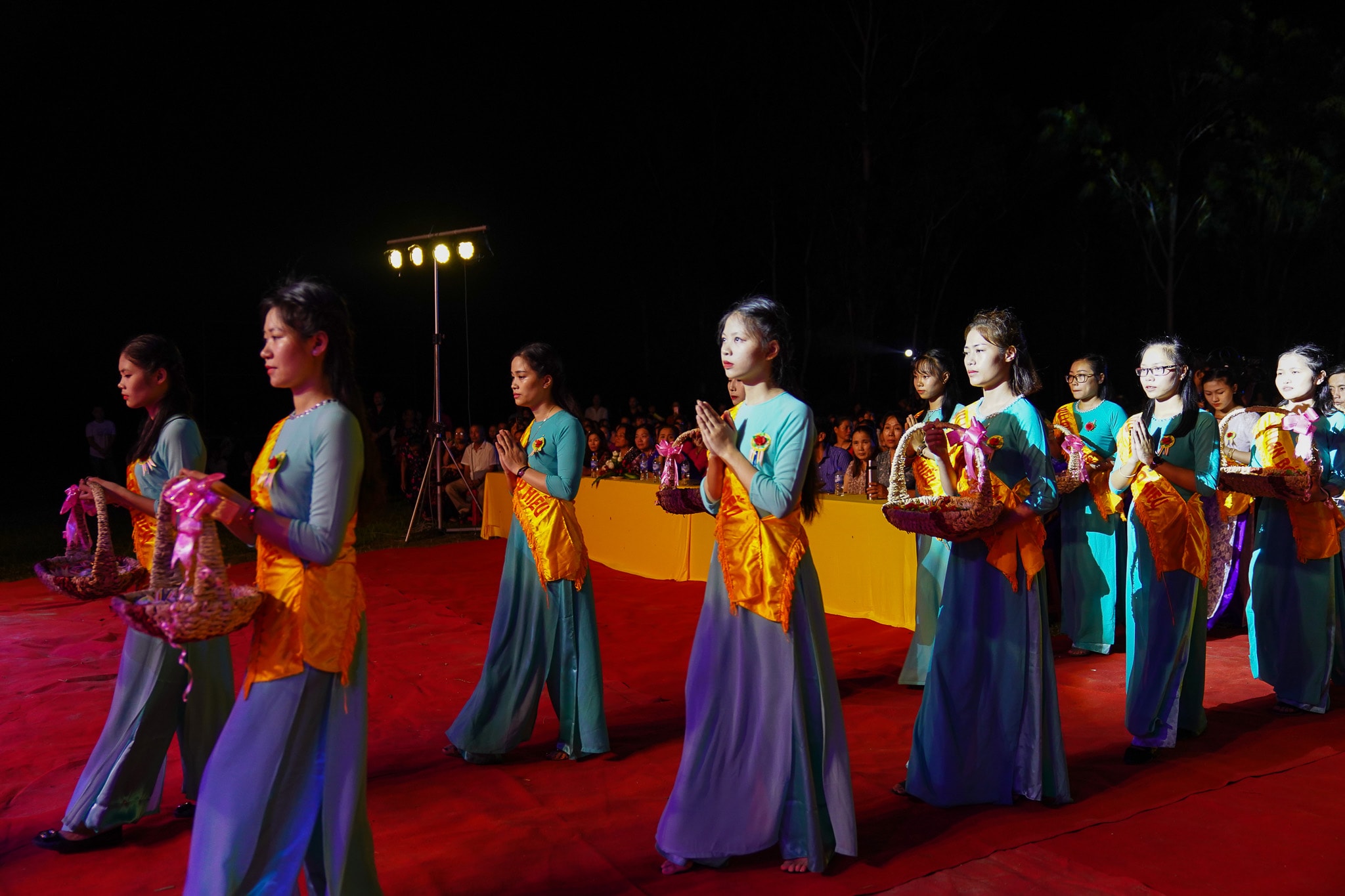
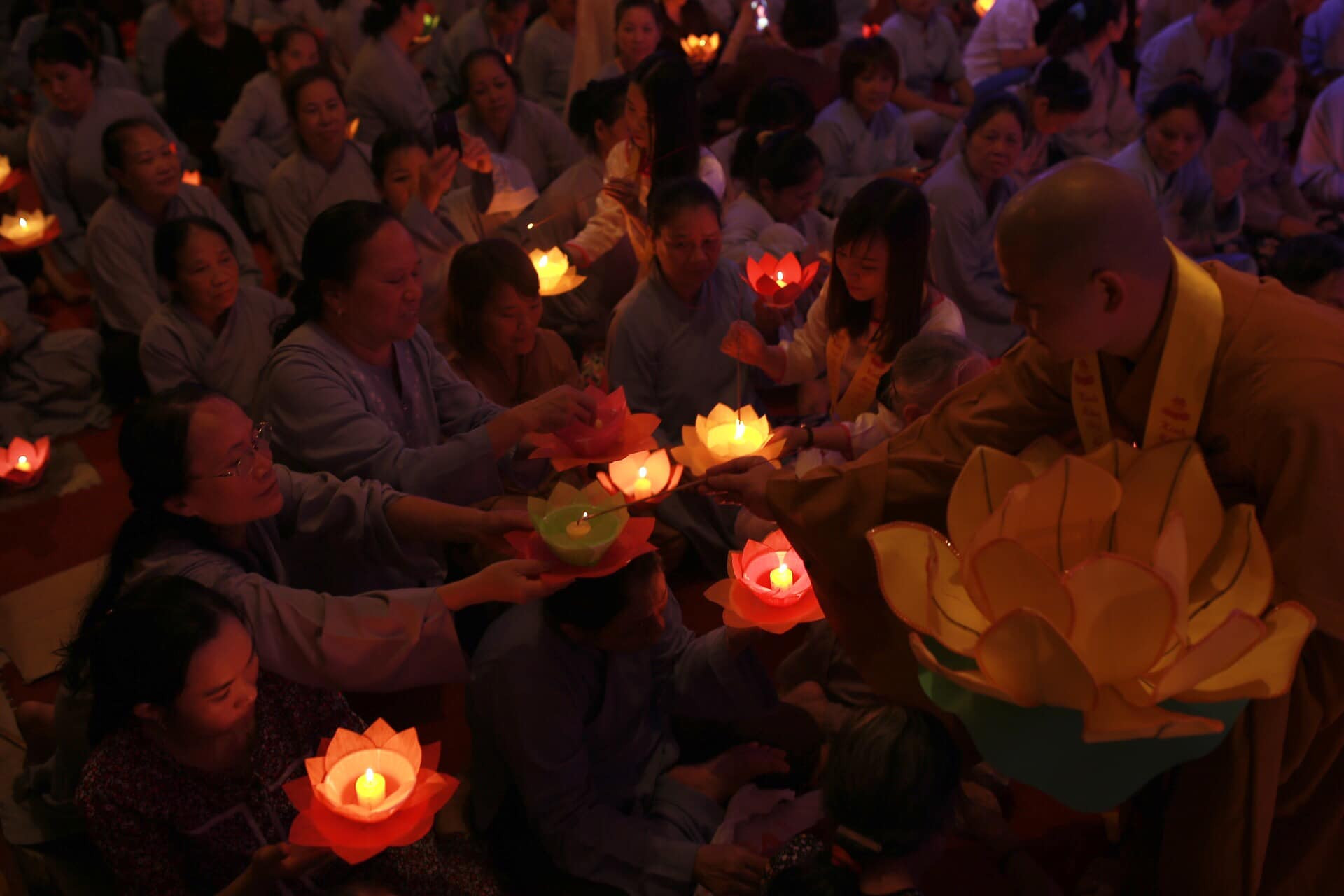
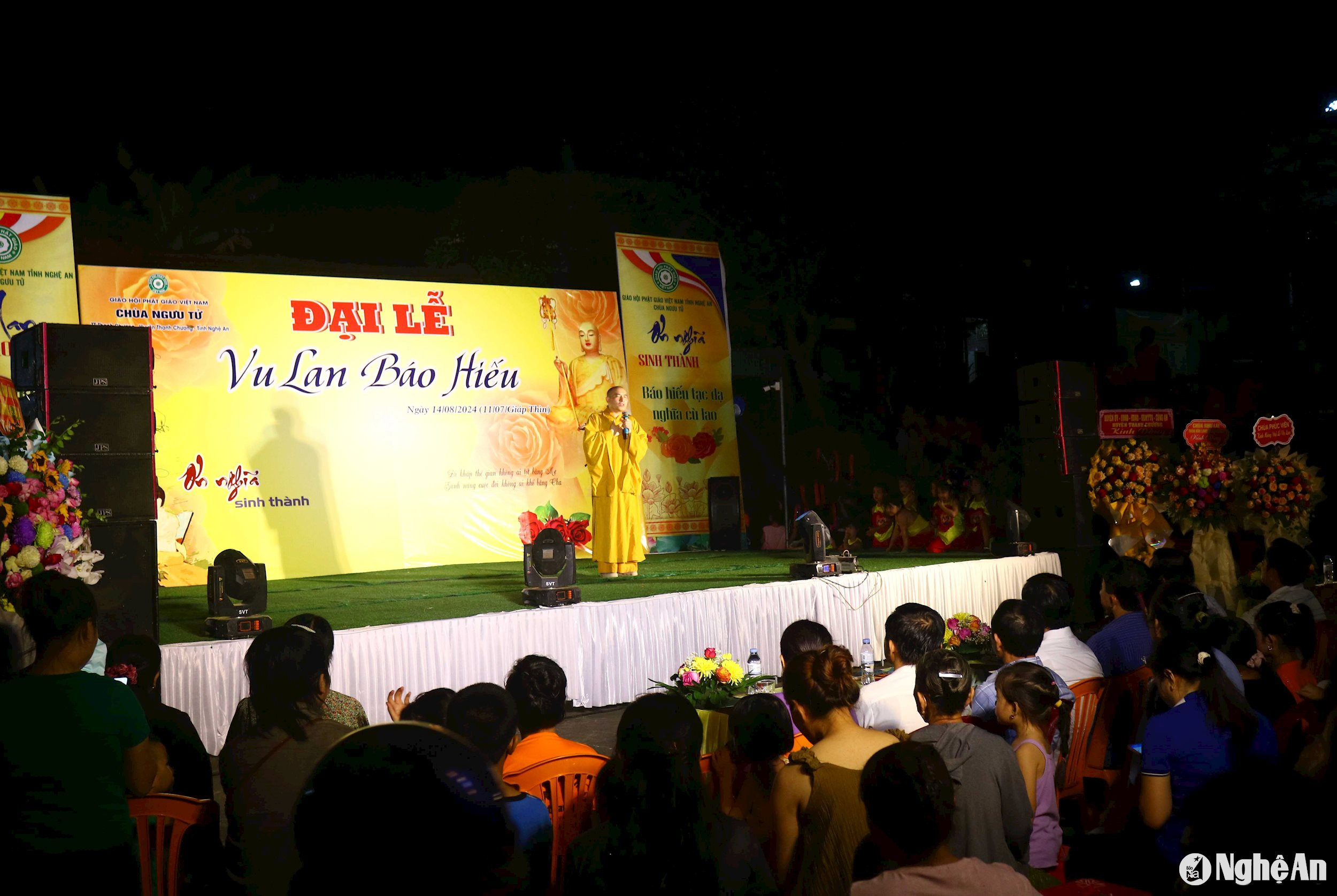
The Vu Lan Festival is celebrated by temples in the main hall or in front of the temple courtyard with elaborate, thoughtful, and solemn preparations by the organizing committee. In the photo: The Vu Lan Festival at Nguu Tu Temple (Thanh Chuong) took place on the night of August 14th. Photo: Huy Thu
PV:It is known that currently, during the Vu Lan Festival and the full moon of the seventh lunar month, there are still some limitations in people's religious practices. Could you elaborate on this issue for our readers?
Researcher Nguyen Hung Vi:Stepping out of the temple and blending into the secular world, the Vu Lan festival inevitably changes with the flow of time and different local customs in order to survive and develop. This process of change is not without negative elements and distortions.
For example, consider the taboos in the seventh lunar month. The "Eulogy for Ten Kinds of Beings" states that in the seventh lunar month, "wandering spirits roam everywhere," potentially harming the living, so the more taboos observed, the more peace of mind one feels. However, these taboos are becoming increasingly excessive and inappropriate, turning into superstition. Buddhism affirms that there are no such things as bad or unlucky days or months that need to be avoided. As long as each person lives virtuously, does many good deeds, and avoids wrongdoing, good fortune will naturally come.
Or consider the story of the custom of burning votive paper money. This isn't originally a Buddhist custom, but rather a Taoist concept of sharing possessions with the deceased in the afterlife. However, today, burning votive paper money has transformed into a form of superstition.
"
Regardless of how much the tradition of the Seventh Lunar Month Festival or the Vu Lan Festival may change, what needs to be preserved is the spirit of filial piety, gratitude to parents, grandparents, and ancestors, and more broadly, respect for nature and the living environment.
However, regardless of any changes to the Seventh Lunar Month Festival or the Vu Lan Festival, what needs to be preserved is the spirit of filial piety, gratitude to parents, grandparents, and ancestors, and more broadly, respect for nature and the environment, because, according to Buddhist philosophy, all of this is just one life in our endless cycle of reincarnation. Our duty is to preserve these unchanging values.
PV:Does the spirit of filial piety and the practice of religious beliefs during the Mid-Autumn Festival in Nghe An province have any unique or distinctive features, sir?
Researcher Nguyen Hung Vi:Filial piety is considered a fundamental moral value of the Vietnamese people, most profoundly reflecting the relationships between family members, especially the relationship between children and their grandparents and parents. Although influenced by Confucianism or Buddhism, through the lens of the Vietnamese people and the realities of Vietnamese society, Vietnamese filial piety also possesses unique characteristics. The spirit of filial piety among the people of Nghe An province is no exception.
But what I appreciate most about the filial piety of Nghe An province is its folk culture, specifically the Nghe Tinh folk songs, with many songs like "The Teacher's Merit, the Mother's Love," "Ten Kindnesses of Parents," "Deep Father-Son Love," "Father's Advice," "Bringing Glory to the Lineage," "The Debt of Parenthood," etc., imbued with the Buddhist spirit of filial piety, reflecting the devotion of poor people who painstakingly raised their children to be good people.
Regarding the Vu Lan festival, it's noteworthy that many families in Nghe An province choose the 15th day of the seventh lunar month as their family anniversary, expressing gratitude to their ancestors and practicing filial piety. The spirit of filial piety is seamlessly integrated with the custom of ancestor worship.


.png)