

The story of the struggle to escape poverty in Chau Kim mountainous commune.
No longer thinking in a short-sighted manner, many ethnic minority households in Chau Kim commune (Que Phong district) have strived to improve their economic situation and voluntarily requested to be removed from the list of poor households. To create a change "in the mindset and practices" of the people, in addition to propaganda work, the Party committee and government have identified a direction suitable to the potential and strengths of the locality, focusing on local crops and products associated with community, ecological, and spiritual tourism…
.jpg)
Focus on developing local products.
Our first impression upon arriving in Chau Kim commune was the sight of vast, lush green rice paddies stretching as far as the eye could see.
Accompanying us, the Chairwoman of the Chau Kim Commune Farmers' Association, Luong Thi Biet, said: "The people mainly focus on growing high-quality Japonica rice and Khau Cay Noi sticky rice (Chicken Sticky Rice), a traditional sticky rice variety of the Thai ethnic people in Que Phong. The outstanding feature of this rice variety is its round, large grains, which become sticky, flavorful, and fragrant when cooked."
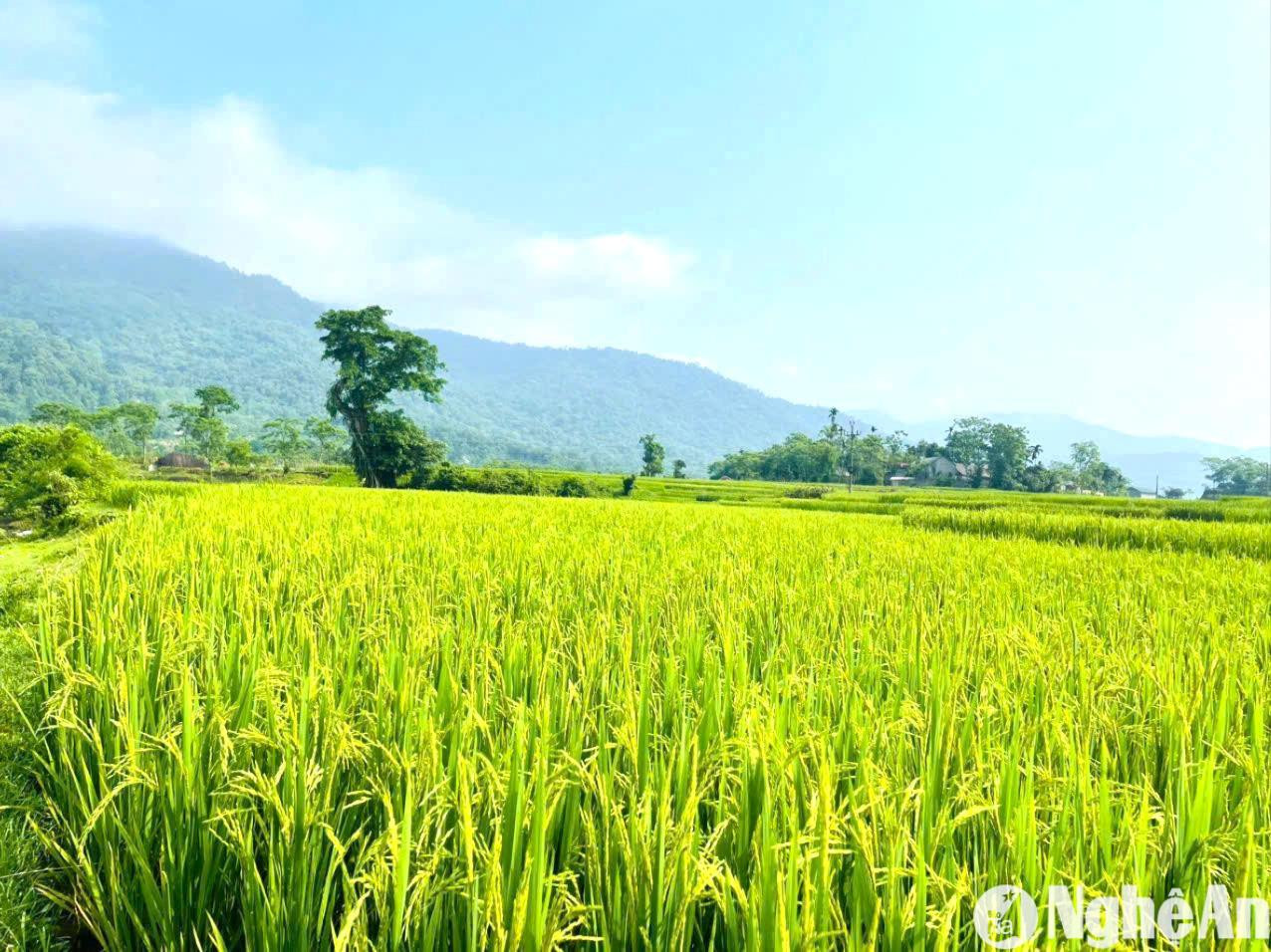
Currently, all six villages in Chau Kim commune cultivate these two types of rice. For example, Lien Phuong village has 50 hectares of rice land; in the spring, they plant Japonica rice, while in the autumn, they plant Khau Cay Noi sticky rice. Each harvest yields 310 tons of rice, with a yield of 62 quintals/hectare.
In Bản Đô village, the focus on producing high-quality Japonica rice and Khau Cày Nọi glutinous rice has brought considerable income to many households. Farmers can sell everything they produce, helping them become more committed to agriculture.
.jpg)
The Party Secretary of Do Luong village, Tien Duy, happily stated: "The village has 23 hectares of land producing high-quality rice with a yield of 53 quintals/hectare. Currently, the price of commercial Khau Cay Noi sticky rice is 250,000 VND/10 kg (sticky rice is 120-150,000 VND/10 kg), and Japonica rice is sold at 200,000 VND/10 kg (rice is 100,000 VND/10 kg)."
According to Mr. Ha Minh Tuan, Secretary of the Party Committee of Chau Kim commune: The locality is blessed by nature with a vast flat area, and the gentle, winding Nam Giai River flows through it, making the fields always lush and fertile.
.jpg)
Therefore, the Party committee and government have implemented solutions to maximize the use of agricultural land to develop high-yield, high-quality intensive rice cultivation areas; at the same time, focusing on reorganizing the fields in conjunction with organizing the transformation of crop structures to increase income per unit area, with an average annual rice yield of 54 - 56.25 quintals/hectare.
Besides Japonica rice, which is grown in all six villages during the spring season, the commune is also focusing on cultivating Khau Cay Noi glutinous rice during the autumn season, striving to build a brand for Muong Ton glutinous rice (the old name of Chau Kim). Notably, the entire commune has expanded the area of commercial Khau Cay Noi glutinous rice cultivation from 37 hectares in 2023 to 70 hectares in the autumn season of 2024, becoming the leading locality in the district in terms of Khau Cay Noi glutinous rice cultivation area.
.jpg)
Besides high-quality rice cultivation, Chau Kim also directed the commune's Mass Mobilization Department to propagate and encourage people to do a good job of protecting forests, planting new trees, and protecting various forest products (forest cover reached 78.9%); directed the Commune People's Committee to coordinate with the consulting unit to complete the dossiers to submit to the higher authorities for land allocation and forest allocation for 419 households and individuals; and at the same time built models for developing medicinal plants under the forest canopy (cardamom, mulberry, seven-leaf ginseng, etc.), especially preserving the golden flower tea with an area of 97 hectares and planting 17 hectares of new trees concentrated in Co Muong and Huu Van villages.
.jpg)
To date, the political system of Chau Kim commune has implemented 30 "Effective Mass Mobilization" models across all fields, including 13 economic models. Typical examples include the vegetable farming model in Do, Khoang Do, and Co Muong villages; the model for preserving and developing cinnamon trees in Co Muong village with a total area of 5 hectares; the model for renovating neglected gardens and planting fruit trees on 2.9 hectares in Co Muong and Huu Van villages; and the goat farming cooperative in Huu Van village…
Currently, the commune has 3 farms with an average income of 100-120 million VND/year; there are 16 large and small family farms mainly raising buffaloes, cows, chickens and growing acacia and cinnamon trees… The income from these households is 50-60 million VND/year.
.jpg)
Simultaneously, seizing the advantages of the area, which includes the Nine-Room Temple - a historical and cultural relic with a long history associated with the formation of the villages of the Thai ethnic group, and which has been ranked as a National Monument by the Ministry of Culture, Sports and Tourism; along with the terrain of many waterfalls and rapids; and the culture with diverse characteristics, including long-standing traditional crafts such as weaving and brocade making... Chau Kim commune has issued and implemented a plan for the development of ecotourism and community tourism associated with the preservation and promotion of ethnic cultural values in the commune for the period 2021-2025, with a vision to 2030.
.png)
A highlight is the successful development and operation of a community-based tourism model in Co Muong village, supported by Resolution 07/2021/NQ of the Provincial People's Council. This has created a livelihood model and leverage for people to sustainably escape poverty…
People voluntarily request to be removed from the poverty list.
Thanks to proactive propaganda and mobilization efforts, combined with the exemplary role of cadres and Party members in "eliminating the mentality of dependence and reliance," and eradicating poverty in residential areas, the people of Chau Kim commune are increasingly conscious of their own actions and are striving to overcome difficulties and escape poverty.
In February 2023, Que Phong district held its first conference to commend households that had made significant efforts in socio-economic development and escaping poverty. Notably, among the 34 exemplary households honored at this conference, 30 were ethnic Thai households from Chau Kim commune.
.jpg)
Mr. Luong Van Truong (70 years old) from Co Muong village, Chau Kim commune - who was honored to be selected to speak at the conference - shared: "The reason I wrote the application to be removed from the list of poor households is simply because my family previously benefited from the support policies and programs of the Party, the State, and the local authorities for poor households. Now, thanks to investing in planting 7 hectares of forest, developing a herd of buffalo and cattle, and diligently farming... our economy has become more stable, so my family has decided to become self-reliant and give way to others who are more disadvantaged."
.jpg)
According to the leaders of Chau Kim commune, by the end of 2023, 40 households in the commune had submitted applications to be removed from the poverty list, hoping to escape dependence and become self-reliant. A typical example is the family of Mr. Vi Van Tuyen (born in 1957) in Khoang Do village. Previously facing hardship, thanks to hard work and his eldest son working abroad, he proactively submitted an application to be removed from the poverty list, citing his "efforts to improve his situation as the reason for escaping poverty."
Some families, starting from humble beginnings, have now risen to become well-off or wealthy. A prime example is Mr. Vi Kim Sinh's household in Co Muong village, with 3 hectares of fruit trees and timber trees such as teak, acacia, and cinnamon; combined with two fish ponds and breeding buffalo and cattle, generating an income of 90 million VND per year. The integrated farming model of Mr. Kim Van Dung's family in Huu Van village (garden, pond, livestock, forest) generates an average annual income of 200-300 million VND.
.jpg)
Most encouragingly, some village officials have been working alongside the people in poverty alleviation, such as Ms. Ha Thi Phuong Lan - Head of the Co Muong village committee, who has successfully persuaded 10 households in the village to switch to growing peanuts and corn on abandoned rice fields, yielding two harvests per year with a productivity of 4-5 quintals per harvest, and is currently conducting a trial of growing Cham Nieu sticky rice with promising results.
For example, Mr. Lo Van So - Secretary of the Party Branch of Co Muong village - is one of the three pioneering households to develop homestays to create community tourism destinations in Co Muong village… contributing to job creation and increased income for local workers.
.png)
Despite the difficulties, the proactive efforts of the people of Chau Kim commune to legitimately enrich themselves on their homeland, or their voluntary request to be removed from the list of impoverished households, represent a significant shift in awareness. This creates momentum for economic development, contributing to reducing the poverty rate and building a new rural area in the locality.