
Online scams are booming.
With the development of information technology, online sales, and cashless payments, the situation of cybercrime exploiting cyberspace and using high technology to defraud and misappropriate assets is becoming increasingly complex.
Bank employee uncovers fraud.
For two consecutive days, thanks to their vigilance and experience, the staff of Agribank's Tay Nghe An branch helped customers avoid online scams.
Ms. Tran Thi Thuy, Head of the Accounting and Treasury Team at the Cho Moi Transaction Office of Agribank's Tay Nghe An branch, stated that at approximately 3:20 PM on October 15th, at the Cho Moi Transaction Office, customer NTO, residing in Hamlet 4, Nghia Thuan Commune, Thai Hoa Town, came with her husband to withdraw money from their savings account to transfer 90 million VND to their daughter's account.
During the transaction, the teller noticed some irregularities and investigated further, learning that the customer wanted to transfer money to several accounts in Soc Trang province, while her daughter was studying and working in Japan. The teller quickly stopped the withdrawal transaction and persuaded the customer to call the account of a relative to verify if her daughter's social media account had been compromised.
Upon verification, it was discovered that the customer's daughter's Facebook account had been hijacked by fraudsters who tricked Ms. O into sending money to a different account.
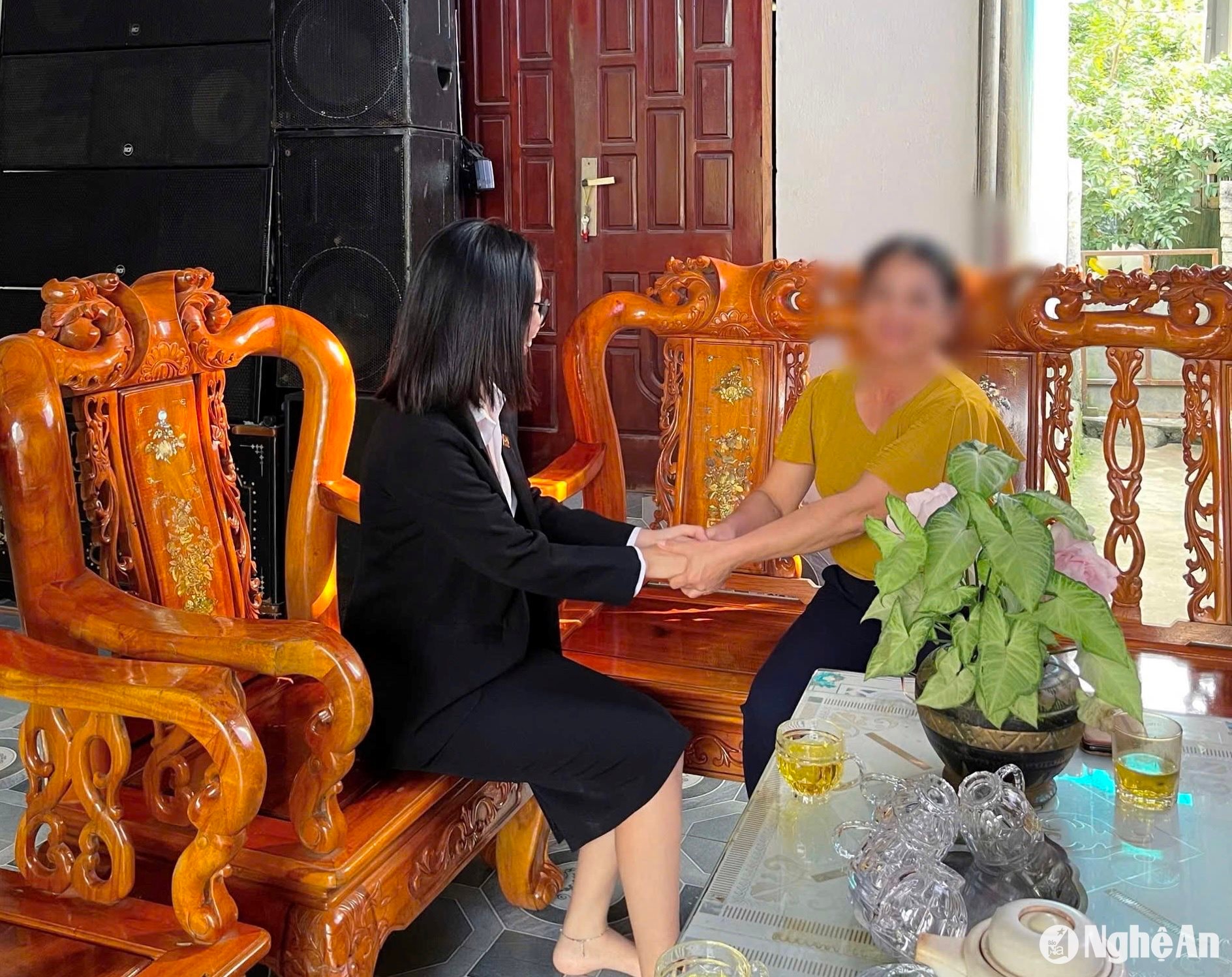
The following morning, October 16th, Ms. Dao Thi H., a resident of Dong Hieu commune, Thai Hoa town, and her husband came to the transaction office hoping to mortgage their land use rights to borrow 200 million VND. Noticing the customers' fearful and confused behavior, the transaction officer invited them to the second floor for further discussion and simultaneously reported the matter to higher-level management.
Analyzing recent common online scams for clients. After chatting and conversing with the customer, the client realized they were being scammed. The scammers' tactic was to threaten the client, claiming they were involved in a criminal ring being investigated by the Thai Hoa town police, and that they needed to transfer money to cooperate with the investigation or they would be detained.
Reportedly, the customer received a call from the number 0332303262, with the caller claiming to be a police officer from Thai Hoa town, informing her that her husband was involved in a drug trafficking ring. The callers contacted her using various phone numbers, constantly pressuring her to transfer money and threatening her not to inform relatives or bank employees.
Impersonating police officers to extort property.
"My family has just been scammed, everyone. They target elderly people to carry out their scams." This is a post shared by Ms. P from Vinh City on Facebook, recounting how her relatives were recently defrauded by scammers posing as police officers.
Ms. P recounted: "First, they called and asked why we hadn't gone to the local police station to integrate the social insurance software into our personal identification account. They impersonated a police officer at the station named Son, then they transferred the call to someone else, impersonating a city police officer named Hai. After that, they told us to leave it there and they would do it for us, no need to go to the city police station anymore."
After gaining the victim's trust, the perpetrator claimed to have a complaint containing the victim's personal information, accusing them of involvement in a money laundering and drug trafficking ring. The victim asked if the victim had lost their citizen identification card or revealed any bank account details to anyone.
After the victim starts to stammer, they will say: "I know you've been deceived and exploited, but we are working on a major international and national case. We will help you clear your name in this case, on the condition that it is kept completely confidential. Don't reveal this to anyone, especially your relatives and children. If you don't cooperate, it will greatly affect the reputation and honor of your children. It might not matter to you, as you are elderly, but your children will be affected. If you agree, we will help you prove that you have sufficient financial resources to avoid participating in money laundering by transferring 200 million VND to this account. After two days, we will complete the case file and return the money to you intact."
This scam tricks elderly people into believing it's free and readily pays. If the victim has money in their bank account and makes the transaction through the app, they will immediately transfer the money to the scammers.
If the victim doesn't have a banking app, they will instruct the victim on how to deposit cash. On weekdays, the scammers will direct the victim to go to the bank to deposit cash, claiming it's for their children or grandchildren. Later, when bank employees became vigilant, detected the scams, and coordinated with the police to prevent some cases, the perpetrators demanded immediate payment on holidays when the bank was closed, instructing the victim to go to a gold shop to transfer the money.
If the victim doesn't have enough money to pay, they will instruct the scammers on how to borrow money easily and discreetly. After paying the amount requested by the scammers, if they haven't been exposed yet, the scammers will invent another situation to get the victim to pay more. If the victim doesn't pay more, they will lose the amount already paid. And so the victim ends up handing over all their money and assets that can be converted into cash...
In my family's case, the scammers told us to hide it from our children and grandchildren, and to borrow money under the pretext of building a church or buying a car... Luckily, our neighbors saw the elderly couple borrowing money and called me, so we were able to stop them in time! Therefore, everyone should be vigilant when receiving threatening phone calls, demanding money, or asking them to install strange apps. And if you see someone suddenly asking to borrow money, especially an elderly person, be careful and check their information, lest you become an indirect victim of fraud!
Ms. P. issued a warning.
Scams are rampant.
Currently, in Nghe An province, there is a surge in scams involving impersonating delivery drivers, calling customers to inform them of online orders, and requesting payment in order to steal their money. Ms. H, residing in Ha Huy Tap ward (Vinh City), recounted that she often orders online and usually only transfers money upon receiving the goods (cash on delivery). One day, while she was away, she received a call asking her to transfer 350,000 VND for goods. Because she had ordered quite a lot and wasn't sure what the items were, she transferred the money. When she got home and couldn't find the goods, she tried calling the number again, but the line was disconnected…
Scams are rampant, in all forms, many involving billions of dong, but also some involving only tens of thousands of dong. These are calls claiming that you have goods for free, just transfer a few tens of thousands of dong for shipping...

Recently, another scam has emerged: many people who place orders are scammed by fraudulent messages on Zalo, requesting them to transfer money, even using bank accounts in the seller's name. Many people have to constantly remind customers that these Zalo order confirmation messages are scams and that they should not transfer money!
Ms. NH, who sells fashion items, said that her account was recently impersonated. To avoid being scammed, she had to post a message on Facebook advising customers not to transfer money in advance via Zalo. "To avoid scammers, please do not transfer money to anyone in advance. I will deliver the goods first and then you pay. I do not confirm orders or payments via Zalo," Ms. NH's account posted.
Furthermore, nowadays, through malware installed on victims' mobile devices, fraudsters can track users' every move, including password authentication for bank and securities accounts, and then steal money.

Reportedly, the Ministry of Public Security has listed 24 forms of online fraud, ranging from the most sophisticated methods such as deepfake videos (fake images and information), to impersonating police, prosecutors, courts, and tax officials, making threatening calls to victims via the internet, and then stealing personal information and assets.
Online scams are becoming increasingly sophisticated, making them difficult for many people to recognize. Therefore, people need to be vigilant and verify the information of anyone who proactively contacts them and claims to be a police officer, bank employee, etc. Do not install or download any applications directly from links sent via SMS, chat on social media platforms or messaging apps, or from websites provided by these individuals. Do not trust, follow, or contact anyone advertising on social media platforms such as Facebook, Zalo, Viber, Telegram, etc.
Thu Huyen