

The Ministry of Education and Training is proposing a formula for converting university admission scores.
The Ministry of Education and Training requires that the rules for converting equivalent scores be simple, easy to understand, and convenient to apply.
From 2025 onwards, universities must convert equivalent scores between different admission methods and combinations to a common scale. According to the draft guidelines for university and college admissions in 2025, the Ministry of Education and Training requires that the conversion rules be simple, easy to understand, and convenient to apply.
Furthermore, the conversion process must be based on scientific and practical grounds. Schools use high school graduation exam scores or high school academic results as the basis for establishing conversion rules. In addition, schools base their conversion rules on statistical data and analysis of the academic performance of admitted students from previous years (at least two consecutive years) and the individual academic results of each student, according to each admission method.
Based on an analysis of the correlation between university academic performance and the score distribution of different admission methods for the same group of candidates; from the minimum quality assurance threshold to the maximum score on the admission scale, universities must identify at least 3 score ranges (e.g., Excellent - Good, Fair, and Pass) to construct at least 3 linear correlation functions (3 first-order functions) for these 3 score ranges.
Conversion table:
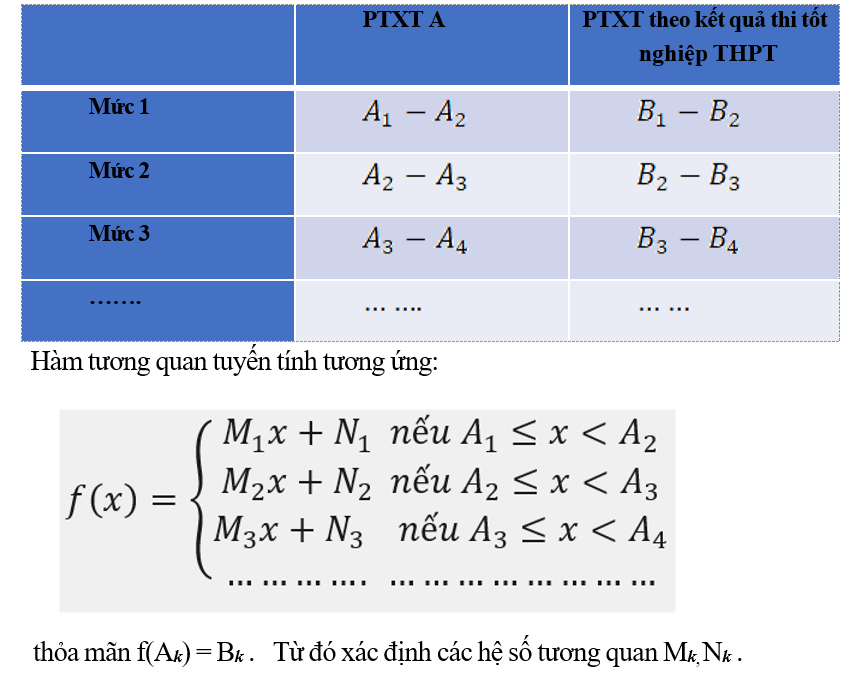
Based on the above plan, and in accordance with the standard rules announced by the Ministry of Education and Training after the 2025 high school graduation exam results are available, schools should finalize the conversion rules based on the specific characteristics of their ngành (field of study) and training program.
For example:Analyzing the results of the same group of candidates using the 2024 high school graduation exam results and academic transcripts (6 semesters) according to the 5 traditional subject groups; based on the assessment of students' academic performance in previous years, it shows that: Excellent candidates account for 30% of the total number of admitted candidates, corresponding to a high school graduation exam score of 24.75 and an academic transcript score of 25.75; candidates with good or higher scores account for 80% of the total number of candidates, corresponding to a high school graduation exam score of 20.5 and an academic transcript score of 22.0; the remainder are at the passing level.
Accordingly, schools can use the scores (24.75; 25.75); (20.5; 22) along with the score as the minimum quality assurance threshold for admission and the maximum score of the examination scale (30; 30) to linearize each region and establish a formula (in the form of a first-degree equation) to convert the equivalent admission score between the two methods.
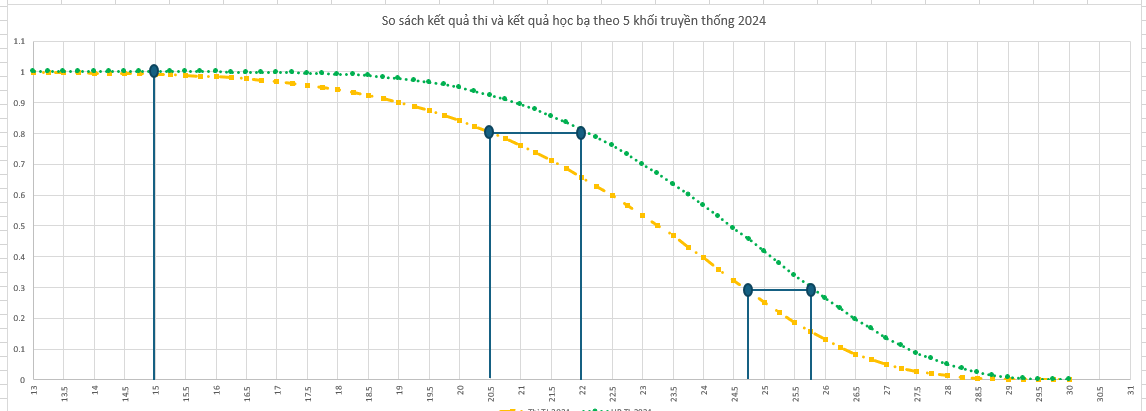
Yellow represents the High School Graduation Exam score; Green represents the academic transcript score.
Assuming the minimum score is 15 for both methods, then:
| Point | High school graduate | academic transcript |
| Obtain | >=15 and <> | >= 15 and <> |
| Rather | >= 20.5 and <> | >=22 and <> |
| Good – excellent | >=24.75 and <> | >=25.75 and <> |
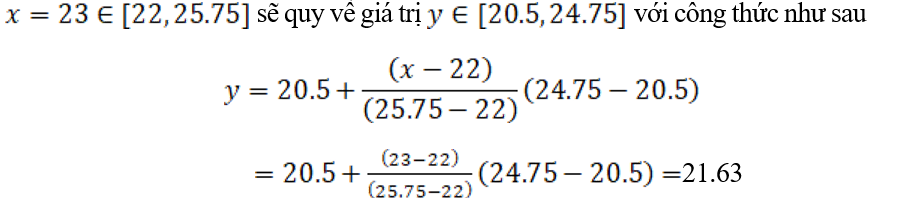
A candidate A with a GPA of 23 will have their score converted to the original scoring method, which is based on the high school graduation exam score, as follows:
Additionally, the difference in scores (grades from 6 semesters of high school transcripts and high school graduation exam scores) can range from 1.0 to 1.5 points for this group of candidates.