

Be wary of fake news and misinformation about storms, floods, and natural disasters.
These days, in addition to getting updates on storms and floods from official sources, people can also watch many livestreams sharing information about the storm – information that has not been verified (using maps from foreign apps, etc.) – from personal channels/pages...
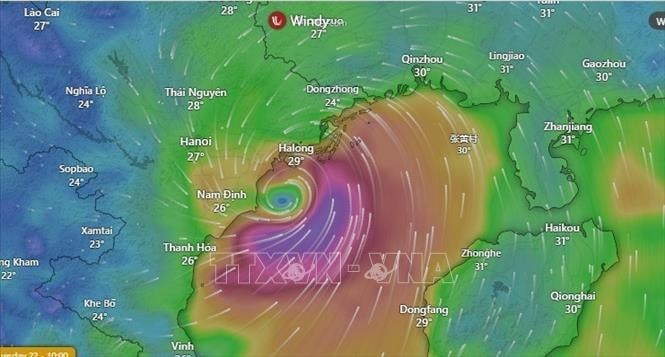
Regarding this issue, Mr. Vu Duc Long, Head of the Meteorological and Hydrological Forecasting and Information Management Department, Meteorological and Hydrological Administration, Ministry of Agriculture and Environment, stated: In the digital age, it is essential for people to access and share information quickly. People proactively updating and sharing information about storms is positive, demonstrating concern for the community. However, in a highly specialized field like meteorology and hydrology, the agency is very concerned about the situation where some individuals without expertise or formal training are independently livestreaming, analyzing, and forecasting storms and floods based on maps from foreign applications without a thorough understanding.
"This not only disrupts information but also poses a potential risk of causing public panic, affecting people's safety and the disaster prevention and control efforts of relevant agencies," Mr. Vu Duc Long noted.
Assessing the reliability of the above information, Mr. Vu Duc Long stated that meteorological forecasts, especially for dangerous weather phenomena such as typhoons and tropical depressions, require global observational data, complex computational models, and analysis and correction by a team of formally trained experts in the field of meteorology and hydrology.
Weather charts from foreign apps cannot be used alone for prediction and certainly cannot replace official forecasts from the national meteorological and hydrological forecasting system - the only authority in Vietnam to issue meteorological warnings and forecasts.
"Therefore, information from spontaneous livestreams, using maps from foreign applications without the ability to conduct scientific analysis, has very low reliability and may even be seriously inaccurate," Mr. Vu Duc Long emphasized.
Furthermore, when people view such information as having serious and multifaceted impacts, it becomes apparent that people have access to it.misinformationTwo scenarios are possible: First, people become complacent and negligent, failing to implement necessary preventative measures because they believe their area will not be affected. Second, people panic, evacuate spontaneously, hoard excessively, disrupting social life and hindering the local government's response efforts.
Furthermore, the spread of unverified information erodes public trust in the official information system, thereby seriously impacting the effectiveness of disaster management and response – which requires high levels of coordination and discipline in information and action.
Given the situation, Mr. Long advised that people should only receive and share information about weather, storms, and floods from official sources such as the national meteorological and hydrological forecasting and warning system, the National Center for Meteorological and Hydrological Forecasting, meteorological and hydrological stations, the National Steering Committee for Civil Defense, the People's Committees and local disaster prevention and control agencies, and official television and newspapers.
People should not share information from unprofessional, unverified, or unsubstantiated personal channels, especially during times of complex natural disasters. People should also remain calm, follow the guidance of local authorities and relevant agencies, and avoid acting impulsively or following advice from unreliable sources.
"In case of any questions, people can directly access the website or contact units within the National Meteorological and Hydrological Forecasting and Warning System for accurate advice and support," Mr. Vu Duc Long suggested.
According to Mr. Vu Duc Long, information is crucial during natural disasters. "We urge people to be vigilant against fake news and misinformation; and to proactively and responsibly receive, verify, and disseminate accurate information, contributing to ensuring the safety of themselves, their families, and the community," Mr. Long hoped.