

Typhoon No. 11 is approaching the mainland, with wind gusts reaching level 16.
Typhoon No. 11 is moving rapidly towards the Northeast region of Vietnam with wind gusts reaching level 16, causing heavy rain, storm surges, and strong winds in many provinces and cities, including Hanoi.
On the afternoon of October 5th, Typhoon No. 11 was actively moving across the northwestern part of the East Sea. The typhoon's center was located at approximately 20.8 degrees North latitude and 110.4 degrees East longitude, about 270km east-southeast of Mong Cai city (Quang Ninh province).
The strongest winds near the center of the storm reached levels 12–13 (118–149 km/h), with gusts up to level 16, causing violent waves and posing a danger to ships. In the next 3 hours, the storm will move in a west-northwest direction at a speed of 20–25 km/h, heading directly towards the Northeast region of Vietnam.
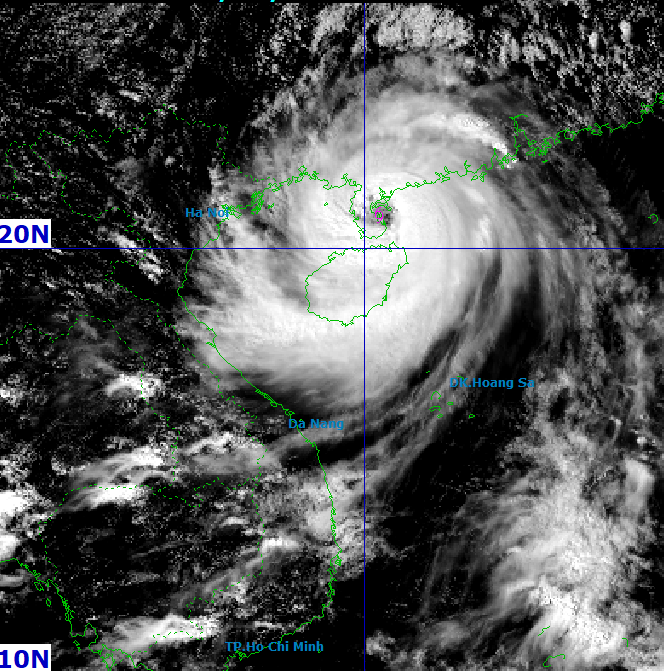
The northwestern part of the South China Sea is experiencing strong winds of force 8-10, reaching force 11-13 near the storm's center, with gusts of force 15-16; sea waves are 6-8 meters high, and the sea is extremely rough, potentially sinking large ships.
From the afternoon of October 5th, the northern Gulf of Tonkin area, including Bach Long Vi, Van Don, Co To, Cat Hai, and Hon Dau, began to experience strong winds of force 6-7, later increasing to force 8-9, with winds near the storm's center reaching force 10-12, gusting to force 15, and waves 3-5 meters high.
Coastal areas of Quang Ninh and Hai Phong may experience rising water levels of 0.4–0.6m, combined with high tides, posing a risk of flooding in low-lying areas, river mouths, and coastal regions on the evening of October 5th.
From the night of October 5th to noon on October 6th, coastal areas from Quang Ninh to Hung Yen and Lang Son will experience increasingly strong winds, reaching levels 6-7, with winds near the storm's center reaching levels 8-10, and gusts up to levels 11-12. With these wind speeds, the likelihood of roofs being blown off, trees being broken, and houses being damaged is very high.
In the inland areas of the Northeast region, winds are at level 4-5, in some places level 6, with gusts up to level 7-8, affecting daily life and transportation.
Hanoi is on full alert, preparing to cope with heavy rain and rising water levels.
Given the complex developments of Typhoon No. 11, the Hanoi Department of Agriculture and Rural Development has directed dike management units to deploy personnel on duty 24/7. Each shift consists of two people, tasked with closely monitoring weather conditions, being ready to handle dike incidents, and promptly reporting to the Sub-Department of Water Resources and Disaster Prevention.
According to forecasts from the National Center for Hydrometeorology, Typhoon No. 11 will make landfall in the Northeast region of Vietnam on the afternoon of October 6th. From the night of October 5th to the end of the night of October 7th, the Northern Delta region and Thanh Hoa province will experience moderate to heavy rain, with rainfall amounts generally ranging from 70–150 mm, and exceeding 200 mm in some areas.
In Hanoi, rain began early in the morning of October 6th and lasted until the evening of October 7th. Total rainfall in the central and northern parts of the capital ranged from 80–150 mm, with some areas exceeding 150 mm; the southern areas received 50–100 mm of rain. Winds are expected to gradually increase to level 4–5, accompanied by thunderstorms and prolonged heavy rain.
The Hanoi Department of Water Resources and Disaster Prevention has requested an increase in on-duty personnel to two people per shift, regular monitoring of weather information, and ensuring the safety of dikes, reservoirs, and irrigation works.
The units were tasked with updating information on storms, floods, and damage in order to promptly advise relevant authorities and ensure the well-being of the people during prolonged periods of heavy rain and storms.