
Pepper prices today, October 31, 2025: Another sideways trading session.
Pepper prices today, October 31, 2025: Domestic pepper prices are trading around 144,000 - 146,000 VND/kg. World pepper prices remain unchanged, marking the third consecutive day of sideways movement.
Domestic pepper prices today, October 31, 2025
Today, October 31, 2025, pepper prices in some key growing regions are trading around 144,000 - 146,000 VND/kg. Specifically:
In Dak Lak today, pepper is trading at 146,000 VND/kg; unchanged from yesterday.
The price of pepper in Dak Nong (Lam Dong province) remains at 146,000 VND/kg, unchanged from yesterday.
Today, the price of pepper in Gia Lai remains unchanged at 144,000 VND/kg, the same as yesterday.
Traders in Dong Nai are selling pepper at 145,000 VND/kg; unchanged from yesterday.
The price of pepper in Ba Ria - Vung Tau (Ho Chi Minh City province) remains at 145,000 VND/kg; unchanged from yesterday.
Meanwhile, traders in Binh Phuoc (Dong Nai province) continue to trade at 145,000 VND/kg; unchanged from yesterday.

According to the Vietnam Commodity Exchange (MXV), domestic pepper prices entered a sharp upward cycle from the second quarter of 2024. In May and June, pepper prices increased by more than 50,000 VND/kg, reaching a peak of 180,000 VND/kg, the highest in the past 10 years. This price surge indicates a shortage in supply compared to global demand.
The main reason stems from the fact that major producing countries such as Vietnam, Brazil, India, and Indonesia have all reduced production by 10-20% due to unfavorable weather conditions, while consumption demand continues to increase by 3-4% annually, especially in South Asia and the Middle East. This supply-demand imbalance has driven up pepper prices and created prolonged shortages.
Entering 2025, pepper prices are expected to remain high thanks to reduced inventories and the impact of new trade policies. The US imposition of a 40% tariff on re-exported goods has led domestic businesses to prioritize the domestic market, helping to keep pepper prices stable around 150,000 - 151,000 VND/kg.
Experts predict that in early November, pepper prices will stabilize or increase slightly by 0-5% compared to the end of October. If supply remains limited, prices could rise more sharply. In the long term, Vietnam will continue to dominate international prices, helping growers and businesses maintain stable profits.
Today's pepper prices on the world market.
On the world market, based on quotations from exporting companies and export prices in various countries, the International Pepper Association (IPC) updates the latest pepper prices as of October 31, 2025 as follows:
Indonesian Lampung black pepper prices remained unchanged at US$7,211 per ton. Similarly, Muntok white pepper prices remained unchanged at US$10,061 per ton.
The price of Brazilian ASTA 570 black pepper remained unchanged at $6,100 per ton.
Malaysian ASTA black pepper prices remain unchanged at US$9,375 per ton. Similarly, ASTA white pepper prices also remain unchanged at US$12,400 per ton.
Prices for all types of Vietnamese pepper remain unchanged. Specifically, the price of Vietnamese black pepper (500 gr/l) remains unchanged at US$6,400/ton; and the price of black pepper (550 gr/l) remains unchanged at US$6,600/ton.
Similarly, the price of Vietnamese white pepper remained unchanged at $9,050 per ton.
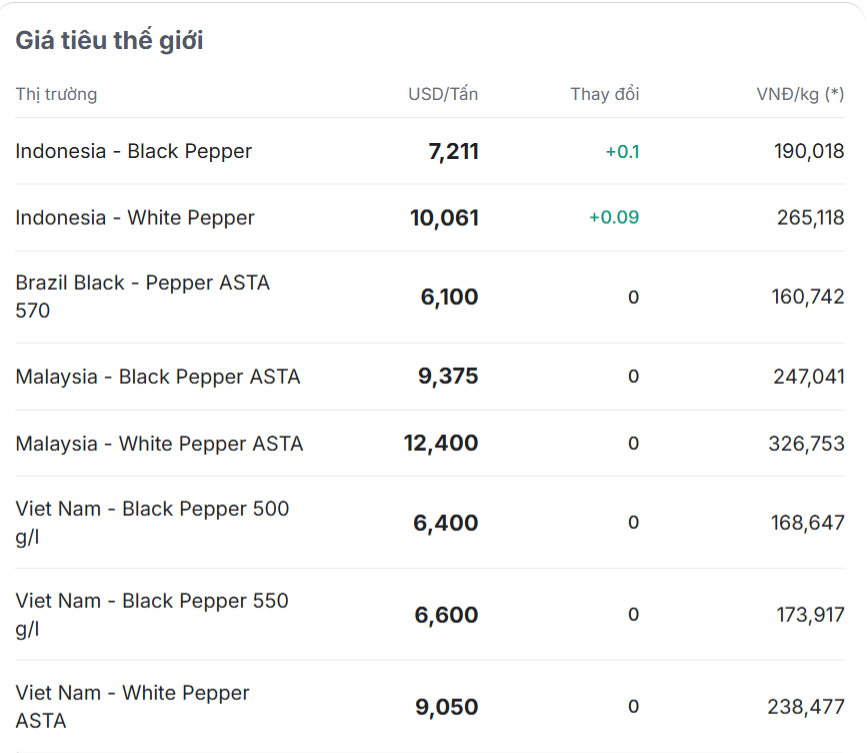
World pepper prices remained unchanged today, marking the third consecutive day of sideways trading. Amidst worsening crop diseases and climate change, maintaining pepper yield and quality is proving challenging. Experts predict pepper prices will remain high due to reduced supply while global demand is recovering.
According to a report by the International Pepper Community (IPC), the last week of October saw mixed trends among countries. India was a bright spot, with the Rupee appreciating by 1%, helping domestic and export pepper prices rise for the third consecutive week.
Conversely, the US saw a decline in pepper prices for the third consecutive week due to a weakening US dollar and rising inflation. Indonesia and Sri Lanka maintained stable prices, while Brazil, Cambodia, and China (white pepper) saw no change. Malaysia experienced a slight decrease, except for its white pepper exports, which remained at the same price.
In India, Brazilian pepper is flooding the domestic market at just 750 Rupees/kg, equivalent to $6,000/ton, significantly lower than the $8,000/ton price of domestic pepper. This cheap supply is putting pressure on Indian pepper consumption in the Tamil Nadu, Wayanad, and Coorg regions.
Quoc Duan