

Samsung Odyssey OLED G6: Is a 500Hz refresh rate enough to lead the pack?
With its 500Hz QD-OLED display, premium metal design, and anti-glare matte finish, the Samsung Odyssey OLED G6 is a top choice for gamers. However, its HDR performance and some features still lag behind its direct competitors.
The Samsung Odyssey OLED G60SF (or G6 for short) is a special gaming monitor, not only notable for its 500Hz QD-OLED panel but also for its sophisticated design and unique matte finish. Aimed at professional eSports gamers, it also offers versatility in various lighting conditions, creating an interesting competitor in the high-end monitor market.
Detailed specifications of the Samsung Odyssey OLED G6
The focus of the Odyssey OLED G6 is its 500Hz refresh rate, one of only three QD-OLED displays on the market to achieve this figure by the end of October 2025. However, other specifications are also crucial in determining its position.
| Parameter | Detail |
|---|---|
| Screen size | 26.5 inches, 16:9 aspect ratio |
| Resolution | 2560x1440 |
| Panel type | QD-OLED |
| Scanning frequency | 500Hz |
| Adaptive synchronization | AMD FreeSync Premium Pro, G-Sync compatible. |
| HDR | VESA DisplayHDR 500 |
| Connection port | 2x HDMI 2.1, 1x DisplayPort 1.4, 1x USB-B Upstream, 2x USB-A 3.2 Gen 1 |
| Sound | No built-in speakers, but it has a 3.5mm jack. |
| Additional features | CoreSync RGB LED ring on the back |
| Suggested price | $999.99 |
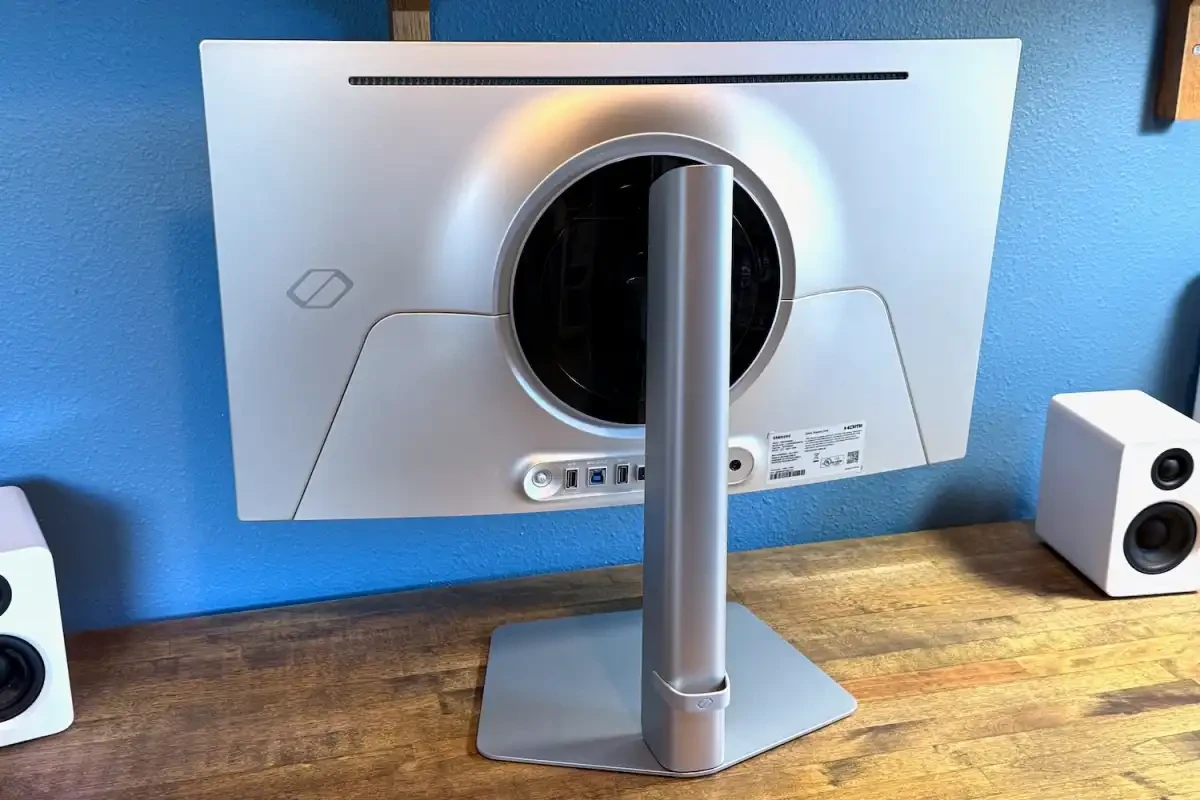
Premium design and unique matte finish.
Samsung has opted for a professional and premium design approach for the Odyssey OLED G6. The back of the screen is finished in silver metal instead of plastic like many competitors, giving it a solid and luxurious feel. A customizable RGB LED ring with integrated CoreSync technology synchronizes the lighting with the content on the screen, although the brightness is quite low and only truly effective in a dark room.
The G6's stand has a flat and compact design, saving desk space. It offers full height, tilt, and swivel customization, and can even rotate 90 degrees for portrait use. Additionally, the monitor supports a VESA 100x100mm mount for third-party stand solutions.
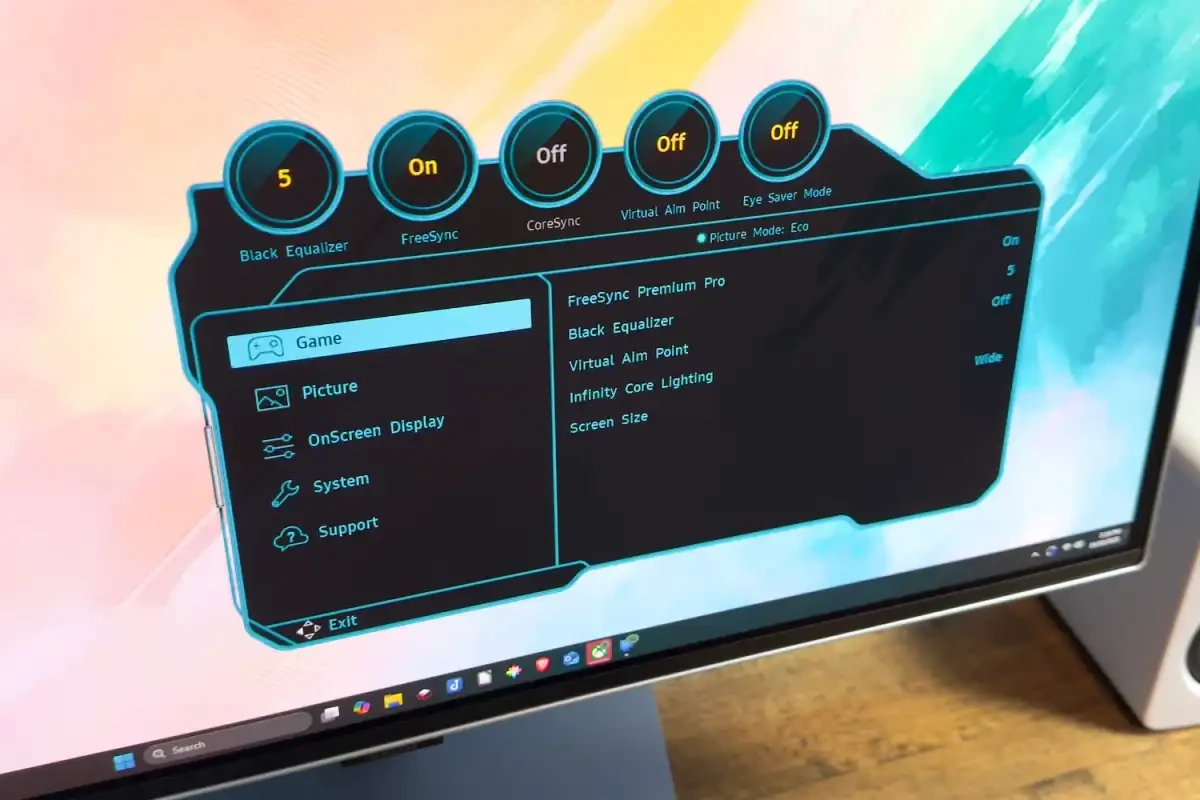
Connectivity and menu system: Areas for improvement
Connectivity is a slight disappointment. The monitor features two HDMI 2.1 ports and one DisplayPort 1.4, but lacks a USB-C port. Instead, it only offers two USB-A 3.2 Gen 1 ports. This is similar to its competitor, the Asus ROG Strix XG27AQDPG, but some other OLED monitors on the market have integrated USB-C with power capabilities, making it more convenient for laptop users.
The joystick-controlled menu system is quite easy to use, but the image quality adjustment options lack precision. There are no specific gamma or color temperature values, making fine-tuning more difficult compared to competing products. Samsung also doesn't offer a Windows application to manage features, a shortcoming compared to brands like Asus or Dell.
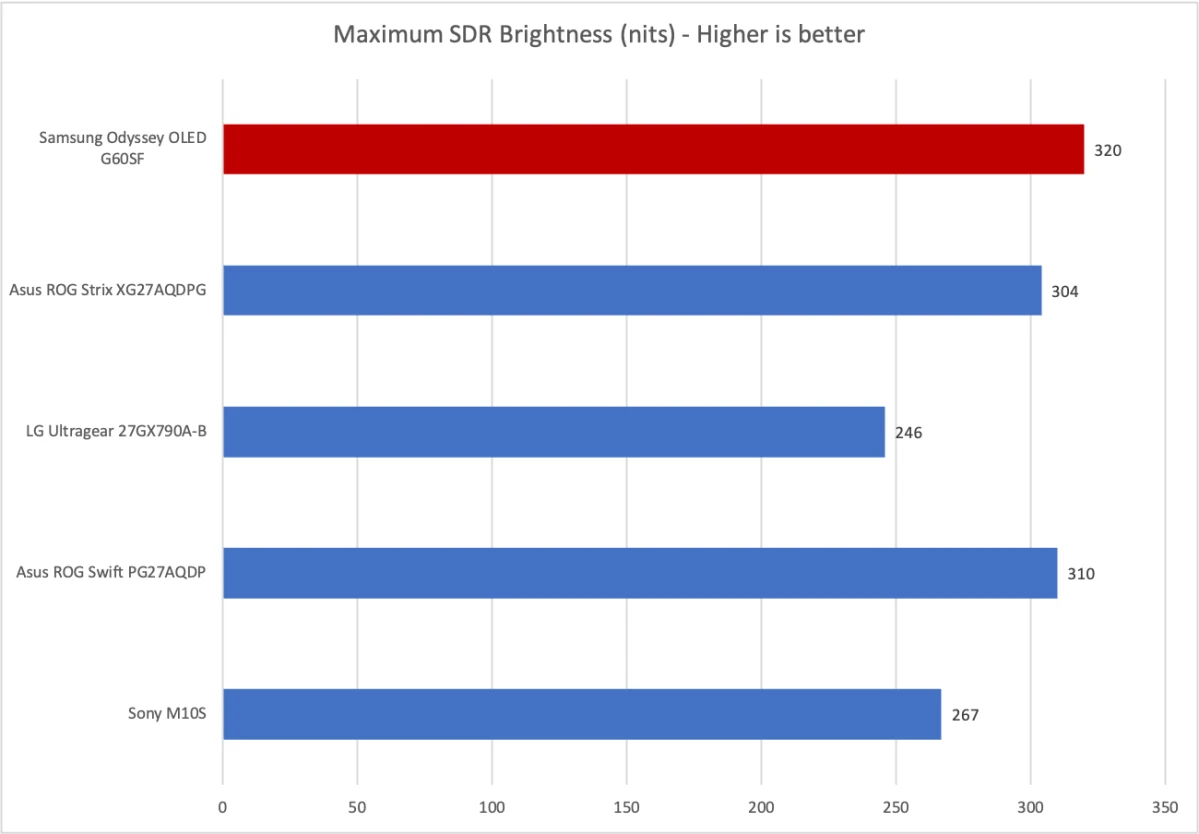
Image quality analysis
Utilizing a next-generation QD-OLED panel, the Odyssey G6 delivers excellent overall image quality, but still has some distinguishing features compared to its competitors.
SDR performance: Impressive brightness and vibrant colors.
In SDR mode, the screen reaches a maximum brightness of 320 nits, an impressive figure for OLED technology, ensuring good visibility in bright environments. The anti-glare matte coating is a major advantage, effectively minimizing reflections although it may slightly reduce perceived contrast compared to a glossy screen.
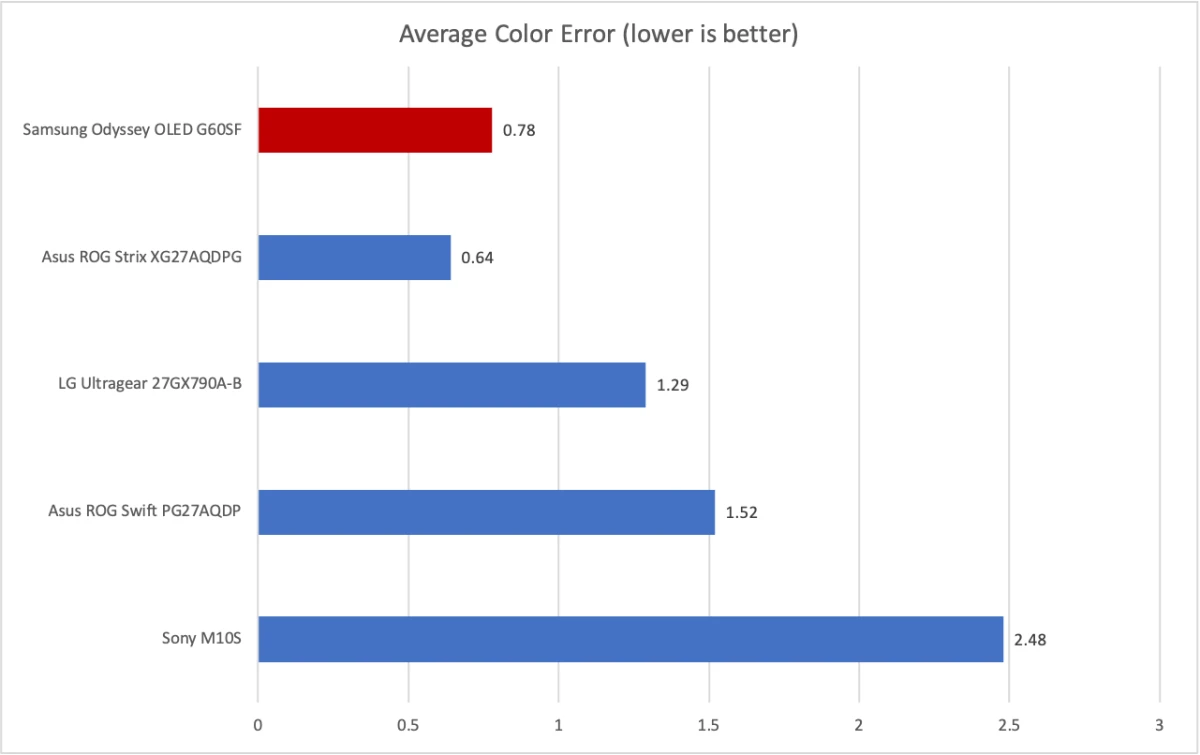
In terms of color, the G6 covers 100% sRGB, 98% DCI-P3, and 95% AdobeRGB, delivering vibrant and vivid images. Color accuracy is also very high. However, the default gamma is slightly off at 2.3 and the color temperature is a bit warm (6200K), and fine-tuning it is quite difficult due to menu limitations.
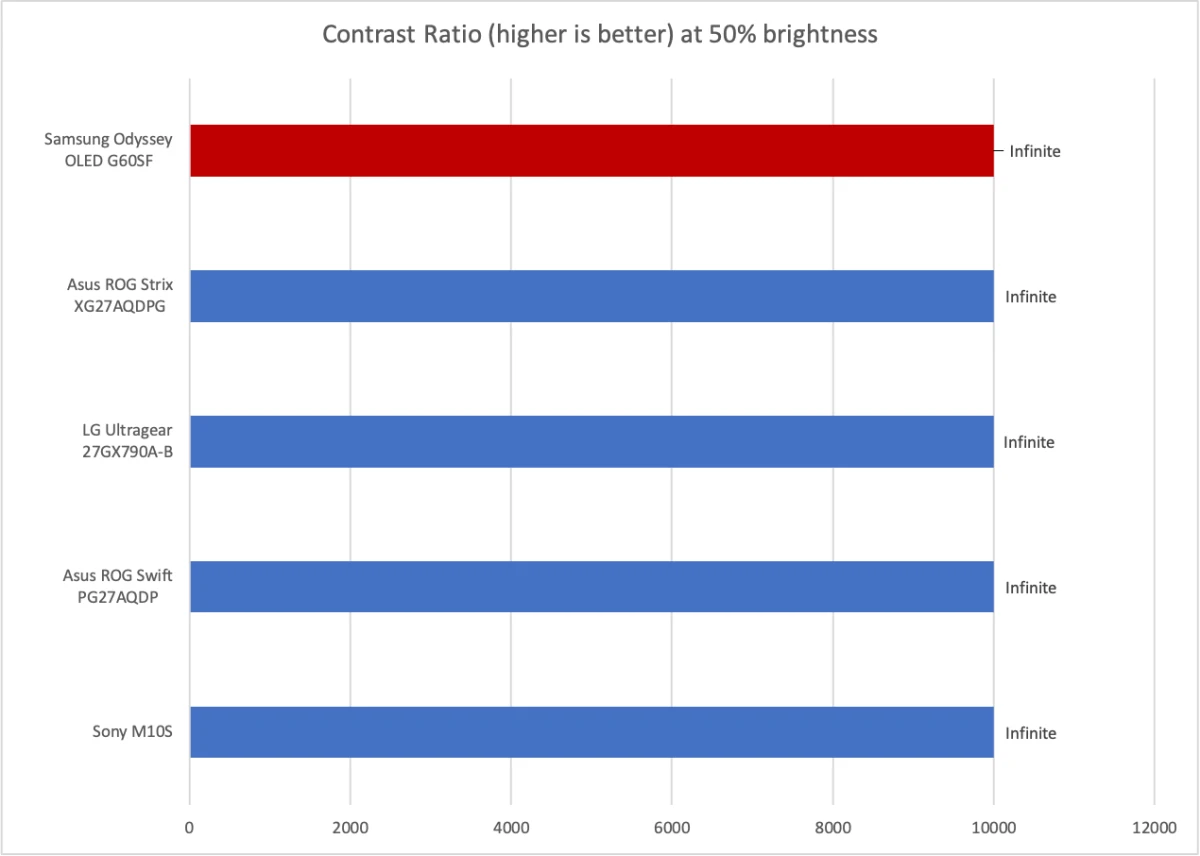
HDR performance: Good, but not the best.
While its direct competitor, the Asus ROG Strix XG27AQDPG, can achieve HDR brightness up to 953 nits, the Odyssey G6 only recorded a maximum of 678 nits. This difference is noticeable in high-contrast movie or game scenes. Although the G6's HDR performance is still good, it's not a top choice in this segment.
Experience 500Hz motion: An advantage for eSports gamers.
This is the most valuable aspect of the Odyssey G6. The 500Hz refresh rate combined with the near-instantaneous response time of the OLED panel creates incredible motion clarity. In fast-paced games like DOTA 2, every detail, from character names to health bars, is clearly visible even while moving quickly. The monitor supports both AMD FreeSync Premium Pro and G-Sync compatibility, ensuring a smooth, tear-free experience.
However, competitor Asus adds Extreme Low Motion Blur (ELMB) technology, which improves sharpness at lower refresh rates (below 240Hz), giving a slight advantage in games that can't reach 500 FPS.
Conclusion: Choosing between features and personal preference.
The Samsung Odyssey OLED G6 is an excellent 500Hz monitor with vibrant image quality and a premium design. However, it faces a strong competitor in the Asus ROG Strix XG27AQPDG, which is superior in HDR performance and has more features.
The final decision depends on the user's priorities. If you prioritize maximum HDR performance and additional features, the Asus product might be a more sensible choice. But if you love a sophisticated, professional design and especially prefer a matte, anti-glare screen coating, the Samsung Odyssey OLED G6 remains a great and worthwhile option.