

The Vietnamese national team's two wing positions reveal weaknesses under coach Kim.
Quang Vinh and Tien Anh are the main wingers in coach Kim Sang-sik's 3-4-3 formation, but they lack dynamism and depth; the Vietnamese national team needs a plan against Laos in the 2027 Asian Cup qualifiers.
In coach Kim Sang-sik's 3-4-3 system, the wings are the gateway for both attack and defense. The Vietnamese national team currently has a core lineup with Cao Pendant Quang Vinh on the left and Truong Tien Anh on the right, but these two flanks still show limitations in terms of unpredictability and depth of backup players, requiring adjustments ahead of the 2027 Asian Cup qualifiers against Laos.
The 3-4-3 system and the crucial role of the two wingers.
With three central defenders, the right wing-backs must operate at high intensity to both stretch the opponent and protect the flanks behind them. After a year of experimenting with many players from various age groups, coach Kim Sang-sik has finalized two options: Quang Vinh on the left and Tien Anh on the right. Both meet the criteria of speed, stamina, and continuous movement.
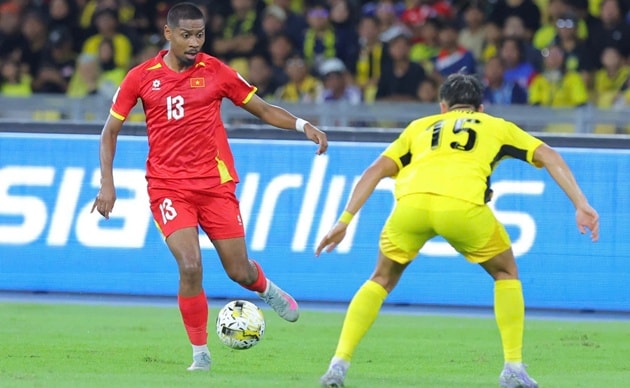
Quang Vinh: high energy, but lacks connection when the opponent defends low.
Called up in June, shortly after acquiring Vietnamese citizenship, Cao Pendant Quang Vinh demonstrated his strength in tackling, his tenacity, and his energetic playing style. On the left wing, he frequently pushed forward, combining with teammates in one-two passes to support the attack.
However, when facing opponents with low defensive lines, like in the two matches against Nepal, weaknesses emerged such as a lack of coordination among attacking players and a lack of decisiveness in the final moments. The attacking rhythm wasn't truly smooth, especially in the second half when stamina decreased, resulting in overlapping runs that didn't create enough continuous pressure.
Tien Anh: good at crossing but needs a better way to get the ball into the penalty area.
On the opposite flank, Tien Anh stands out with his physical fitness and accurate crosses, a quality he has demonstrated at both club and national team levels. However, Vietnam's playing style doesn't always effectively utilize traditional crosses, especially when the team lacks many forwards with strong aerial abilities.
When opponents close off the flanks and narrow the crossing area, Tien Anh needs more options to get the ball into the penalty area, utilizing the striker's speed with flexible combinations or runs instead of relying solely on early crosses.
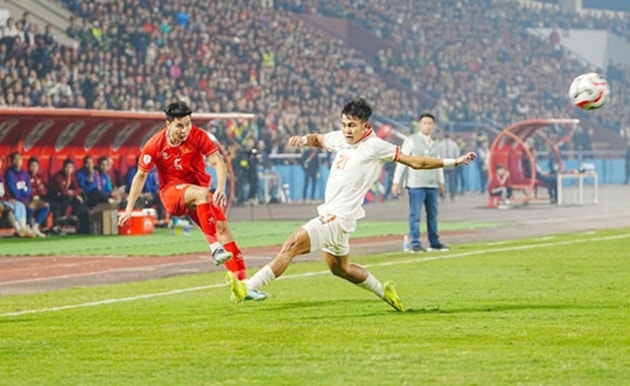
Thin squad depth: the challenge of providing backup for the wings.
Besides attacking performance, squad depth is a major concern. On the left wing, the backup option for Quang Vinh is Khuất Văn Khang. However, this young player is currently playing for the U23 team and needs more time to catch up with the pace and tactical requirements before the match against Laos in the 2027 Asian Cup qualifiers. Nguyễn Văn Vĩ used to play as a winger, but is now moved to play as an attacking midfielder, further limiting backup options.
On the right flank, the situation is even more worrying as Tien Anh has almost no natural replacement. Vu Van Thanh is absent due to injury, and Pham Xuan Manh is deployed as a center-back. Le Van Do has been called up, but the gap between performing well in the V.League and being capable of being a starter for the national team remains significant.
Personnel for the two border corridors
| Wing | Main option | Preventive | Note |
|---|---|---|---|
| Left | Cao Pendant Quang Vinh | Khuat Van Khang | Van Khang is currently playing for the U23 team; he needs more time. |
| Right | Truong Tien Anh | Le Van Do | Vu Van Thanh is injured; Pham Xuan Manh will play center back. |
Tactical impact: the "gateway" that determines the rhythm of attack and defense.
In a three-center-back formation, the two flanks are the balancing points. When the wings are effective, the Vietnamese team can both stretch the opponent in attack and cover the space behind them when they lose possession. However, currently, from integration and creativity to squad depth, there are still gaps on both flanks that need to be filled.
With a squad already formed but not yet complete, coach Kim Sang-sik needs more options to create breakthroughs against opponents with low defensive lines and ensure reliable backup. This problem becomes even more urgent as the Vietnamese national team prepares to face Laos in the 2027 Asian Cup qualifiers.