

Upgraded Kia EV6 GT: Outpaces Ferrari Purosangue
In Carwow's drag racing video, the upgraded Kia EV6 GT consistently takes the lead against the Ferrari Purosangue despite being nearly six times cheaper, thanks to its instantaneous torque and efficient traction distribution.
In Carwow's new drag racing video, the upgraded Kia EV6 GT repeatedly beat the Ferrari Purosangue on the straight. Although the Purosangue theoretically had a slight power-to-weight ratio advantage, the EV6 GT still accelerated better in every run, demonstrating a shift in the performance era – where instantaneous torque and traction management of electric vehicles make a clear difference.
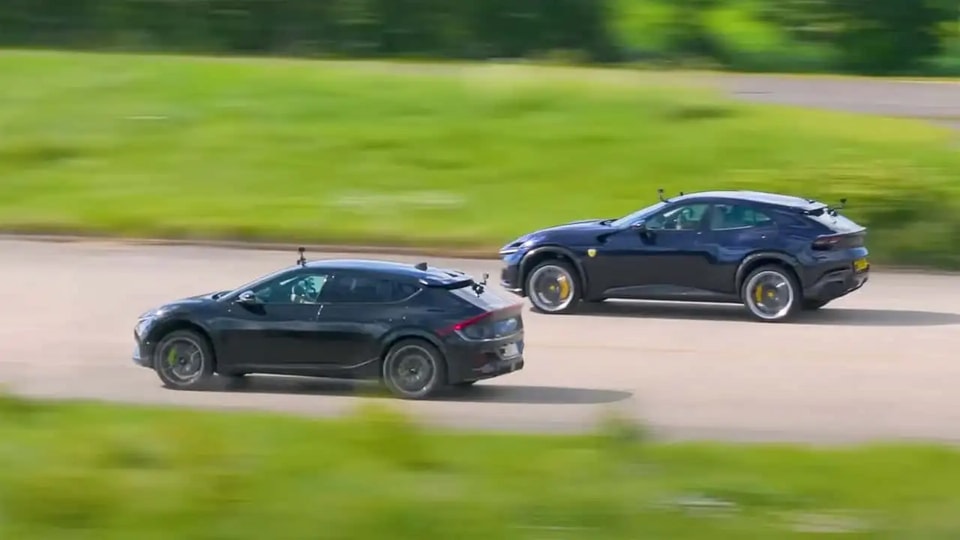
EV6 GT wins on the straight: the result repeats.
According to Carwow, in the main races, Kia consistently took the lead over Ferrari from the start and maintained that gap. Ferrari only won once when presenter Mat Watson switched the EV6 GT to a simulated internal combustion engine power delivery mode, accompanied by dummy gear changes – a setup that did not optimize the electric car's acceleration capabilities.
Dual engine power and torque advantage
The upgraded Kia EV6 GT uses a two-motor powertrain, producing 641 horsepower with a temporary turbocharger. Torque reaches 770 Nm (568 lb-ft). With launch control activated, the EV6 GT can accelerate from 0–96 km/h in 3.5 seconds; independent tests have recorded actual figures a few tenths of a second faster depending on conditions.
Meanwhile, the Ferrari Purosangue is equipped with a naturally aspirated V12 engine, producing 715 horsepower. Ferrari claims it can accelerate from 0–60 mph (96 km/h) in 3.3 seconds. Despite having more peak power, the Purosangue cannot gain a decisive advantage at the start – where the EV6 GT's instantaneous torque allows for immediate acceleration upon flooring the accelerator.
Weight and power-to-weight ratio
In terms of weight, Ferrari claims the Purosangue weighs 4,482 pounds (2,033 kg). However, Car and Driver's actual measurements put it at around 4,850 pounds (2,200 kg) – nearly the same as the Kia EV6 GT at 4,884 pounds (2,215 kg). On paper, the Purosangue has a slight advantage in terms of power-to-weight ratio. Even so, the EV6 GT still has the edge in straight-line acceleration thanks to its 60 lb-ft more torque than the Ferrari (equivalent to about 770 Nm for the Kia), along with more efficient traction distribution from a standstill.
Why is the EV6 GT making such a breakthrough?
The results in Carwow's video show that two key factors often determine performance on the drag race: instantaneous torque and how the car transmits power to the road surface. The EV6 GT makes excellent use of the initial 0–96 km/h range, surging forward quickly when the driver activates launch control. At that point, the Purosangue's advantage in peak power at high revs is not enough to compensate for the gap that Kia has created.
Notably, when the EV6 GT switched to a simulated internal combustion engine transmission mode with dummy gear shifting – which enhances the feel – the acceleration time was no longer optimal, and Ferrari won one of the runs. This reinforces the idea that the most powerful and direct configuration of the new electric powertrain is key for the EV6 GT to regain the lead in the remaining runs.
Price Gaps: A Clear Message of a New Performance Era
The Ferrari Purosangue costs over $395,000 (approximately 10 billion VND) before options. The Kia EV6 GT starts at $65,275 (approximately 1.65 billion VND). This means the Purosangue is almost six times more expensive, yet it can't keep up with the EV6 GT on the straight during main runs. This price difference illustrates a shift in the industry: in the age of electric vehicles, performance is no longer directly proportional to price as it once was. Instantaneous torque and precise traction control are allowing "affordable" models to challenge and sometimes surpass traditional supercars in acceleration.
Experimental reality and context
The EV6 GT's impressive figures (641 hp; 0–96 km/h in 3.5 seconds) are coupled with its stability across multiple runs in the Carwow video. Independent measurements also show that real-world times can be a few tenths of a second better depending on conditions, helping to explain why the EV6 GT outperforms a 715 hp V12 model like the Purosangue in drag racing.
In terms of weight, Ferrari's published and measured figures (4,482–approximately 4,850 pounds) put the Purosangue on par with the EV6 GT (4,884 pounds). However, the difference in torque and how each powertrain delivered power over short distances resulted in Kia winning most of the runs.
Main specifications table by source
| Category | Kia EV6 GT (upgraded) | Ferrari Purosangue |
|---|---|---|
| Power | 641 horsepower | 715 horsepower |
| Torque | 770 Nm (568 lb-ft) | Not specified |
| 0–96 km/h | 3.5 seconds (with launch control); in reality, it can be a few tenths faster. | 3.3 seconds (0–60 mph) |
| Weight | 4,884 pounds (2,215 kg) | 4,482 pounds (2,033 kg; stated) / approximately 4,850 pounds (2,200 kg; Car and Driver) |
| Reference price | 65,275 USD (approximately 1.65 billion VND) | >395,000 USD (approximately 10 billion VND; before options) |
Conclude
The results from Carwow's video are typical of the current performance landscape: electric cars like the Kia EV6 GT, despite their significantly lower price, can outperform high-powered supercars like the Ferrari Purosangue in straight-line acceleration. The difference lies in instantaneous torque, power delivery, and the optimal configuration of the electric powertrain at launch. This is clear evidence of a shift over the past decade – where high performance is no longer the privilege of expensive cars.