

Analysis of China's YJ-17/19/20 hypersonic missile.
China has unveiled the YJ-15, YJ-17, YJ-19, and YJ-20; three hypersonic models using waverider, bisonic, and scramjet designs, deployable from warships and potentially from submarines.
China simultaneously unveiled four YJ-series anti-ship missiles (YJ-15, YJ-17, YJ-19, YJ-20) for the first time during a September parade. According to state media, this is a new generation capable of deployment from warships, bombers, and submarines. The YJ-17, YJ-19, and YJ-20 are considered hypersonic, reflecting different aerodynamic approaches and increasing the challenge for enemy defense systems. The possibility of integration for submarines, if confirmed, would significantly expand their operational range across the Western Pacific.
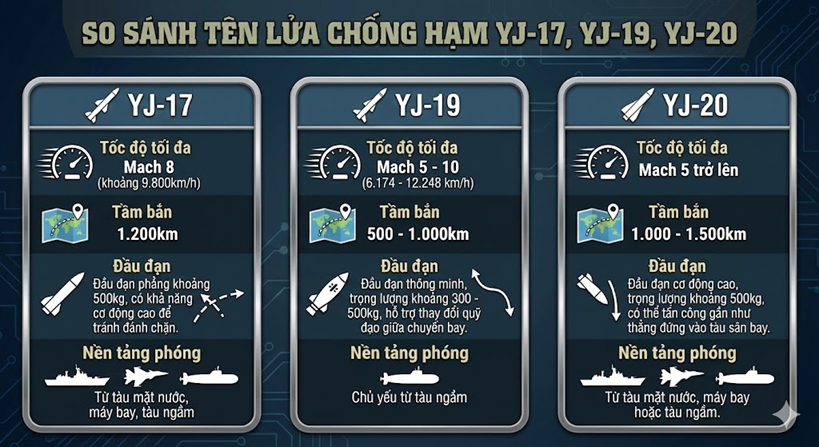
Overview
According to Chinese military observers, the new YJ series demonstrates a more aerodynamic approach to hypersonic flight technology. State media describes it as a “new generation of anti-ship missiles.” Of the four models, the YJ-17, YJ-19, and YJ-20 are considered hypersonic, capable of maneuvering at very high speeds, making them difficult to detect, track, and intercept.
Speeds above Mach 5 – equivalent to approximately 6,174 km/h – are considered hypersonic. Chinese analysts emphasize that the danger lies not only in the speed itself, but also in the maneuverability at that speed, especially during the mid- and final phases of flight.
Technical analysis
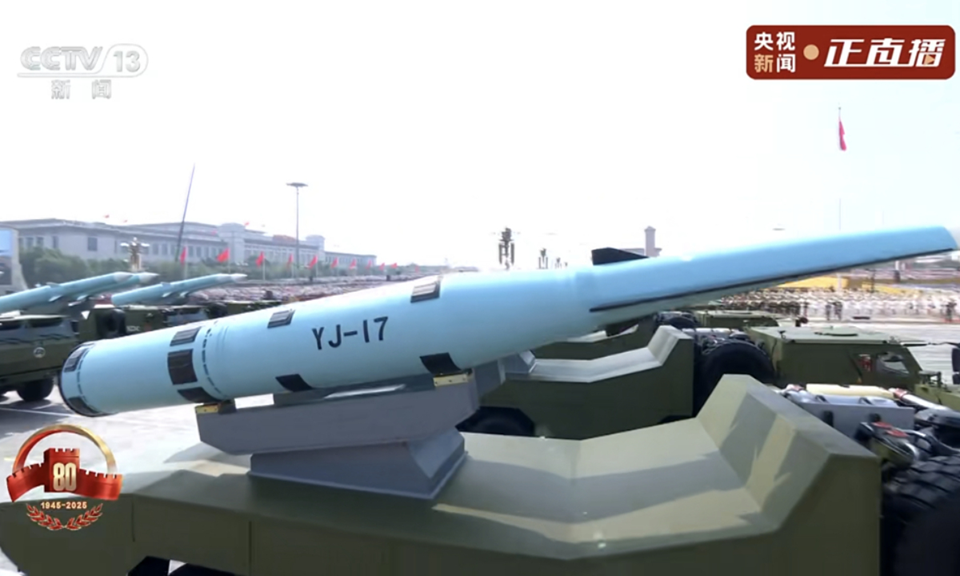
YJ-17: Boost-glide, waverider, highly maneuverable.
According to China Media Group, the YJ-17 operates in a “boost-glide” manner: the missile is propelled upwards by its engine before transitioning to a glide in the atmosphere. The “waverider” design utilizes shock waves to generate lift, providing stability at high speeds. The flattened, triangular nose cone allows for changes in direction along both horizontal and vertical axes, making the trajectory unpredictable and reducing the probability of interception.
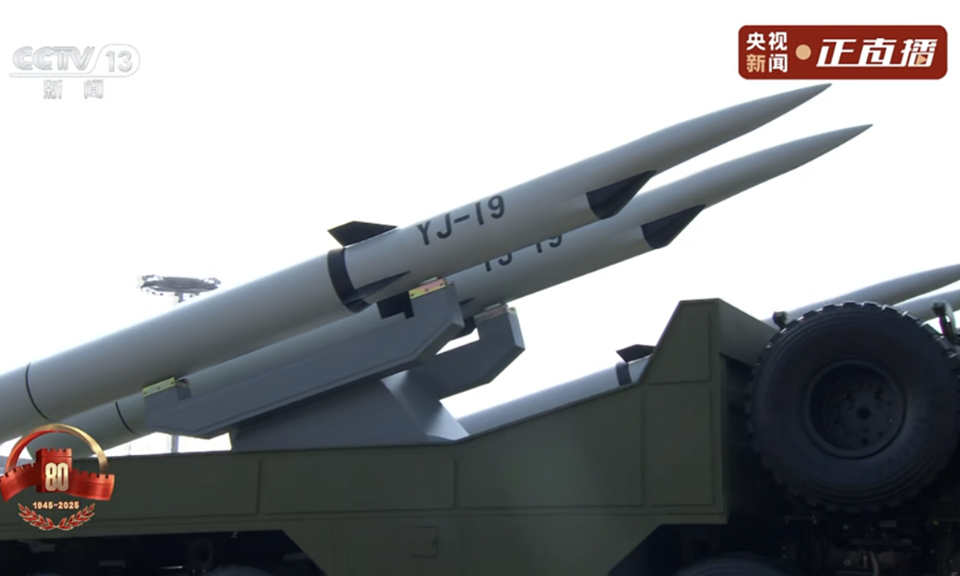
YJ-19: Air-breathing, belly air intake, hypersonic sustain.
The YJ-19 has air intakes on the underside of the fuselage, suggesting the use of an "air-breathing" jet engine. Chinese experts speculate this is a scramjet configuration, allowing for sustained thrust and maintaining supersonic speeds over long distances. Combined with its "waverider" aerodynamic design, the YJ-19 has the potential for long-range flight and high maneuverability during its flight.
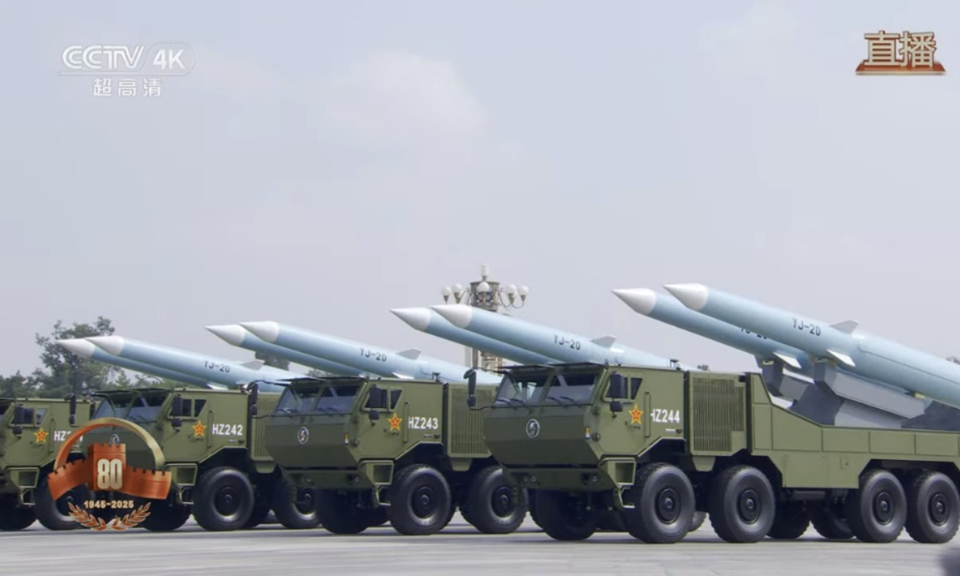
YJ-20: Biconic body, large dip angle in the final phase.
The YJ-20 utilizes a bisonic body structure, creating a high-speed airflow that facilitates controlled gliding in the atmosphere. Experts speculate that this mechanism is similar to some designs in the DF-26D ballistic missile system. As the largest model in the series, the YJ-20 is believed to be capable of switching to a near-vertical attack in the final phase, using aerodynamic control surfaces to adjust its impact point, aiming to penetrate defenses, including carrier strike groups.
Summary of features (based on publicly available sources)
| Sample | Aerodynamic/Engine Characteristics | Flight style/outstanding ability | Note |
|---|---|---|---|
| YJ-15 | Details have not yet been released. | Part of the "new generation anti-ship fleet". | Introducing at the same time |
| YJ-17 | Waverider; Boost-Glide | Hovering in the atmosphere; horizontal/vertical maneuvering | The trajectory is difficult to predict. |
| YJ-19 | Air-breathing (presumably a scramjet) | Maintaining hypersonic range over long distances | belly air intake |
| YJ-20 | Biconical body | High dip in the final phase, aerodynamic control. | The largest model in this launch. |
Launch platform and combat method
According to Chinese state media, the new missiles can be fitted to Type 052D and Type 055 destroyers and H-6 bombers. Integration with submarines is considered feasible by analysts, given that China's nuclear strike platform already uses cruise missiles; a hypersonic version could share the same launch platform with appropriate adjustments.
Thanks to multi-configuration (boost-glide and air-breathing), strikes can be coordinated along multiple axes, overwhelming the processing power of enemy radar and defense systems. If deployed simultaneously from surface ships, aircraft, and submarines, defensive firepower must be dispersed to support "anti-access/area denial" (A2/AD) objectives in key directions.
Impact and reaction
China's rapidly developing hypersonic missile arsenal is causing concern among the U.S. and its allies due to its short warning time and unpredictable trajectories. China maintains that the program is for defensive and deterrent purposes. Internationally, many countries, including the U.S., Russia, and India, are pursuing their own programs, raising concerns about hypersonic arms competition.
Technical notes
A key highlight is the broad technological approach: from waveriders and twin-cone hulls to air-breathing/scramjet engines (as speculated), suggesting an effort to find the optimal configuration for each launch platform. If submarine-launched capability is confirmed, China's maritime operational range could be significantly expanded thanks to this stealthy and multi-directional approach.