

TF Scorpion Strike: US establishes LUCAS UAV squadron in the Middle East
CENTCOM established Scorpion Strike, the first unit to operate suicide drones in the Middle East, using LUCAS, developed from the Shahed-136; with a range of over 800 km and a cost of $35,000.
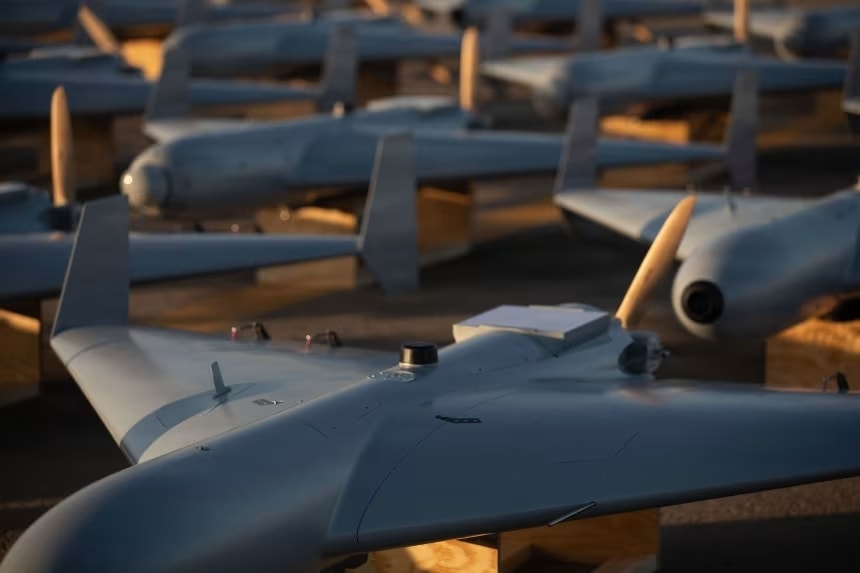
The U.S. Central Command (CENTCOM) announced the establishment of Task Force Scorpion Strike (TFSS), the first unit dedicated to operating suicide drones in the Middle East. The unit will utilize the LUCAS system, developed using reverse engineering technology from the captured Shahed-136 drone. This move reflects a shift in Washington's operational thinking toward prioritizing speed, quantity, and cost-effectiveness, rather than relying solely on expensive equipment.
Colonel Tim Hawkins, a CENTCOM spokesperson, emphasized: “Low cost does not mean low capability; LUCAS can provide a more flexible operational option, suited to the pace of today’s battlefield.” According to CENTCOM, on November 23, 2025, the LUCAS drone was deployed on a runway at an undisclosed base within CENTCOM’s area of operations.
Specifications and costs
CENTCOM states that LUCAS has the following characteristics:
- Range: over 800 km.
- Navigation: automatic.
- Deployment: via various launch mechanisms, suitable for field launchers and mobile ground vehicles.
- Cost: approximately $35,000 per unit; hundreds of times cheaper than the MQ-9 Reaper UAV, which costs tens of millions of dollars.
| System | Key features confirmed | Unit cost (by source) |
|---|---|---|
| LUCAS | Range >800 km; autopilot; multi-launch mechanism; suitable for swarm/saturation | ~35,000 USD/unit |
| MQ-9 Reaper | Not mentioned in the source. | Tens of millions of USD (no specific price) |
Tactics: herd mentality and cost symmetry.
LUCAS is considered suitable for saturation tactics and swarm attacks, a trend emerging in Ukraine and the Middle East. At a low cost, this system allows for a high density of firepower, forcing the enemy to disperse their sensors and air defenses, thereby eroding their defensive capabilities over time.
Analysts see the US use of inexpensive kamikaze drones as a shift in thinking: instead of using expensive weapons to intercept cheaper vehicles, Washington is symmetrically adapting its tactics, reducing cost disadvantages in a high-paced battlefield.
Operating context
Over the past two years, Iran and its proxy forces, such as Hezbollah, Houthi, and Kataib Hezbollah, have repeatedly launched drone attacks on US bases in Iraq, Syria, Jordan, and the Middle East. The drone attack on Tower 22 in Jordan nearly two years ago, which killed three US soldiers, served as a warning. According to CNN, in 2024 alone, the US intercepted more than 70 drones and numerous ballistic missiles during large-scale attacks by Iran against Israel. The Houthi forces also exerted continuous pressure on shipping lanes through the Red Sea.
In this context, deploying TFSS gives the U.S. an additional option for precision strikes against launch sites, weapons depots, or forces preparing for an attack without deploying strategic assets or special forces.
Organization - industry: from Shahed-136 to Lucas
LUCAS was developed using reverse engineering technology from a captured Shahed-136 UAV. In July 2024, US Secretary of War Pete Hegseth announced the “Drone Dominance” initiative with the goal of equipping every US Army unit with inexpensive attack UAVs within two years. LUCAS is a pioneering product under this framework, with the participation of many US defense industry companies in the reverse engineering and redesign process.
According to Caitlin Lee, Director of Technology Policy at the RAND Corporation, the availability of commercially available components is making it easier to manufacture inexpensive UAVs; the U.S. is forced to adapt to avoid falling behind in this new wave of warfare.
Impact assessment
The US deployment of a squadron of LUCAS suicide drones in the Middle East shows that Washington is adjusting its strategy towards a "low-cost, high-efficiency" approach. This move sends a deterrent message to Iran and pro-Tehran forces that the US is not only defensive but also prepared to retaliate with similar methods.
With its multi-platform launch capability and rapid deployment, LUCAS is well-suited to maintaining a military presence without significantly increasing budgets, given the U.S.'s dispersed resources between Europe and the Indo-Pacific. The proliferation of inexpensive UAVs could lead to faster and more difficult-to-control competition in the region.