

T-95 Object 195 configuration: 152 mm cannon, unmanned turret.
BMPD released 3D images of Object 195: 58 tons, 2A83 152 mm cannon and 2A72 30 mm cannon, 3-person crew in armored compartment, 1,650 horsepower engine, Afganit APS; discontinued 2008-2010.
The military blog bmpd has published a series of 3D renderings of the first prototype of the Object 195 (T-95) tank, based on leaked factory design documents that reached Western sources several years ago. The data presented indicates that the T-95 aims for a powerful firepower configuration with an unmanned turret, a 152 mm 2A83 smoothbore gun with 40 rounds of ammunition, and a 30 mm 2A72 automatic cannon; a three-person crew in an armored compartment within the hull; a 1,650 horsepower engine; and an Afganit-type active protection system. The project was developed in the late 1990s and early 2000s in Nizhny Tagil but was halted by the Russian Ministry of Defense between 2008 and 2010 due to high costs and technical risks; many improvements were subsequently transferred to the T-14 Armata.
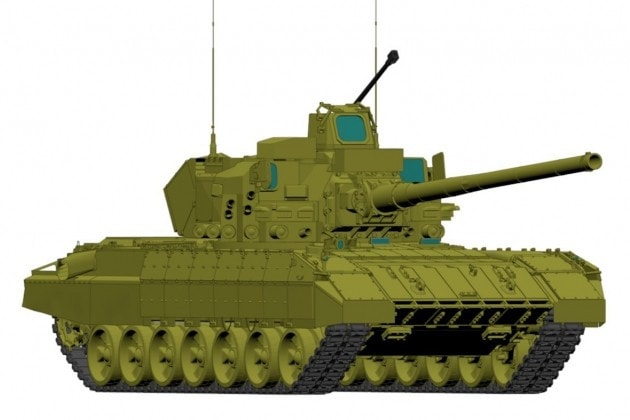
Technical specifications have been released.
| Category | Information |
|---|---|
| Mass | 58 tons |
| Turret | Unmanned |
| Main artillery | 2A83 152 mm smoothbore, 40 rounds |
| Secondary weapons | 2A72 30 mm automatic cannon |
| Crew | Three people, positioned in an armored compartment within the vehicle's body. |
| Engine | 1,650 horsepower |
| Defense | Afghani-style active defense system |
| Development phase | Late 1990s – early 2000s |
| Project status | Stopped 2008–2010 |
| Source | bmpd (3D rendering based on leaked design) |
Technical analysis
Unmanned turret and armored crew compartment
The T-95 aimed to separate the crew from the combat compartment by moving the entire three-person crew down into an armored compartment in the hull, while converting the turret to an unmanned configuration. This arrangement aimed to reduce the risk of casualties if the turret was penetrated, while also optimizing the turret volume for ammunition loading and sensors. However, the large turret size is still present in the re-creation and is noted by the authors as a weakness against top-down fire aimed at the vehicle's roof.
Firepower: 2A83 152 mm and 2A72 30 mm
The 152 mm 2A83 smoothbore cannon with a 40-round magazine demonstrates a breakthrough in firepower compared to more common calibers. The addition of a 30 mm 2A72 automatic cannon expands the target range and firing options. However, alongside its lethality advantage, the 152 mm caliber entails bulky ammunition and high storage requirements, coupled with limited supply, posing a challenge in balancing firepower and resupply.
The 1,650 horsepower engine and the maneuverability challenge.
Weighing in at 58 tons, the 1,650-horsepower engine, on paper, partially offsets the weight burden. However, increased weight always brings challenges in operational mobility (crossing bridges, navigating weak roads, transportation) and maintenance. This is one of the technical risk factors – a cost factor – that led to the project being halted.
Afghan-style proactive defense
The Afganit-type active protection system, as published, reflects an approach to proactive protection against anti-tank guided missiles (ATGM). However, the inherently heavy configuration with its large turret and roof, which makes it vulnerable to attack, was emphasized by the authors of the re-creation even before the prevalence of top-down projectiles and suicide drones.
Tactical aspect
Based on what is stated, the T-95 is an attempt to push the barrage of firepower and protection using a combination of: an unmanned turret, a 152 mm cannon, an armored crew compartment, and active protection. Tactically, this configuration is suitable for fire-breaking missions and direct fire engagements with fortified targets. Conversely, the large turret surface area and the vulnerable top make top-down attack crucial for cover, coordination between different branches of the military, and combat in sheltered terrain. This explains the perceived impasse of the "classic super-heavy tank" concept mentioned in the source.
Program impact and technology transfer
Although halted during the 2008–2010 period due to cost and technical risks, the source emphasizes that many improvements of Object 195 were later applied to the T-14 Armata. Thus, the T-95 served as a technological springboard: testing the placement of crews in armored compartments, unmanned turrets, and the integration of active protection – directions for the modernization of main battle tanks.
Level of reliability and information limitations
The images and configurations in this article are based on a 3D rendering by an artist from a leaked factory design album, published by bmpd. This is not official material from the manufacturer; therefore, the article only uses the parameters stated in the source and does not make any further inferences beyond this scope.