

Velikiye Luki submarine and Project 677 Lada capabilities
The flag-raising ceremony for the diesel-electric submarine Velikiye Luki took place on December 16, 2025. TASS reported that Project 677 Lada is an improved version of Project 877, prioritizing noise reduction, high automation, and the ability to integrate anaerobic systems; its main weapon is the Kalibr.
On December 16, 2025, the Russian Navy flag-raising ceremony took place aboard the new generation large diesel-electric submarine Velikiye Luki, of the Lada class, Project 677. The vessel was built for the Baltic Fleet at the Admiralty Shipyard (part of the United Shipbuilding Corporation of Russia – USC) in St. Petersburg; TASS has compiled key information about this class of submarine.
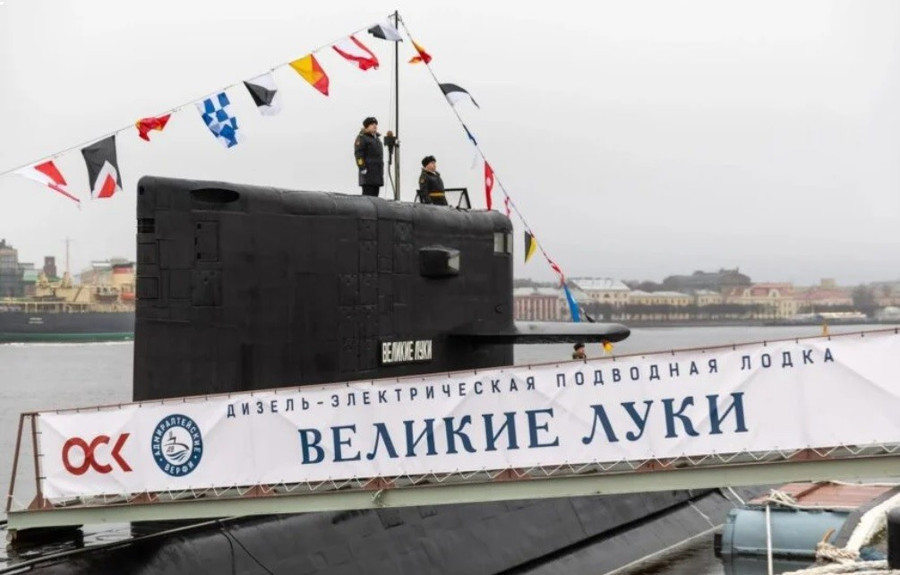
Overview: Project 677 Lada in the structure of the Russian submarine force.
According to TASS, the Project 677 Lada diesel-electric submarine is an improved version of the Project 877 Paltus (or Varshavyanka). The stated design objective is to completely replace Project 877, with a primary requirement of minimizing noise.
The project was developed by the Rubin Central Design Bureau for Marine Engineering (St. Petersburg) from the 1990s under the supervision of Chief Engineer Yury Kormilitsyn. The Admiralty Shipyard was the manufacturer of all submarines under this project.
Technical analysis: key aspects of design and systems.
Hull and orientation for noise reduction
TASS noted that Project 677 has a single-hull structure. Compared to the Lada Project 877 submarines, Project 677 submarines are described as having lower noise levels and a higher degree of automation. These are factors that directly impact survivability when operating in an anti-submarine environment, where the advantage usually lies with the first to detect.
Displacement when floating and speed when submerged
Sources indicate that the surface displacement of Project 677 is nearly 1.3 times lower than that of Project 877, while its submerged speed is also faster. For diesel-electric submarines, these two parameters are often linked to overall design optimization, potentially impacting performance and maneuverability during patrol or target approach missions.
Power source: diesel-electric and the possibility of integrating anaerobic systems.
The primary propulsion system for Project 677 is diesel-electric. TASS also noted that this class of submarine could be equipped with an anaerobic (airless) propulsion system with a chemical generator to increase endurance and range; the Rubin Central Design Bureau is developing this system.
The information above indicates an open direction for upgrades, but at the level of "potentially available" and "under development," so it needs to be distinguished from the confirmed configurations currently in operation on each specific ship.
Weapon: Kalibr cruise missile system
According to TASS, the main weapon is the Kalibr cruise missile system, capable of launching multiple missiles simultaneously at sea. Within the mission framework of a diesel-electric submarine, this salvo launch capability increases the probability of penetrating defenses and expands firepower options from a stealthy position, depending on combat conditions and target designations.
Export variant
According to TASS, export versions of the Project 677 Amur-950 and Amur-1650 have been developed. However, the source did not provide detailed specifications or configuration differences, so an in-depth assessment of compatibility or system modifications needs to be based on other official technical documents.
Summary Table: Project 677 Lada vs. Project 877, according to TASS
| Criteria | Project 677 Lada | Project 877 Paltus/Varshavyanka |
|---|---|---|
| Role in design | An improved version, aimed at a complete replacement. | Predecessor platform |
| Noise level | Lower | Higher (relatively) |
| Automation | Higher | Lower (relatively) |
| Displacement when floating | A reduction of nearly 1.3 times. | benchmark |
| Speed while diving | Faster | Slower (relatively) |
| Motivation | Diesel-electric; anaerobic integration is possible. | Not mentioned in the source. |
| Main weapon | Kalibr; capable of launching multiple missiles simultaneously. | Not mentioned in the source. |
Tactical perspective: mission type and operating environment
TASS describes Project 677 as being designed to destroy enemy surface ships, patrol, reconnaissance, protect sea lanes, lay mines, and perform other tasks. This class of ship can operate in all weather conditions, in shallow and deep waters across the world's oceans, except for areas of perpetual ice.
In terms of force deployment, the aforementioned tasks are consistent with the typical roles of diesel-electric submarines: stealth operations, lurking in target areas, controlling shipping lanes, and creating deterrent pressure through underwater attack capabilities. Improvements in noise levels and automation (as TASS mentioned) could help increase operational efficiency and reduce crew load, especially during extended patrols.
Construction and commissioning process: the ships have been described.
TASS lists a series of ships belonging to the project with key milestones:
- Saint Petersburg(hull number 01570): Construction began on December 26, 1997, and it was launched on October 28, 2004. Tests in the late 2000s revealed problems with the main propulsion system, but the submarine was still commissioned into the Northern Fleet on May 8, 2010. In November 2011, a decision was made to reconfigure and complete the submarines according to the revised design (upgrading the control system, electric propulsion, and navigation). On February 5, 2024, it was announced that the submarine would be decommissioned and dismantled; a source close to the Navy told TASS that the modernization was “very expensive; a new submarine could be built for the same amount of money.”
- Kronshtadt(Ship number 01571): Construction commenced July 28, 2005; temporarily suspended in 2009, resumed July 9, 2013 after reviewing the results of the first ship's trials; launched September 20, 2018; commissioned into the Northern Fleet January 31, 2024.
- Velikiye Luki(Number 01572): Construction began on November 10, 2006, under the name Sevastopol; temporarily halted in 2009; relaunched on March 19, 2015, under the name Velikiye Luki; commissioned on December 23, 2022; flag-raising ceremony on December 16, 2025.
- Vollogda(Project number 01573): Construction commenced on June 12, 2022.
- Yaroslavl(Project number 01574): Construction commenced on June 12, 2022.
Background of the Baltic Fleet according to source information
According to the quoted content, among the Russian Navy fleets, the Baltic Fleet is described as having the most developed training infrastructure, including military science and training centers in St. Petersburg and Kaliningrad. The flagship mentioned is the Sovremenny-class destroyer Nastoichivy, Project 956.
The Russian Ministry of Defense also announced that since 2017, the Baltic Fleet's support units have been supplied with several new support ships and submarines; the air force has received Su-30SM multirole fighter jets and upgraded Ka-29 helicopters. The fleet participated in activities such as joint exercises with the Chinese Navy "Joint Sea-2017", the Russia-Belarus joint exercises "Zapad-2017", and "many other large-scale exercises", and also carried out "several" special missions in the Mediterranean.
In this context, the completion of the flag-raising ceremony for Velikiye Luki adds another Project 677 diesel-electric submarine platform to the force, with features that TASS emphasizes as lower noise levels, higher automation, and the potential for future propulsion upgrades, along with the Kalibr system as its primary weapon.