

Ukrainian 400 km/h interceptor drone confronts Geran UAV.
Ukraine has introduced an interceptor drone powered by a Motor-G engine, capable of reaching speeds of 400 km/h to track Geran-3 UAVs traveling at approximately 370 km/h, at a cost of under $6,000 per unit, with a view to mass production.
Ukraine claims to have developed a domestically produced interceptor drone capable of speeds up to 400 km/h, aimed at countering Russia's Geran suicide drones, amid Moscow's deployment of the Geran-3 variant, which uses jet engines and has a speed of approximately 370 km/h.
High-speed interceptor drones to counter Geran UAVs.
In a statement on December 15, Ukrainian Minister of Digital Transformation Mykhailo Fedorov said that the new interceptor drone, using an engine manufactured by Motor-G and a member of the Brave1 defense platform, can reach speeds of up to 400 km/h. This is a direct attempt to catch up with and surpass the speed of the Geran UAVs used by Russia.
Fedorov emphasized that manufacturing such engines domestically in Ukraine was considered almost impossible two years ago. He stated that an increasing number of drones in Ukraine's arsenal are using domestically produced engines.
Industrial platform: Motor-G and the Brave1 initiative
Brave1 claims that Motor-G is currently shipping around 100,000 drone motors per month. This figure indicates a significant production scale, allowing Ukraine to pursue a strategy of deploying interceptor drones in large numbers.
Brave1 is a developer established by the Ukrainian government, tasked with promoting domestic defense projects, with drones being a key focus. Localizing the motor helps reduce dependence on external suppliers and shortens the time from research to deployment on the battlefield.
Specifications and costs of interceptor drones
Ukraine's new interceptor drones stand out for two factors: high speed despite using only propeller engines and relatively low cost. According to published information, these weapons typically cost less than $6,000 each.
Unlike many high-speed UAVs that use jet engines or solid-fuel rockets, Ukraine's interceptor drones still use propeller engines but achieve very high speeds. Earlier this year, the volunteer organization Wild Hornets introduced an interceptor drone model with a speed of approximately 315 km/h, many times higher than the typical 60 km/h of first-person drones.
Speed and engine comparison table
| System | Engine type | Publication speed | Note |
|---|---|---|---|
| Ukraine's new interceptor drone | Propeller, Motor-G motor | 400 km/h | Used to intercept Geran UAVs. |
| Wild Hornets interceptor drone | Fan | 315 km/h | The model was introduced in the middle of the year. |
| Conventional first-person drone | Fan | 60 km/h | Widely used for close-range attack missions. |
| Geran-2 | Piston engine | 185–290 km/h | Suicide drones are widely used by Russia. |
| Geran-3 | Jet engine | Approximately 370 km/h | The high-speed variant has been in production since the beginning of the year. |
The above figures indicate that Ukraine is attempting to bring its interceptor drones to speeds even higher than the Geran-3, in order to gain the necessary kinetic advantage in tracking and destroying targets.
Changes in tactics for intercepting suicide drones.
Since the beginning of the year, Russia's deployment of the Geran-3, with a speed of approximately 370 km/h, has rendered Ukraine's previous interceptor drones unable to keep up with their targets. This poses a significant challenge to low-altitude air defenses based on UAVs.
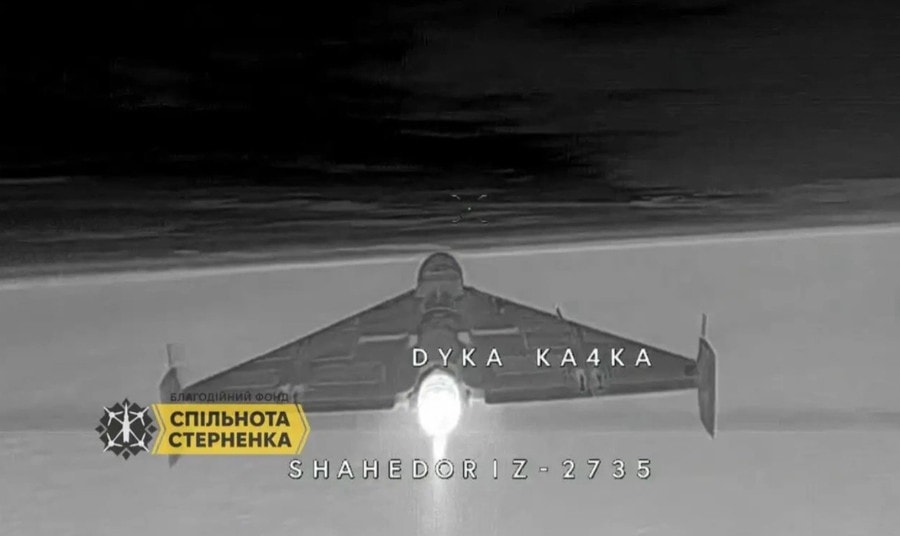
With a speed of 400 km/h, the new interceptor drone is theoretically capable of tracking and approaching the Geran-3 UAV in low-speed air combat, especially with precise guidance. The released images show the Ukrainian drone approaching and attacking the Russian jet UAV from behind, reflecting the feasibility of this high-speed UAV interception option.
The use of interceptor drones also adds an extra layer of defense to traditional air defense systems. Drones can be controlled flexibly, prioritizing targets with unpredictable trajectories or appearing in clusters, while the cost per drone remains under $6,000.
Quantity advantage over cost
The price of under $6,000 per interceptor drone allows Ukraine to pursue a large-scale deployment approach when needed. Given Russia's frequent use of multiple Geran UAVs simultaneously to saturate its air defenses, the ability to deploy large numbers of cheaper interceptor drones is a crucial tactical and economic advantage.
Combined with Motor-G's production capacity of approximately 100,000 motors per month, Ukraine has the industrial base to maintain and expand its interceptor drone force if supplies and components are secured.
Technological drivers from conflict
According to assessments from Ukraine itself, the current conflict is driving the rapid development of the country's defense industry. Civilian drones are being upgraded to become high-speed interceptor vehicles, reflecting a trend of utilizing existing platforms for military purposes.
Besides regular units, volunteer organizations also play a significant role. Wild Hornets is an example, having introduced a 315 km/h interceptor drone. Serhii Sternenko, the leader of a volunteer organization that donates drones to the Ukrainian military, released images in November showing a Ukrainian interceptor drone successfully destroying a Russian jet drone from behind.
These facts suggest that Ukraine is seeking to overcome the speed limitations of its previous interceptor drones, gradually shifting towards a class of air defense UAVs with better tracking capabilities against targets such as the Geran-3. In the confrontation between suicide drones and interceptor drones, speed, cost, and mass production capabilities are becoming key parameters shaping battlefield tactics.