

Allag-E: EDGE's high-speed drone interceptor.
The Allag-E interceptor aircraft, developed by EDGE, has a speed of over 250 km/h, carries a 1.7 kg warhead, and is designed to destroy small, high-speed UAVs at altitudes up to 3,000 m.
Allag-E is a new drone interceptor system developed by EDGE, optimized for modern warfare where drones are prevalent. With a flight speed exceeding 250 km/h, the ability to intercept UAVs flying up to 200 km/h, and a 1.7 kg fragmentation warhead, Allag-E is expected to enhance low-altitude defense capabilities against the threat from UAVs.
Overview of the Allag-E system
EDGE, a defense technology company based in the United Arab Emirates, unveiled the Allag-E at the Dubai Airshow 2025. This is an electronic interceptor aircraft specifically designed to counter high-speed drone threats in a modern combat environment.
According to descriptions, Allag-E is likened to a "predating eagle," capable of swooping down on and destroying smaller, faster drones. This system targets reconnaissance and attack drones operating at low altitudes, a class that is increasingly prevalent on the battlefield.
Key design and specifications
The Allag-E is compact, with a wingspan of approximately 700 mm and a fuselage length of 900 mm. The airframe utilizes a cylindrical composite frame, combined with a delta-shaped main wing and smaller apical wings, providing a foundation for high maneuverability and stability during low-altitude maneuvers.
The system utilizes two electric fans symmetrically positioned above and below the tail section. This configuration allows for balanced thrust distribution, supporting precise control when sudden changes in direction are needed to approach, track, and attack agile UAV targets.
The Allag-E has a maximum takeoff weight of approximately 8.5 kg, light enough for flexible deployment and suitable for low-altitude interception missions where rapid response and good acceleration are required.
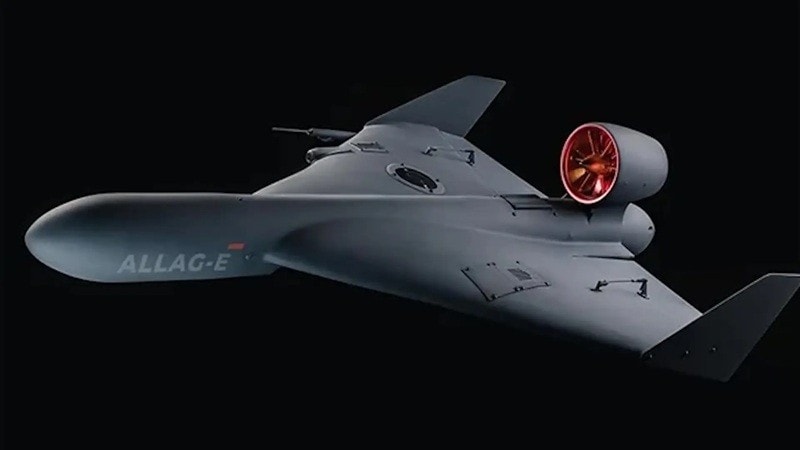
In terms of performance, the Allag-E achieves a flight speed exceeding 250 km/h. At this speed, the aircraft can pursue and destroy drones flying at speeds up to 200 km/h, operating at a maximum altitude of approximately 3,000 m. This is a common altitude range for many small UAVs on the battlefield.
The Allag-E's primary weapon is a 1.7 kg warhead, a disc-shaped fragmentation device, combined with a proximity sensor. This arrangement allows for damage even without direct impact, simply by approaching the target. The warhead's lethal radius exceeds 5 m, with accuracy within 10 m, increasing the probability of destroying small and maneuverable UAVs.
| Parameter | Value |
|---|---|
| Wingspan | 700 mm |
| Body length | 900 mm |
| Maximum takeoff weight | 8.5 kg |
| Flight speed | > 250 km/h |
| Target UAV speed | Up to 200 km/h |
| Maximum operating altitude | 3,000 m |
| Warhead weight | 1.7 kg |
| radius of destruction | > 5 m |
| Accuracy | Within a 10-meter radius |
Methods for destroying UAVs and their tactical roles.
With its compact design, high speed, and proximity-sensing fragmentation warhead, the Allag-E is optimized for "dive-detonate-slice" interception missions against small UAVs. Even without a direct hit, the disc-shaped fragments can still cause significant damage to the target's fuselage, wings, or sensor systems within a radius of over 5 meters.
This system is designed to counter a wide variety of drones, from reconnaissance aircraft to attack UAVs. With its high maneuverability and speed, Allag-E is suitable for operation in combat zones, especially at low altitudes – where drones are densely present and pose significant challenges to ground forces.
According to EDGE, Allag-E is a new advancement in the anti-drone arsenal, reflecting the shift in modern warfare as drones become increasingly prevalent and play a growing role in reconnaissance and attack.
Modern drone warfare and the need for specialized interceptor systems.
In 2024, several Ukrainian military officials admitted that "drones have killed more soldiers on both sides than any other weapon." This admission highlights the level of danger posed by UAVs in today's combat environment, especially on the front lines and near the ground.
Therefore, military forces around the world are rapidly developing new defense solutions. Allag-E is an example of this trend towards building specialized interceptor systems, focusing on quickly detecting, engaging, and eliminating UAVs before they can cause damage to ground forces or infrastructure.
The context of the US strengthening its defenses against UAVs.
The emergence of Allag-E comes as many countries, including the US, are stepping up training and deploying new air defense systems to counter drones. The US Marine Corps recently announced it will test a prototype of a handheld anti-drone system on the battlefield, while also emphasizing the need for air defense training for ground troops.
At a Marine Corps modernization workshop held as part of the U.S. Navy's Sea, Air, and Space Expo, Lieutenant General Benjamin Watson, Commander of the Marine Corps Training and Education Department, stated: "We may never again be able to fight with the same air superiority we once did."
This statement reflects the reality that the proliferation of UAVs is shifting the balance of power on the battlefield. New interceptor systems, including platforms like Allag-E, are expected to become crucial tools for ground forces to mitigate the threat posed by drones.
The significance of Allag-E in the anti-drone trend.
With its electric design, small size, high speed, and proximity-sensing fragmentation warhead, Allag-E demonstrates a trend towards focusing on flexible UAV interception solutions that operate effectively at low altitudes. According to EDGE, this system aims to fill a gap that traditional air defense solutions struggle to cover in the context of increasingly diverse drones.
Allag-E can therefore be seen as part of a broader picture of low-altitude air defense and anti-UAV modernization, where military forces must adapt quickly to an operational environment where air superiority is no longer a given.