

Analyzing the offensive capabilities of the Russian Oreshnik missile.
The controversy surrounding the scenario of the Oreshnik missile from Belarus striking Kyiv within 1 minute and 51 seconds reveals numerous technical inaccuracies, from its ballistic trajectory to its minimum range of approximately 700km and its practical deployment feasibility.
In recent weeks, scenarios have appeared on social media and some Ukrainian media outlets suggesting that if launched from Belarusian territory, Russia's Oreshnik medium-range ballistic missile could strike Kyiv in approximately 1 minute and 51 seconds. Similar estimates have also been made for Lviv, Warsaw (Poland), and Vilnius (Lithuania). However, compared with the operating principles of ballistic missiles and available technical information, these figures do not accurately reflect the actual combat capabilities of the Oreshnik.
Controversy surrounding the script for "111 seconds to Kyiv"
The figure of "1 minute 51 seconds," cited repeatedly, is primarily based on a simple calculation: dividing the straight-line distance from Belarus to Kyiv by the Oreshnik's supposed maximum speed, approximately Mach 10 (equivalent to about 12,300 km/h). This calculation assumes the missile flies in a straight line, maintaining a constant velocity from launch to impact.
The problem is that the above assumption doesn't fit how a ballistic missile actually operates. Unlike low-flying aircraft or cruise missiles, ballistic missiles don't "plunge straight" like a beam of light. Instead, they fly along a large arc trajectory, often rising very high before plunging down to their target, and only reaching maximum speed during a short phase of their flight.
Ballistic missile trajectories are not straight lines.
A ballistic missile like the Oreshnik has a typical flight path consisting of three main stages, each with different velocity characteristics. Based on this structure, using "maximum speed" divided by distance to deduce the total flight time is inherently flawed.
The first phase is the acceleration phase. The missile starts from a standstill, its engines activate to overcome gravity and air resistance, and simultaneously lift the missile body to the required altitude. During this phase, the velocity gradually increases but does not reach its maximum, while the distance covered is primarily an "ascent" rather than a horizontal flight towards the target.
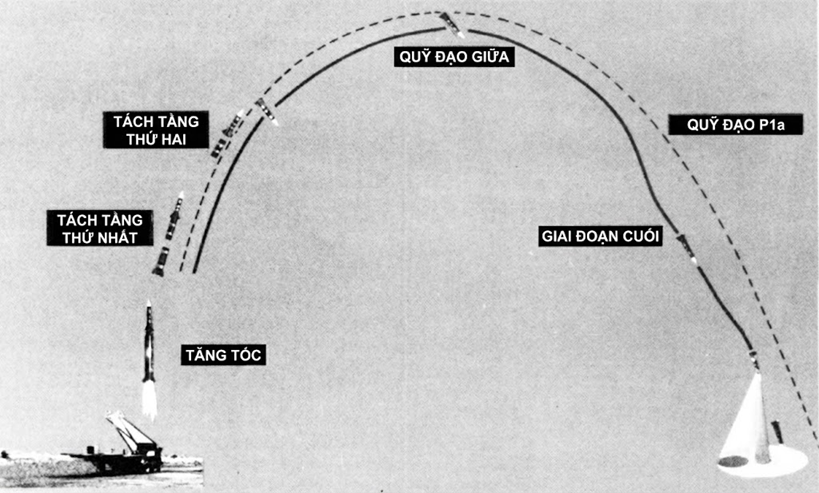
The second phase is the mid-flight phase, when the missile flies through a very thin or near-vacuum atmosphere. This is when its velocity can reach its highest level, mainly due to inertia after the engines stop. However, this maximum speed only lasts for a relatively small portion of the flight.
The third stage is re-entry into the atmosphere, when the warhead returns to the thicker layers of the atmosphere and plunges towards the target. During this stage, air friction, along with any maneuvering (if present), can cause the velocity to change, or even decrease compared to the mid-stage.
Therefore, the actual flight time of a ballistic missile is always significantly longer than the calculation of "straight-line distance divided by maximum speed". The arc trajectory and the phased velocity distribution make any scenario that reduces to a simple division unscientific.
Minimum firing range and operational "blind zones"
Another crucial technical specification often overlooked in general discussions is the minimum range. Every ballistic missile system has an area around the launch pad where it cannot effectively strike, often referred to as the "blind zone" or "dead zone" of the operation.
According to information released by the Ukrainian Security Service at a press conference in late October 2025, the Oreshnik is classified as a medium-range ballistic missile, with a maximum range of approximately 5,500 km. Notably, the system is said to have a minimum range of around 700 km – meaning targets closer than this threshold are not within its effective operational range.
This factor is particularly important when considering the scenario of launching the Oreshnik from Belarusian territory. The straight-line distance from southern Belarus to Kyiv is approximately 660km, and even shorter at some points near the border. This figure is lower than the minimum range of 700km stated by Ukraine.
Based solely on these technical specifications, Kyiv is not within the effective operational zone of the Oreshnik system when deployed in Belarus. The claim that the missile could strike the city within “111 seconds” from such a location is inconsistent with the published technical parameters.
Solid-fuel engines and range adjustment limits
Older generations of ballistic missiles, such as the Scud series, use liquid-fuel engines, allowing for control of fuel flow during flight. Thanks to the ability to shut off early or adjust thrust, this type of engine offers greater flexibility in changing range, suitable for a variety of targets at different distances.
In contrast, the Oreshnik is designed with a multi-stage solid-fuel engine to meet the requirements of rapid response, high reliability, and long-term storage capacity. Once the solid-fuel engine is activated, combustion continues until all the fuel in the combustion chamber is consumed. Turning off the engine mid-cycle or adjusting the thrust at will is very difficult, if not impossible, under standard operating conditions.
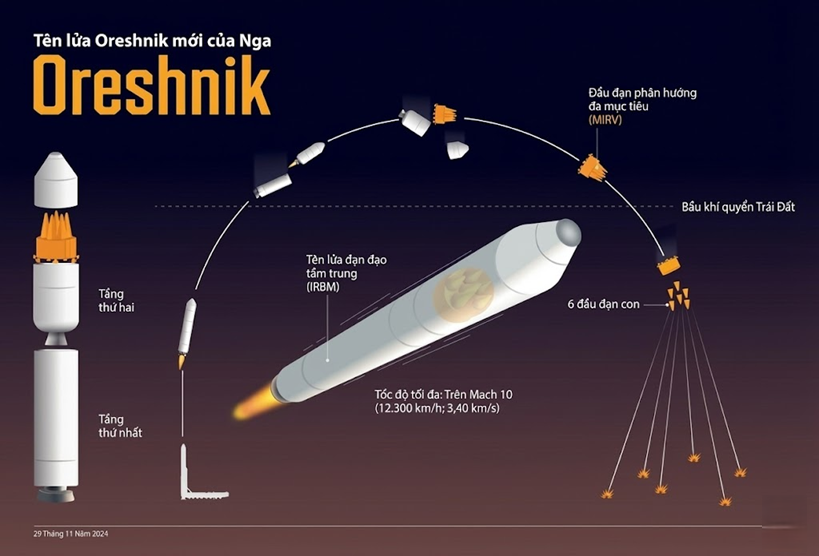
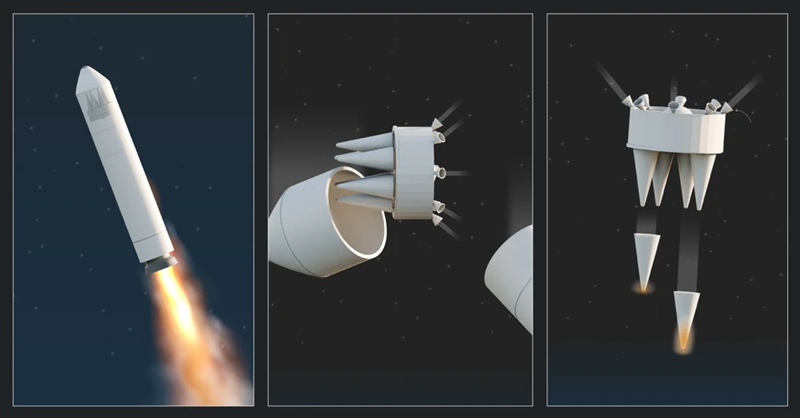
In the described two-stage structure, the first stage is responsible for generating sufficient thrust to propel the missile out of the dense atmosphere and reach a predetermined altitude. The second stage operates in a thinner atmosphere, requiring a certain velocity and stability to ensure accurate flight trajectory, facilitating the separation and guidance of the warhead.
The entire cycle of combustion, stage separation, kinetic stabilization, and warhead deployment requires a minimum flight time and distance; this is a physical and technical limitation that cannot be arbitrarily shortened. If forced to attack a target too close, the missile may not complete its operational cycle, or may have to descend at an unfavorable trajectory angle, placing the guidance system and warhead outside the design range, significantly reducing accuracy and effectiveness.
Practical implementation capacity and strategic significance
Although technical analyses suggest that the scenario of the Oreshnik missile attacking Kyiv from Belarusian territory in 1 minute and 51 seconds is unrealistic, military experts in Ukraine still consider it a noteworthy strategic weapon system in large-scale conflict scenarios, especially targeting objectives deep within European territory – that is, within the missile's effective range.
In a statement in Warsaw on December 19th, during a meeting with Polish President Karol Nawrocki, Ukrainian President Volodymyr Zelensky stated that the Oreshnik medium-range ballistic missile is currently uninterceptable by air defense systems. Zelensky said that Ukraine has repeatedly warned its European and American partners about this threat, and according to Ukrainian assessments, this type of missile remains "unshootable" to date.
However, intelligence assessments released by Ukraine also reveal significant limitations regarding practical deployment capabilities. According to these sources, the number of Oreshnik missiles currently possessed by Russia is believed to be very limited: Russia has only one missile in combat-ready condition, one has been used in testing, and another is believed to have been destroyed in an attack on a weapons depot in the summer of 2023.
If the above information accurately reflects the situation, Oreshnik is not currently a system mass-produced in sufficient quantities to carry out continuous saturation strikes. This makes its role significantly different from inexpensive cruise missiles or drones, which can be deployed at high density and frequency in modern warfare.

According to the Ukrainian side, Russia first deployed the Oreshnik system in combat in November 2024, when Moscow announced an attack targeting an industrial facility in the city of Dnipro. This move was described by Russia as a response to Ukraine's use of Western-supplied long-range weapons to attack Russian territory. Images and videos broadcast showed bright flashes of light in the sky over Dnipro during the attack.
In another development, in September, Belarus announced that the Russian and Belarusian armed forces had conducted exercises related to planning the use of non-strategic nuclear weapons, and simulated the deployment of the Oreshnik system as part of the joint Zapad-2025 exercises. This indicates that Russia considers Oreshnik a crucial component of its regional deterrence structure, despite the limited number of missiles currently available.
In summary, the technical and deployment data show that the Oreshnik is a medium-range ballistic missile system with a long range and significant deterrent potential against targets deep within Europe. However, scenarios emphasizing the ability to "hit Kyiv in less than 2 minutes from Belarus" have overly simplified core elements such as flight trajectory, minimum range, and engine structure, leading to assessments far removed from the realities of combat.