

Russian tanks fitted with shipping containers are protected against UAV attacks.
The Russian army is mounting ISO-standard containers on top of tanks, creating a new layer of field protection against the threat of UAVs, but the thin material and current arrangement suggest limited protection capabilities.
The Russian military has begun mounting standard shipping containers onto tanks as a kind of makeshift protective "coat" against the threat of aerial drone attacks. This structure utilizes a corten steel container shell combined with a metal mesh on top, but still reveals many limitations in terms of bullet resistance and combat deployment.
Overview of the "container shell" solution for tanks.
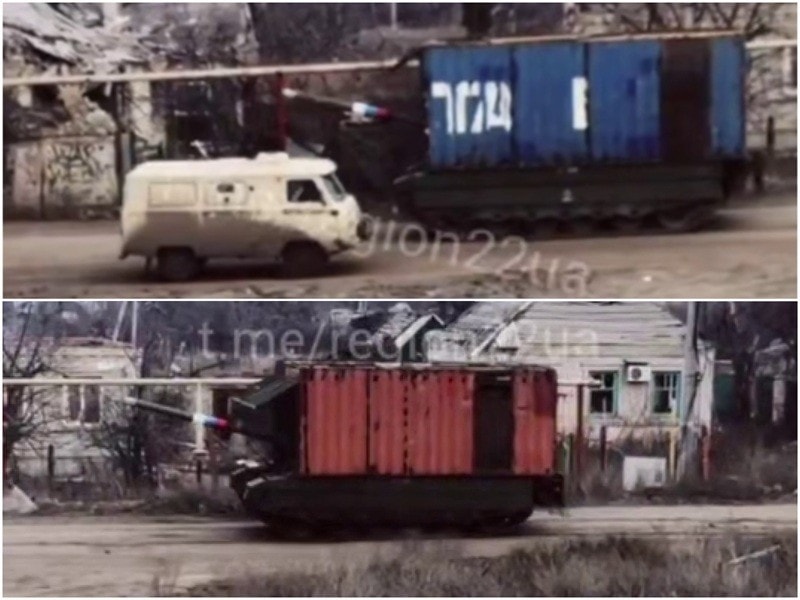
According to a video released by the Telegram channel Region 22, two Russian tanks were observed with a new form of protection: shipping containers mounted directly on top of the hull. Due to the low image quality and the containers obscuring the view, accurately identifying the tank type is difficult. However, features at the rear suggest these are most likely T-80BVM tanks.
The container was positioned along the vehicle's body, covering almost the entire upper section, replacing the "warehouses" or "cages" previously seen on the battlefield. A sufficiently large opening was cut in the front of the container to allow the main gun to operate, enabling the tank to maintain its primary firepower.
Technical structure of the container protection layer
The video shows that the front of the container has been partially cut away to make room for the cannon barrel and the basic elevation angle. A layer of metal mesh is also placed on top of the container, likely to provide a protective barrier against projectiles, grenades, or explosive devices dropped from above by the UAV.
The rear section of the container appears to be virtually unmodified, retaining its original box structure. The sides of the container feature handcrafted openings for the engine's exhaust system, designed to prevent exhaust gases from accumulating in the enclosed space, causing overheating or affecting the crew's operation.
However, the tank's hull – particularly the sides and lower section – remained completely exposed, with no additional armor modules or protective structures. No electronic warfare systems, sensors, or jamming equipment were observed installed on the top of the container.
Material characteristics: thin corten steel, not armor.
Standard ISO sea containers typically have relatively thin walls, only about 1.5–2 millimeters. The primary material is Corten steel, optimized for corrosion resistance and the marine environment, not designed for bulletproofing. At this thickness, the container shell is essentially no match for tank armor, which is many times thicker and optimized for penetration resistance.
Due to its material properties, the container shell can be easily penetrated by infantry fire, artillery shrapnel, and even small projectiles dropped by UAVs. Therefore, the container structure in this case can hardly be considered true protective armor, but primarily serves to shield, create distance, and distort the target's shape rather than withstand direct impact.
A standard container weighs approximately 2.2 tons. In the tank configuration, the bottom and front sections have been removed, likely reducing the weight. However, this still represents a significant structural element on top of the vehicle, potentially impacting the overall load and center of gravity distribution.
Assessing the effectiveness and limitations in terms of combat operations.
In theory, the container structure and metal mesh on the roof could create an additional buffer zone between an attack from above and the turret roof – an area vulnerable to UAV attacks. Some types of small explosive projectiles or shrapnel could have their energy reduced when penetrating the thin casing and mesh, or detonate prematurely before directly hitting the tank's roof.
However, with a shell thickness of 1.5–2 millimeters and materials not specifically designed for bulletproofing, its ability to protect against direct fire – including small-caliber infantry rounds – remains very limited. Against anti-tank weapons or high-explosive projectiles, the container serves almost no purpose as armor, but rather as a secondary structure.
Mounting a large container on top of a tank can also increase the geometric size of the target, making the vehicle more easily detected visually. Additionally, the enclosed structure can restrict the crew's field of vision, narrowing the perimeter and thus affecting the ability to detect threats early, especially in urban warfare or on complex terrain.
From a maneuverability perspective, the additional weight – even after being reduced by cutting the bottom and front – still adds load to the suspension and chassis. In rough terrain, high-speed maneuverability can be affected, especially when the vehicle has to overcome obstacles or perform sharp turns.
Compared to previous field structures
Before the advent of the "container armor" solution, the battlefield had seen various forms of field protection on Russian tanks, such as "warehouse" or "iron cage" structures on the roof, aimed at countering UAVs and aerial attacks. These structures typically used metal frames, mesh, or steel plates temporarily attached to the vehicle's hull.
In November, Russian forces unveiled tanks dubbed "Hedgehog Assault Tanks." According to Militarnyi, these vehicles are equipped with a dense network of ropes to protect against UAVs, combined with mine-clearing equipment and electronic warfare systems. The approach here is to use both physical (ropes, external structure) and electronic measures to reduce the effectiveness of UAVs.
Meanwhile, the current container structure shows that the focus remains on rudimentary physical reinforcement, lacking externally observable electronic warfare equipment. This highlights a difference in defense philosophy: one emphasizes a combination of soft and hard (physical and electronic) defenses, while the other favors utilizing readily available materials to create additional layers of protection.
Tactical impact and unanswered questions
The video currently only shows two tanks fitted with containers, so there is no data yet on whether this configuration will be widely adopted or is just a trial solution at a specific unit. The scale of deployment, standardization procedures, and evaluation of its effectiveness in real-world battlefield conditions have not been released.
From a tactical perspective, the continuous emergence of various forms of field protection such as "warehouses," "iron cages," "hedgehog assault vehicles," and now "container jackets" shows that the threat from UAVs is forcing armored forces to adapt quickly. However, the actual effectiveness of each solution depends on the type of UAV, the type of ammunition used, the method of attack, and the ability to coordinate with other air defense and electronic warfare measures.
In this context, the containerized structure can be seen as an attempt to utilize readily available materials to add an extra layer of protection from above, but it is not a replacement for specialized armor solutions and active protection systems. More detailed assessments of the survivability of tanks in this configuration will only be possible when more data from actual combat becomes available.