

Belarus receives 10 Oreshnik 4,000 km range missile systems from Russia.
Belarus has confirmed the acquisition of 10 Oreshnik hypersonic ballistic missile systems with a range of 4,000 km, capable of carrying nuclear and non-nuclear warheads, aimed at strengthening deterrence against NATO forces deployed near its borders.
Belarus has received 10 Russian-made Oreshnik hypersonic ballistic missile systems, a weapon with an estimated range of 4,000 km, capable of carrying both nuclear and non-nuclear warheads. This move is seen as a step to enhance Minsk's long-range deterrence capabilities against the dense NATO forces deployed around its borders.
The first 10 Oreshnik complexes in Belarus.
On December 22, Belarusian President Aleksandr Lukashenko confirmed that the country had received up to 10 Oreshnik hypersonic ballistic missile systems. These are the first systems of the new missile series developed by Russia to be delivered to another country.
The delivery follows reports earlier this year that Oreshnik systems would be prioritized for transfer to Minsk. In 2024, Lukashenko mentioned the figure of "ten systems at the present time," implying that Belarus could possess a larger Oreshnik arsenal in the future if subsequent batches are delivered.
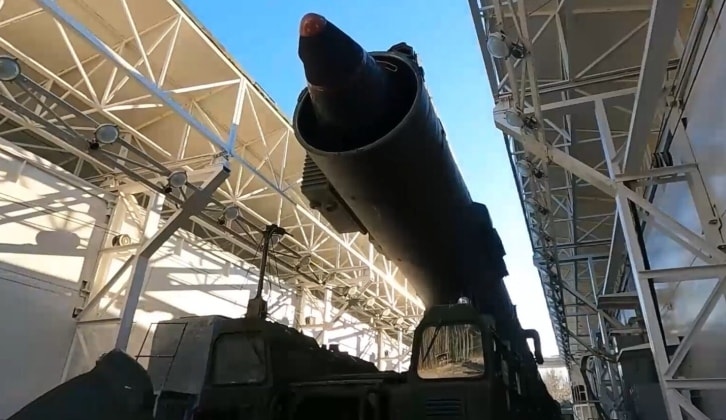
According to Belarusian assessments, the Oreshnik system represents a turning point in the operational range of the country's armed forces, significantly expanding their long-range strike capabilities. This new weapon provides a more effective means of countering the large and rapidly increasing military capabilities of NATO members surrounding Belarus.
The Oreshnik can deploy both nuclear and non-nuclear warheads, allowing it to serve as both a strategic deterrent and a tactical weapon for attacking enemy ground forces and military targets. The addition of the Oreshnik is seen as a refinement of the Russian-made Iskander-M short-range missile class, some of which are already equipped with nuclear warhead capabilities.
Technical specifications and missile defense penetration capabilities.
According to published information, the Oreshnik is a medium-range ballistic missile with an estimated range of approximately 4,000 km. With this range, the systems deployed in Belarus can cover targets deep within European territory, serving the strategic deterrence function that Minsk has repeatedly emphasized.
The missile carries multiple independently targetable reentry vehicles (MIRVs), mounted on hypersonic glide vehicles. Each warhead is capable of maneuvering and approaching the target from unexpected directions, making the overall trajectory difficult to predict for missile warning and defense systems.
Combining very high speed and the maneuverability of its warhead, the Oreshnik significantly degrades the interception capabilities of traditional air defense and missile defense systems. Sources emphasize that the Oreshnik is designed to pose a challenge to modern systems such as the Arrow 3, a high-altitude interceptor missile recently acquired by Germany.
Operational progress and first use
On December 17, Russian President Vladimir Putin announced that the Oreshnik system would officially enter active service by the end of 2025. In this context, the systems already delivered to Belarus are believed to have either reached operational readiness or will soon be put into service in the near future, in line with the roadmap announced by Russia.
The Oreshnik was fired for the first time in combat on November 21, targeting objectives in Ukraine. It was also at this time that the existence of the Oreshnik program became widely known to the world, although Russia had confirmed its mass production of the weapon back in June.
Belarus is on heightened alert amid NATO pressure.
Belarus claims that security threats from across its border are increasing. On May 22, the German Army launched its new 45th Armored Brigade, stationed in Vilnius, Lithuania. This unit serves as an elite mechanized force, deployed forward on former Soviet territory, just 150 km from Minsk.
The 45th Armored Brigade was prioritized for equipping itself with the most modern equipment of the German Army, including the first Leopard 2A8 tanks. The presence of this unit was closely monitored by Belarus due to its close geographical proximity and the nature of its combat operations.
In Poland, the modernization of its ground forces is proceeding rapidly through major deals with South Korea, including hundreds of K2 tanks, K9 self-propelled artillery, and Chunmoo multiple rocket launcher systems. The Polish Air Force is also being significantly strengthened with contracts to purchase F-35A and F/A-50 fighter jets, while upgrading its existing F-16 fleet to the F-16V standard.
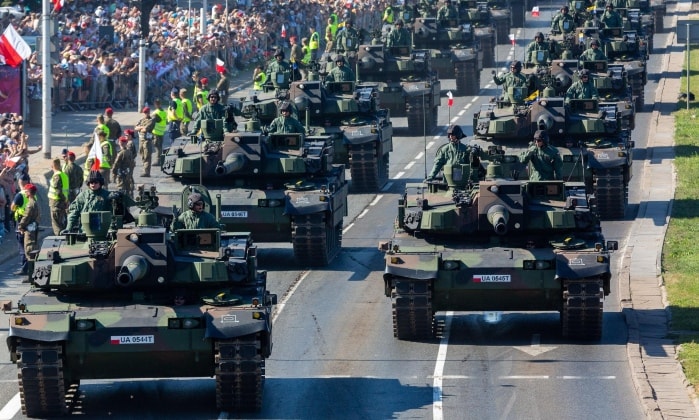
Since late 2020, the Belarusian Armed Forces have also invested in new equipment such as Mi-35 attack helicopters, Su-30SM fighter jets, and S-400 air defense systems. However, the scale of these deals remains more modest compared to the rearmament programs of neighboring countries. In this context, the Oreshnik system is seen as a means to help Minsk re-establish a balance on the border, thanks to its superior long-range strike capabilities compared to previous systems.
Belarus' defense industry and the significance of the transfer.
It is noteworthy that Belarus is the production site for the mobile launch vehicles of the Oreshnik system. The country's defense industry has extensive experience in manufacturing chassis and launch vehicles for numerous Russian missile programs, from the Soviet era to the present day. Therefore, Minsk is not only a customer but also directly involved in the production chain.
The plan to supply Belarus with Oreshnik missiles was confirmed by Russia on December 6, 2024. According to sources, this will be the only transfer of medium-range ballistic missiles between the two countries since the beginning of the 21st century, given that most previous missile programs of this type were deployed domestically and not for export.
President Lukashenko stated that Belarus already has sites available for deploying the Oreshnik system. He emphasized a crucial condition: the targets will be determined by Belarus's political and military leadership, while Russian specialists will be responsible for maintaining the weapon. This division of roles indicates Minsk's desire to maintain control over deployment decisions while leveraging Russia's technical capabilities in maintaining a complex system like Oreshnik.
Overall, the deployment of 10 Oreshnik systems in Belarus is both a step to bolster Minsk's long-range deterrence capabilities and reflects the increasingly evident military competition along NATO's eastern flank. Current information suggests the focus remains on the technical and tactical aspects of the weapons, with broader geopolitical implications to be monitored through subsequent military actions by both sides.