

Donut Lab's solid-state batteries are ready for production.
Donut Lab's fully solid-state battery technology, ready for production, promises to revolutionize the electric vehicle industry with an energy density of 400 Wh/kg, ultra-fast charging, and a lifespan of up to 100,000 cycles.
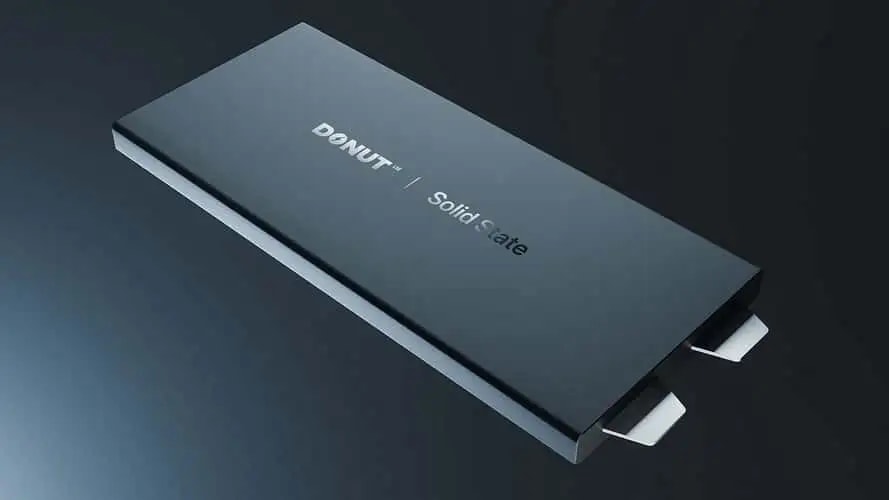
Donut Lab, the tech startup behind Verge Motorcycles' wheel-mounted electric motors, has announced the successful development of the world's first fully solid-state battery ready for mass production. This breakthrough marks a significant milestone for the electric vehicle (EV) industry and global energy storage systems, effectively addressing the limitations of traditional lithium-ion batteries in terms of charging time and safety.
A revolution in energy density and charging speed.
Unlike current battery types, Donut Lab's technology uses absolutely no liquid electrolyte. Eliminating this component makes the battery cells lighter, safer, and achieves an energy density of up to 400 Wh/kg. This is significantly higher than the average of 250 to 300 Wh/kg for the most advanced lithium-ion batteries currently on the market.
Notably, Donut Lab claims the new battery can be fully charged in just about 5 minutes. This speed is comparable to the refueling time of a traditional internal combustion engine vehicle, completely eliminating concerns about charging time for electric vehicle users. Beyond speed, the battery also boasts impressive durability with 100,000 full charge cycles, while conventional lithium-ion batteries only achieve around 5,000 cycles under optimal conditions.
Operates reliably in harsh environments.
One of the biggest challenges facing electric vehicles today is the significant drop in performance with temperature changes. However, Donut Lab's solid-state batteries are claimed to retain over 99% of their capacity across an extreme temperature range, from as low as -30°C to as high as 100°C. This allows electric vehicles to operate stably in frigid climates or under continuously high load conditions without fear of failure or reduced range.
In terms of safety, the company claims the battery poses no risk of catching fire even in the event of physical damage. Specifically, Donut Lab emphasizes that its manufacturing process does not rely on rare earth materials, minimizing geopolitical risks and lowering production costs to a more competitive level compared to comparable lithium-ion batteries.
Practical application on the Verge TS Pro electric motorcycle.
The clearest evidence of this technology's power is the upgraded Verge TS Pro electric motorcycle. The older version, using a lithium-ion battery, had a range of approximately 349 km in urban areas and required 35 minutes to charge. With the new solid-state battery option of the same size, the range is increased to 595 km (an increase of over 70%), while charging time is reduced to under 10 minutes.
| Parameter | Used Lithium-ion batteries | Donut Lab Solid State Battery |
|---|---|---|
| Energy density | 250–300 Wh/kg | 400 Wh/kg |
| Charging time | ~35 minutes | ~5 minutes |
| Lifespan (charging cycles) | 5,000 | 100,000 |
| Low heat resistance | Least | Maintains 99% of its capacity at -30°C |
Marko Lehtimäki, CEO of Donut Lab, stated that solid-state batteries have long been considered a technology of the distant future and have consistently failed to commercialize. However, the company's battery cells and modules are now ready to supply original equipment manufacturers (OEMs) worldwide on a gigawatt-hour scale. The first Verge TS Pro models using solid-state batteries are expected to begin deliveries to customers in the first quarter of this year.