

Robusta coffee prices surged to $4,078, while the COMEX currency retreated to a one-month low.
Coffee prices led the rally in industrial commodities, boosted by the Brazilian Real, while the COMEX fell nearly 0.8% due to changes in US tax policy.
The commodity market on January 21st saw a tug-of-war between different commodity groups. According to the Vietnam Commodity Exchange (MXV), while industrial raw materials surged thanks to favorable exchange rates, copper faced significant pressure from policy changes in the US and weak demand in China.
Robusta coffee prices rose 3.5% due to supply shortages from Brazil.
For industrial raw materials, green dominated with 6 out of 9 items experiencing price increases. Robusta coffee was the highlight, rising nearly 3.5% to close at $4,078 per ton. Arabica coffee also recorded a slight increase of 0.3%, reaching $7,661 per ton.
The main driver behind the surge in coffee prices comes from the Brazilian Real's strong performance. After the Brazilian Monetary Policy Committee (COPOM) maintained the Selic interest rate at 15% per annum, the Real reached its highest level against the US dollar in over a month and a half. The strong domestic currency has led Brazilian farmers to limit sales to international markets, waiting for better prices, directly contributing to short-term supply shortages.
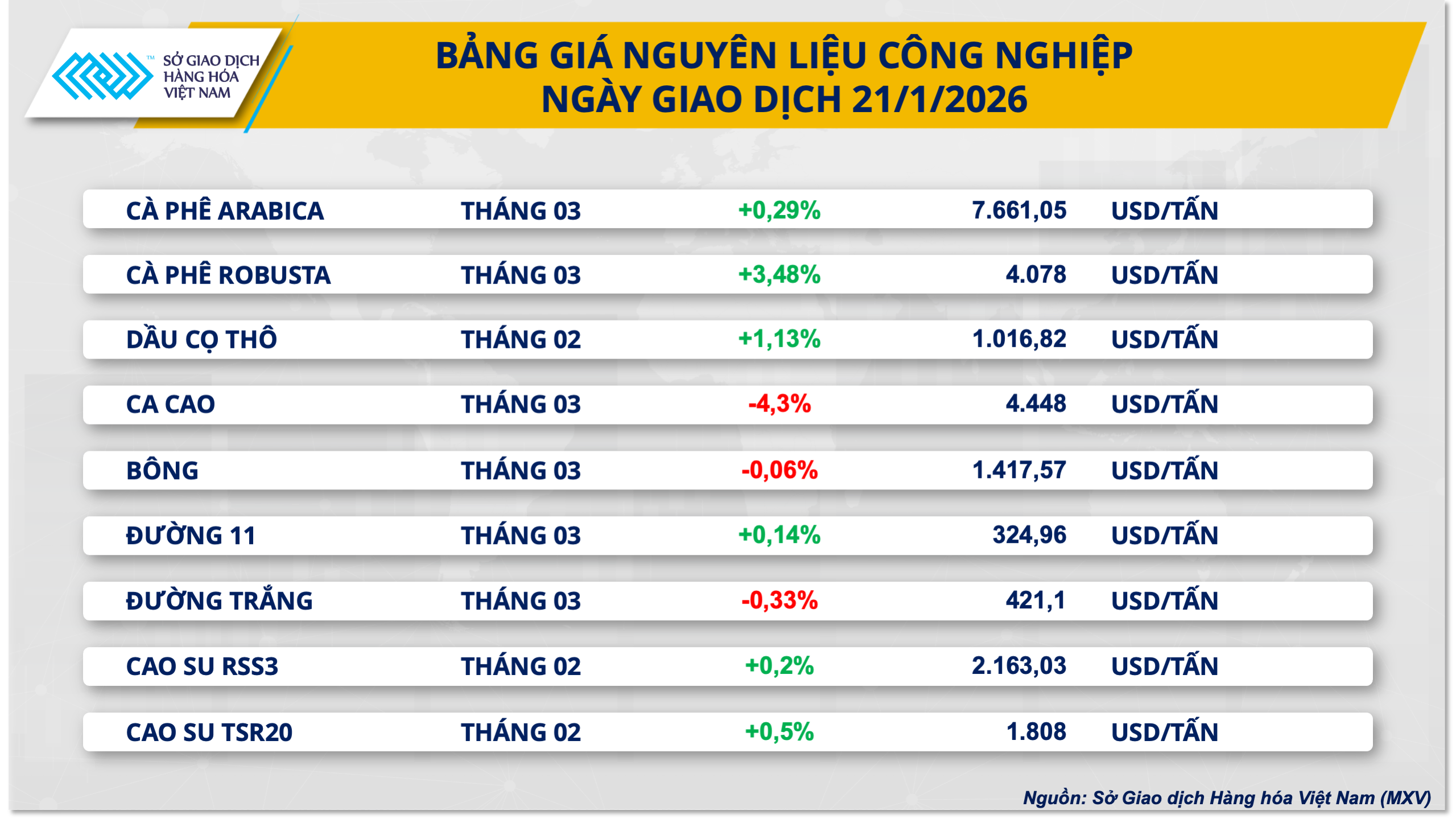
Data from the Brazilian Coffee Exporters Association (Cecafe) shows that in December 2025, the country's total green coffee exports decreased by 18.4% compared to the same period last year, reaching 2.86 million bags. In particular, Conilon (Robusta) coffee saw a severe decline of 61%, falling to just over 222,000 bags. In contrast to supply, demand in the US remained stable, increasing by 4% in the first 10 months of 2025.
The domestic coffee market remained stable before Tet.
In Vietnam, dry weather is helping farmers complete their harvest in key provinces such as Dak Lak and Dak Nong. However, the price of bulk green coffee beans in the Central Highlands on January 21st saw a slight decrease of 300-500 VND/kg, fluctuating around 99,000-99,500 VND/kg. Trading is currently cautious due to the tendency to hold onto inventory while waiting for prices to recover after the Lunar New Year holiday.
Copper prices fall sharply due to changes in US tax policy.
In contrast to the upward trend in coffee prices, the metals market witnessed a sharp decline in COMEX copper prices. The commodity lost nearly 0.8%, falling to $12,716 per ton, its lowest level since the beginning of January.
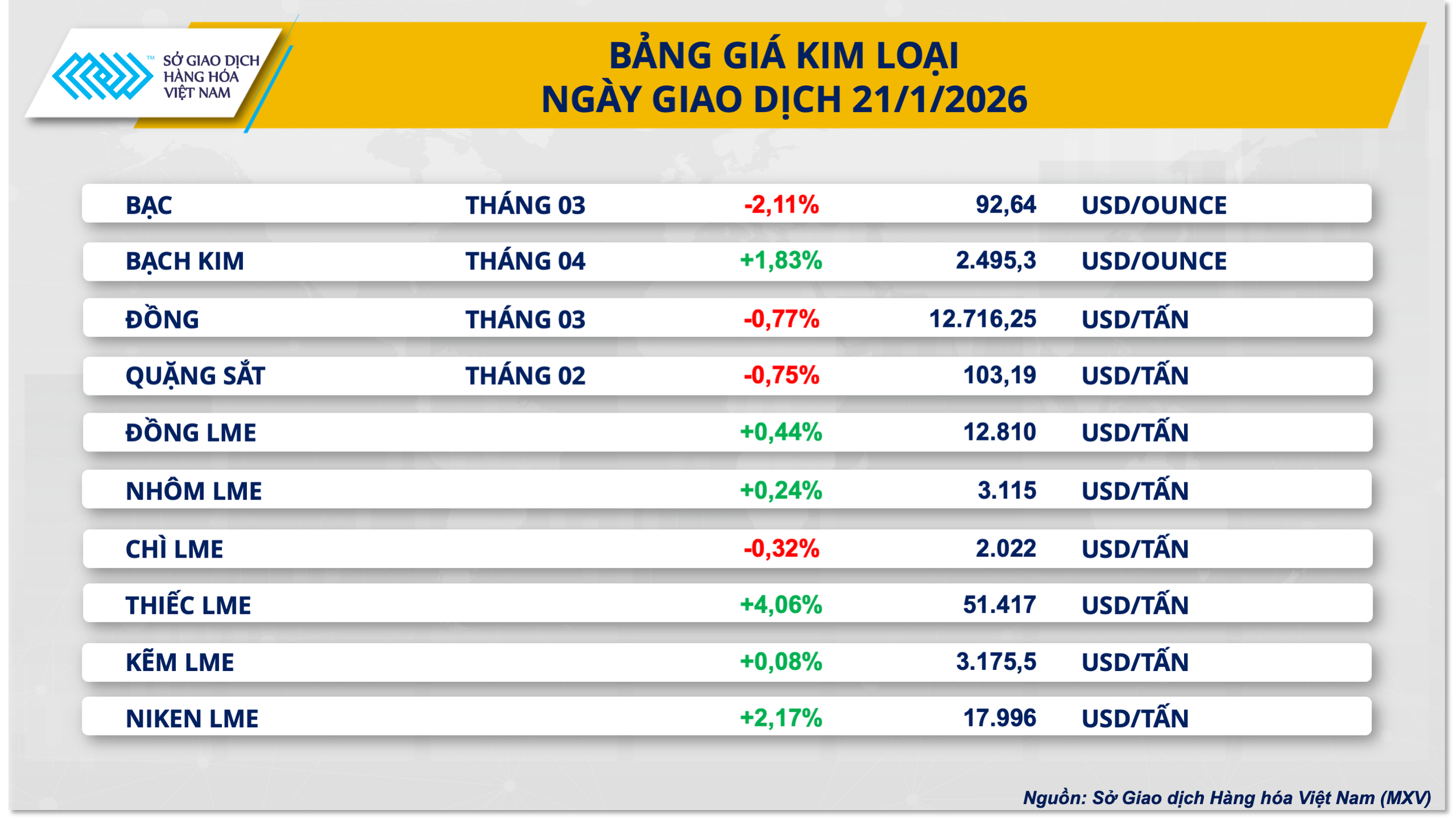
Pressure for adjustment emerged after the US government announced a temporary suspension of new tariffs on key minerals. This unexpected decision neutralized the surge in refined copper shipments to the US, which had been underway since late 2025 to anticipate tariff risks, triggering a sell-off on exchanges.
In China, the world's largest copper consumer market, data from the National Bureau of Statistics (NBS) shows that new home prices in 70 cities fell 2.7% year-on-year in December 2025. This was the sharpest decline in five months, reflecting the fact that the real estate sector has yet to recover, directly dragging down demand for copper in construction.
Demand for copper imports in Vietnam is growing.
Despite a sluggish global market, demand for copper in Vietnam remains positive. According to the General Department of Customs, in the first half of January 2026, copper imports reached 24,782 tons, an increase of nearly 20% compared to the second half of December 2025. This development shows that domestic industrial production activities are maintaining a stable pace in the early part of the new year.