

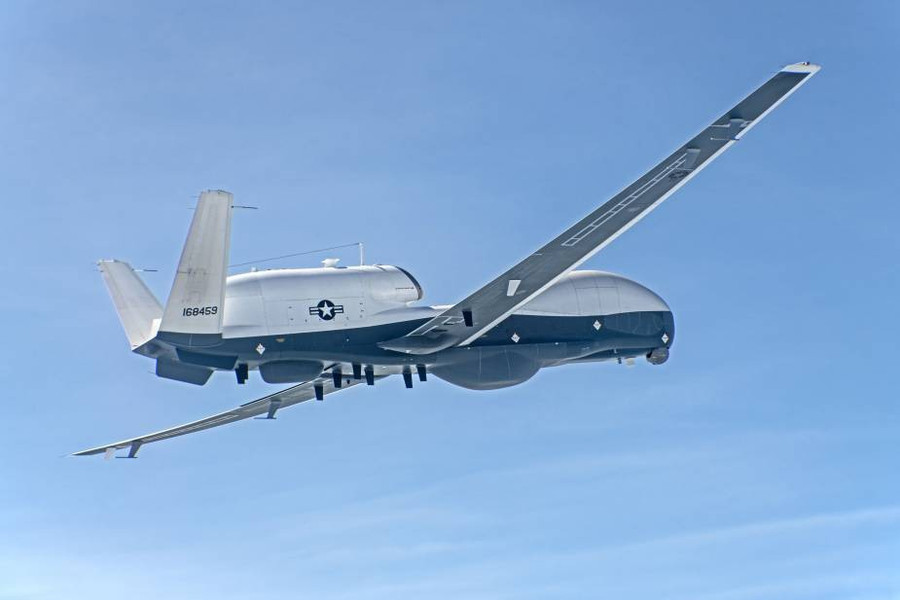
A US MQ-4C Triton sent out a distress signal and disappeared near the Iranian coast.
The U.S. Navy's MQ-4C Triton drone, designation OVRLD1, triggered emergency code 7700 and disappeared from radar while on a mission in the Gulf of Oman.
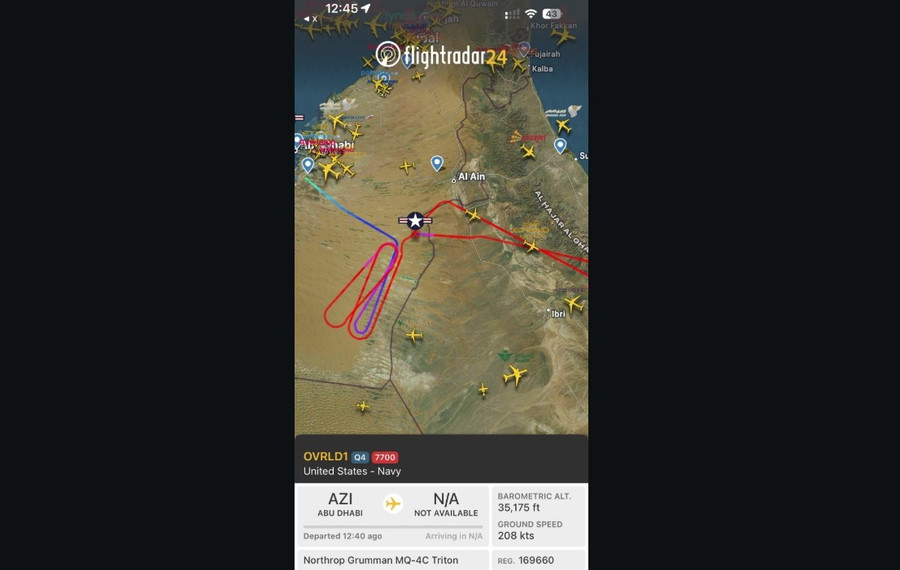
Data from the aviation tracking website Flightradar24 has just recorded a serious incident involving a US Navy MQ-4C Triton unmanned aerial vehicle (UAV). According to the data, the aircraft, with registration number 169660 and call sign OVRLD1, suddenly disappeared from radar screens after sending a distress signal while operating near the Strait of Hormuz.
The sequence of events involving the MQ-4C Triton in the Gulf of Oman.
On February 25, the U.S. military deployed an MQ-4C Triton from Al Dhafra Air Base in the United Arab Emirates (UAE) for a reconnaissance mission. The aircraft flew for several hours continuously over international waters in the Gulf of Oman, along the southeastern coast of Iran, to gather intelligence.
In the final stage of its flight, the monitoring system recorded that the Triton had activated code 7700 – the international standard signal indicating a serious emergency. Immediately after transmitting this signal, all traces of the aircraft on radar completely disappeared, raising concerns about a technical malfunction or external interference.
Suspicions arise regarding the possibility of electronic interference.
According to an analysis by Defence Network, it cannot be ruled out that modern electronic warfare (EW) systems interfered with the operation of the American UAV. The source suggests that Iran currently possesses jamming equipment of Russian or Chinese origin, capable of suppressing the control and navigation signals of long-range reconnaissance vehicles.
While the electronic warfare hypothesis is being discussed, military experts also note the inherent technical issues of this aircraft. The MQ-4C Triton is a high-altitude reconnaissance system capable of flying continuously for over 30 hours at altitudes up to 17,000m and reaching a maximum speed of 610km/h. However, the stability of this fleet remains a major question mark for the US Navy.
Current squadron status and upgrade plans of the US Navy
Information from Militarnyi indicates that in 2025, the United States identified several technical system flaws on the MQ-4C Triton that could hinder deployment in actual operations. Currently, three MQ-4C Tritons are stationed at Al Dhafra base to monitor maritime operations in the Middle East region.
To address this issue, the U.S. Navy has been approved for $83.1 million to upgrade two aircraft to the most modern versions. Simultaneously, the Navy plans to request additional funding to repair and refurbish its entire fleet of strategic reconnaissance UAVs, ensuring stable operational capability in highly contested environments such as the Gulf of Oman and the Strait of Hormuz.