

The US plans to spend $3 billion ordering 785 Tomahawk missiles by 2027.
The Pentagon has proposed increasing its Tomahawk missile orders by more than 1,200% to bolster its strategic arsenal and enhance its long-range strike capabilities.
The Pentagon has just proposed a $3 billion budget to order 785 Tomahawk cruise missiles by fiscal year 2027, marking a breakthrough in U.S. arms procurement plans. This investment is a key part of a proposed record-breaking $1.5 trillion defense budget, heavily focused on long-range precision strike systems.
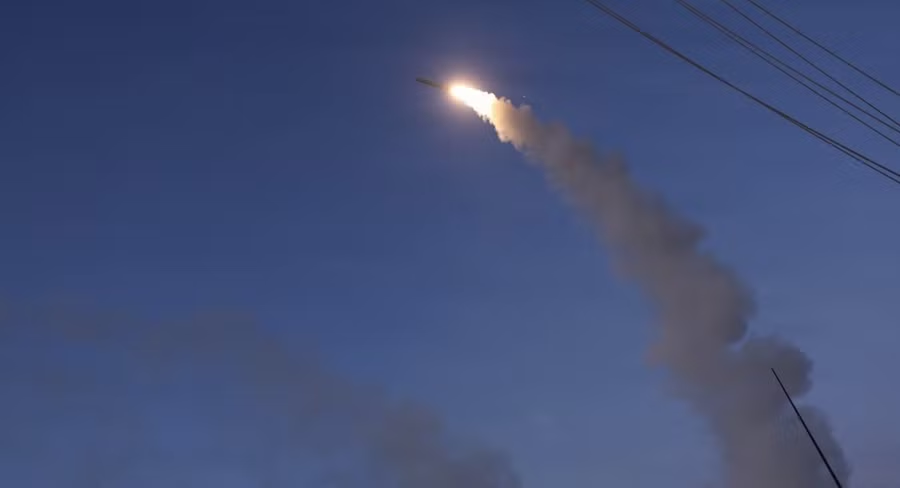
A sudden surge in arms orders.
According to an analysis by the U.S. Naval Institute (USNI), the plan to purchase 785 missiles for 2027 represents a growth of over 1,200% compared to 2026. In fiscal year 2026, the budget for this weapon system was only $257.6 million for 55 missiles. This expansion of production demonstrates the U.S. military's determination to replenish its strategic stockpile.
Each Tomahawk missile currently costs an estimated $3.8 million. Despite the significant budget increase, military experts note that this amount still needs careful balancing against actual usage. For example, in high-intensity operations, the number of missiles consumed could exceed the annual production capacity.
Technical analysis and combat variations
Currently, the US military maintains two main variants of the Tomahawk missile: Block Va and Block Vb. The Block Va variant is specifically designed for anti-ship missions, while Block Vb focuses on attacking fixed land targets. Both variants play a key role in modern long-range warfare doctrine.
In addition to new purchases, the budget proposal includes $1.5 billion for modernizing existing missiles in the inventory, a significant increase from the previous year's $480 million. Furthermore, over $116 million is allocated to control equipment and related infrastructure to ensure system compatibility.
Actual production and delivery schedule
Although the budget is for fiscal year 2027 (beginning October 2026), this does not mean that all 785 missiles will be delivered that year. According to Defense Express, the process from contract signing to production completion typically takes several years.
Contracts executed during the 2024-2025 period are expected to be completed only in early 2028 or 2029. Therefore, the missile batches under the 2027 order are likely to enter combat service only towards the end of this decade. Early funding allocation is a necessary preparatory step for defense contractors to maintain production lines and stabilize the supply chain of high-tech components.