

Russia launched a large-scale Iskander missile attack, overwhelming Ukraine's air defenses.
On April 15th and 16th, Russia deployed 24 Iskander missiles along with hundreds of UAVs to attack key targets, revealing the depletion of Ukraine's air defense network.
On April 15th and 16th, the Russian Armed Forces carried out large-scale coordinated bombing raids using missiles and suicide drones against a series of strategic targets in Ukraine. This operation marked the third consecutive day of intense attacks, placing Ukraine's air defenses on high alert due to severely depleted resources.
Multi-layered coordinated attack tactics
According to a report from the Ukrainian Air Force, electronic warfare units monitored a total of 703 airborne targets within 24 hours. The attack involved 19 Iskander-M ballistic missiles, 5 Iskander-K cruise missiles, 20 Kh-101 cruise missiles, and 659 UAVs of various types. The simultaneous deployment of multiple types of weapons forced the defense forces to stretch their resources across the entire territory at once.
The power of the Iskander-K "sniper missile"
Of particular note in this attack was the appearance of the Iskander-K system, often referred to by military experts as the "sniper missile." This is a cruise missile system designed to complement the firepower of the Iskander-M ballistic variant, focusing on deep and precise strikes at low altitudes.
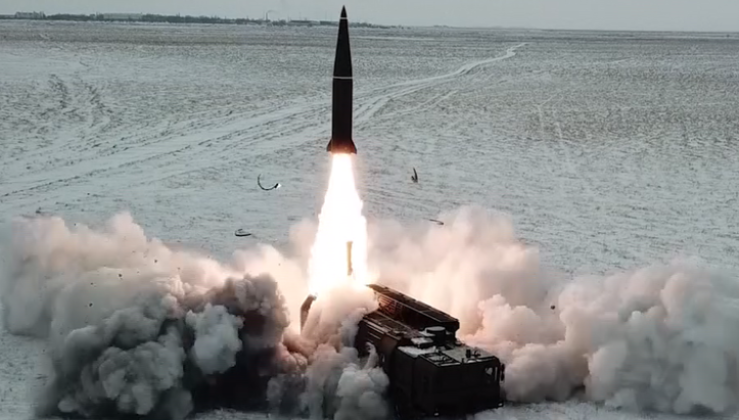
This system uses the 9M728 and 9M729 primary missile types. The 9M729, in particular, has an estimated range of up to 1,500 km. Key technical features include:
- Flight trajectory:Flying low to the ground, following the terrain to penetrate radar barriers.
- Navigation system:Using satellites in combination with advanced sensors.
- Accuracy:Circular error probability (CEP) is only 5–10 meters for high-value fixed targets.
- Mobility:The launcher is capable of carrying two missiles and can be quickly redeployed after firing.
Russia's defense production capacity has surged.
Despite facing numerous sanctions, the Russian defense industry has maintained wartime-standard production of Iskander missiles. Reports indicate that deliveries in 2023 were many times higher than the combined output of all previous years. By mid-2023, the system's output capacity was believed to have increased fivefold.
An assessment from the Kyiv National Research Institute for Forensic Science (KNDISE) in October 2025 indicated that Russia is producing at least seven variants of the missile with different types of warheads, including fragmentation and cluster munitions, to meet diverse operational needs on the battlefield.
The effectiveness of the Patriot interception system is being questioned.
Although Ukraine has received MIM-104 Patriot long-range air defense systems from the West, battlefield experience has shown that their protective effectiveness against these advanced Russian missiles has not met expectations.
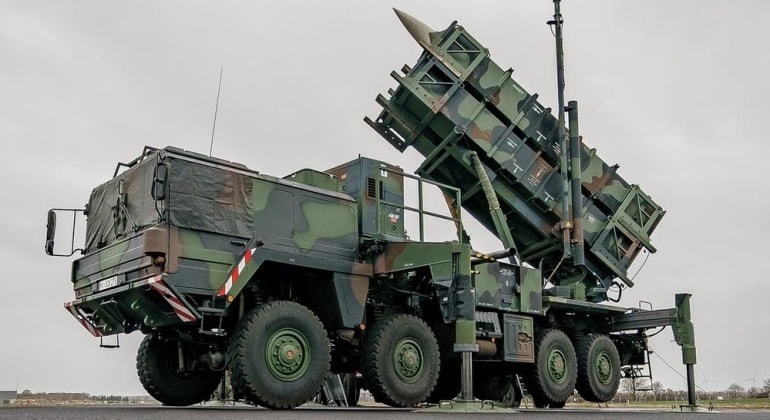
Actual figures show that the Patriot's success rate in intercepting Iskander-M and Kinzhal missiles sometimes only reaches about 6%. Yuri Ignat, spokesman for the Ukrainian Air Force Command, explained that the Iskander ballistic missile is capable of changing its trajectory and performing complex paths when approaching its target.
The Patriot system's automatic mode when intercepting ballistic missiles makes calculating the point of impact extremely difficult as the enemy constantly maneuvers. Furthermore, the cost of each Patriot interceptor missile is significantly higher than the cost of producing and launching an attack ballistic missile.

Military experts believe that, instead of weakening, Russia's air combat capabilities and weapons production are showing strong adaptation, posing a long-term challenge to the defensive network of Ukraine and its NATO allies.