

Like trees with one root, like children of one family.
Today is the anniversary of Hung Kings' death. Throughout thousands of years of nation-building and defense by our ancestors, in the hearts of every Vietnamese person, the spirit of unity, "like a tree with one root, like children of one family," has become sacred and a precious tradition of the nation.
In the context of integration and development, these core values continue to be nurtured and spread, becoming a solid spiritual foundation that contributes to strengthening the great national unity.
Sacred beliefs of the nation
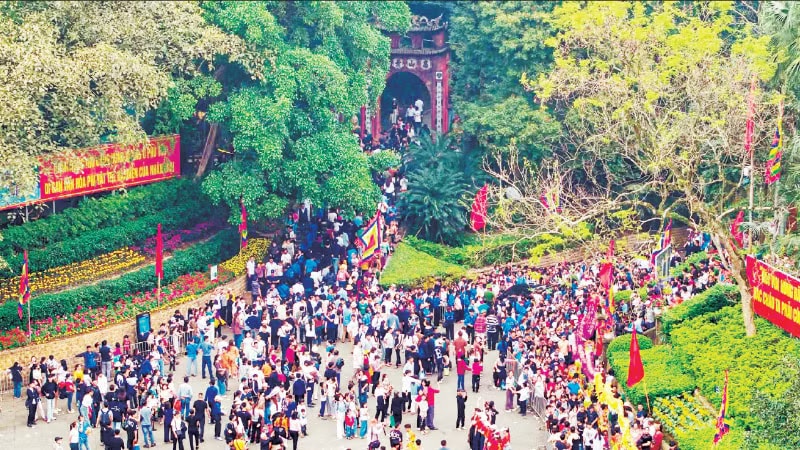
The Hung Kings Commemoration Day has become a sacred symbol in the hearts of every Vietnamese person. Throughout thousands of years of history, every year in the third lunar month, the hearts of millions of Vietnamese people from all over the country beat in unison, turning towards Hung Temple, respectfully lighting incense to express gratitude for the merits of their ancestors.
According to folklore researcher Pham Ba Khiem of Phu Tho province, few nations in the world have a common commemoration day for the entire community like this. From the tradition of ancestor worship in each family to the worship of the National Ancestor at Hung Temple, all combine to form a unique cultural whole, creating a strong sense of community cohesion and a distinct identity for the Vietnamese people. This is what makes the Hung King worship belief unique – a form of cultural activity that is both spiritual and deeply social in meaning.
From the legend of "Children of the Dragon and the Immortal," sharing a common egg sac from Mother Au Co, the awareness of the word "compatriots" has become the spiritual foundation for national unity.
In fact, the Hung Kings worship tradition is not only solemnly practiced at Hung Temple and over 400 other historical sites in Phu Tho province, but has spread widely throughout the country, even to Vietnamese communities living abroad. Wherever there is a Vietnamese community, the Hung Kings worship tradition is present. On the Hung Kings' Commemoration Day, millions of people from all over the country and overseas Vietnamese turn their thoughts to their roots with profound reverence. This is not only an occasion to pay tribute to our ancestors but also a "moment of connection" between generations, helping each individual to better understand their responsibility to themselves, their community, and society, just as President Ho Chi Minh once advised, "The Hung Kings built the nation; we, their descendants, must together preserve it."
Hung Kings Commemoration Day is not just a traditional holiday, but has become a symbol that embodies the national spirit, contributing to fostering national pride and awakening a sense of responsibility for the country's future. This demonstrates the enduring vitality and strong adaptability of the Hung Kings worship tradition in social life.
On Hung Kings' Commemoration Day and throughout the rest of the year, millions of pilgrims flock to the sacred Nghia Linh mountain to commemorate the Hung Kings and remember the contributions of their ancestors in building and defending the nation.
At Hung Temple, traditional ceremonies such as incense offerings, palanquin processions, and sacrificial rituals are held annually with solemnity and adherence to proper standards, creating a vibrant festival atmosphere and keeping the heritage alive within the community.
From Nghia Linh, the principle of remembering one's roots has spread throughout the nation's life in simple yet enduring ways. From the national worship of the National Ancestor to the ancestral altars in each family, from the national Ancestor Commemoration Day to the filial piety practiced in every household, gratitude has become a red thread running through the spiritual life of the Vietnamese people.
According to Associate Professor, Dr. Bui Hoai Son, a member of the National Assembly's Committee on Culture and Society, the Hung Kings worship belief is not a single ritual, nor is it associated solely with a single location in Phu Tho. It is a vast system of cultural practices, stretching from communal houses, temples, and shrines in the northern midland region to Hung Kings worship sites in central and southern Vietnam, and even among Vietnamese communities abroad.
The unique aspect of this belief lies in the fact that it creates a shared sense of national origin. The Hung Temple Festival is not only a cultural and spiritual event, but has also become a symbol of national unity.
From Nghia Linh, the principle of remembering one's roots has spread throughout the nation's life in simple yet enduring ways. From the national worship of the National Ancestor to the ancestral altars in each family, from the national Ancestor Commemoration Day to the filial piety practiced in every household, gratitude has become a red thread running through the spiritual life of the Vietnamese people. For this tradition from Nghia Linh to continue to flourish in today's life, it's not enough to simply preserve the values of the past; we must also ensure that this heritage lives on in the modern era.
LSpreading values in a new space
The Hung Kings Commemoration Day in 2026 takes place in a special context as a new development space is formed from the regional linkage between Phu Tho, Vinh Phuc, and Hoa Binh provinces. More than just a major cultural and spiritual event, this year's Hung Temple Festival carries a deeper meaning as a focal point for spreading sacred ancestral values to the Vietnamese community both domestically and internationally. In this context, Phu Tho – the ancestral land – is facing a great opportunity to affirm its role as a cultural and tourism center of the northern midland and mountainous region.
Following the expansion of Phu Tho's development space, this ancestral land is now presented with the opportunity to become a major cultural and tourism center in the northern midland and mountainous region. From the heritage of the Hung King era to the cultural identity of the Muong, Dao, and Tay ethnic groups, all combine to create a vibrant, profound, and highly exploitable landscape.
Associate Professor, Dr. Bui Hoai Son,
Member of the National Assembly's Committee on Culture and Social Affairs
According to Associate Professor, Dr. Bui Hoai Son, after Phu Tho expanded its development space, this ancestral land is facing the opportunity to become a major cultural and tourism center of the northern midland and mountainous region. From the heritage of the Hung King era to the cultural identity of the Muong, Dao, and Tay ethnic groups, all create a colorful, profound picture with great potential for exploitation.
The highlight of this year's festival season is the Ancestral Land Culture and Tourism Week, featuring a diverse range of activities that harmoniously blend traditional and modern elements. Visitors to Phu Tho not only have the opportunity to make a pilgrimage to the ancestral land and offer incense in remembrance of the Hung Kings, but also to experience the unique cultural atmosphere of this land of origin. Xoan singing – a representative intangible cultural heritage of humanity – is performed at ancient temples and shrines, giving visitors an authentic feel for the cultural and religious life of the local people.
In the ever-changing flow of time, the values of "one tree, one root, one family" remain true, serving as a spiritual foundation for the Vietnamese people to steadfastly move forward on the path of development, building an advanced culture rich in national identity in the new era.
Beyond cultural activities, the Hung Temple Festival is also an opportunity to promote Phu Tho's tourism image with its outstanding destinations. From the sacred beauty of Tay Thien, the poetic charm of Tam Dao, to the vast tea hills of Long Coc or the rare Thanh Thuy hot springs, the Hung King's Commemoration Day in 2026 has opened up a new image, both solemn and traditional, yet dynamic and modern.
This is not just a journey back to our roots, but also a journey of discovery, experience, and connection – where the past, present, and future blend into a unified whole.