

Days I still remember
Almost a month before the anniversary of her death, Mr. Tuan informed me that he wouldn't be able to come home. The project he was working on was entering its final stages; one wrong move and all his hard work would be wasted. Once this project was completed, he would get a promotion, a raise, and bonuses, and he would buy a new car to take his mother on a trip to enjoy her old age.
He said the same thing when he bought his first car. But then, whenever there was a family event, he couldn't even come home, let alone take Mom out. He was always busy. Everyone in this family is busy, except for me! Once, when angry with the three siblings, Mom said something that still bothers Hân. Tuấn's work, Hân's, and Ngân's studies always meant that during holidays and gatherings, if one was there, another was absent. Tuấn wanted a promotion. He was well-educated, capable, and talented, but without a mentor, he had to work much harder than others. Ngân was in her third year, with a heavy curriculum plus training points, internships, and foreign language skills. She was determined to achieve excellent results to stay at the university. Last month, she boasted to Hân, "I've saved up my scholarship money and almost have enough to buy Mom a gold ring to wear during Tet (Lunar New Year) like the other aunts and uncles." A daughter's gift has to be different.
As for Han, she didn't have the same career goals as Tuan, nor did she have the same academic burdens as Ngan. Yet, her vacation days—around ten days or more—were inconsistent; some years she got all of them, other years she didn't. Sometimes it was during the mid-year or year-end review period, other times the department couldn't have two or three people on leave at the same time, so they had to split up, prioritizing those with urgent matters first. Han didn't like arguing; she just silently did her work, often doing tasks that weren't her responsibility because "in a team, the spirit of solidarity and mutual assistance is essential."
This time, too, when she submitted her leave request, the department head frowned. Work was piling up, and she was taking time off. She hesitated, almost withdrawing the request, but the image of her mother pacing back and forth alone on her father's death anniversary flashed through her mind, and she stopped. Ngan couldn't come home either; she was taking her final exams. The other day, when she called, she saw how thin Ngan looked, with dark circles under her eyes from lack of sleep. Hearing Han's complaints, Ngan said she'd catch up on sleep after the exams and gain weight back immediately. There were only two semesters left, and she couldn't afford to be careless for a single moment. She explained that she hadn't used up all her leave, and that she'd brought her computer home to work on her schedule while she was at home. The department head didn't say anything more, just signed the request. That was all, yet for so many years Han had missed out on this right, even though it was a right she was entitled to.
This year, Mom didn't invite anyone; she felt bad about bothering everyone. Everyone's busy. If someone remembered to come and light incense for Dad, Mom would keep them for a glass of wine, that's all. It's just the two of us, Mom and I, making a few simple dishes he liked when he was alive is enough. Mom made a list for Hân to go to the market, telling her to buy the meat from this stall and the spices from that stall for the best taste. Mom stays home to clean, and if anyone remembers to light incense for him, she'll sit and chat with them, inviting them to stay. It's not like the two of us would just close the door and go to the market. Besides, Mom is old now, she can't go to the market for long. Her back aches terribly, and her legs and arms always feel so uncomfortable, like they belong to someone else.
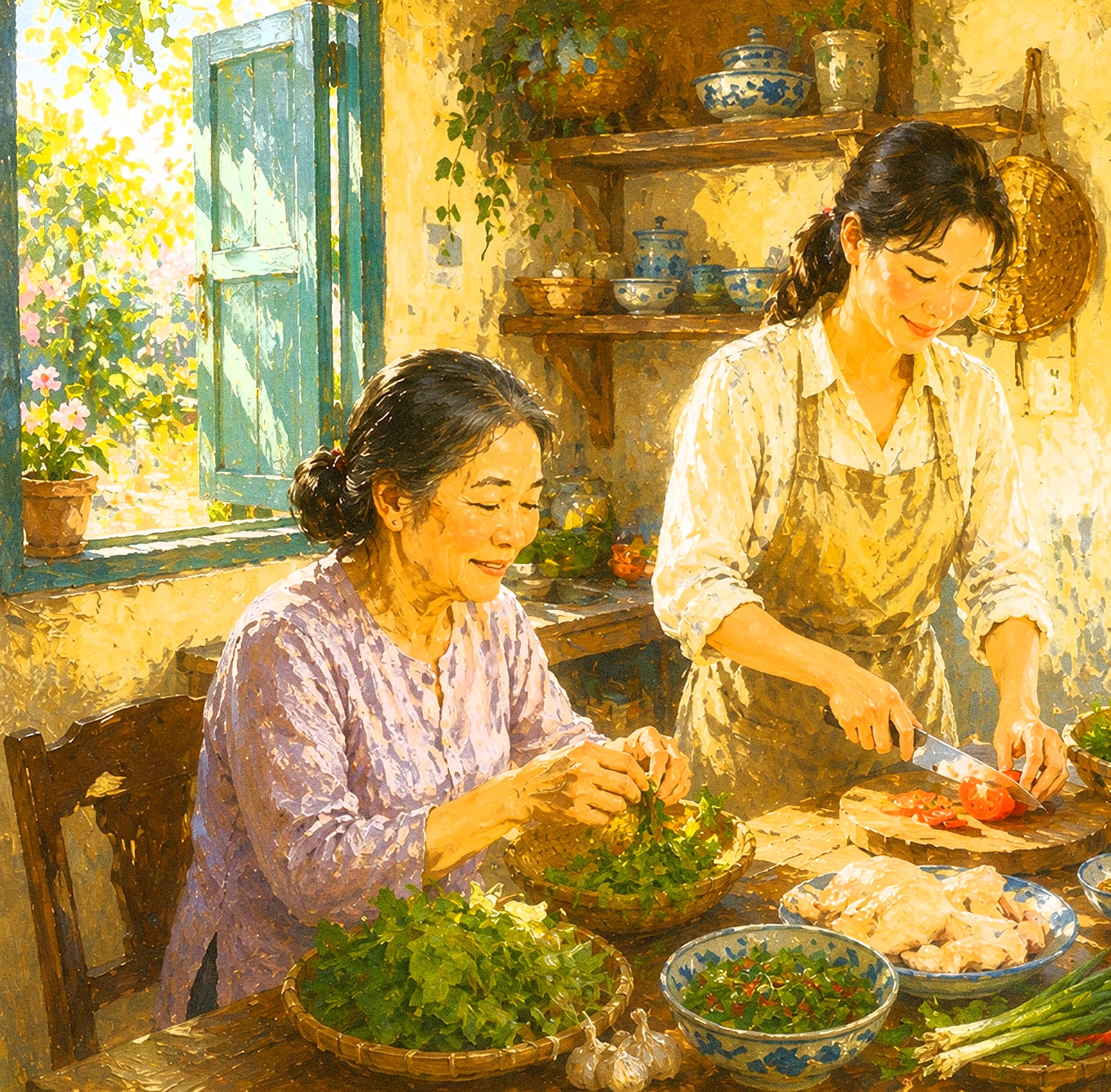
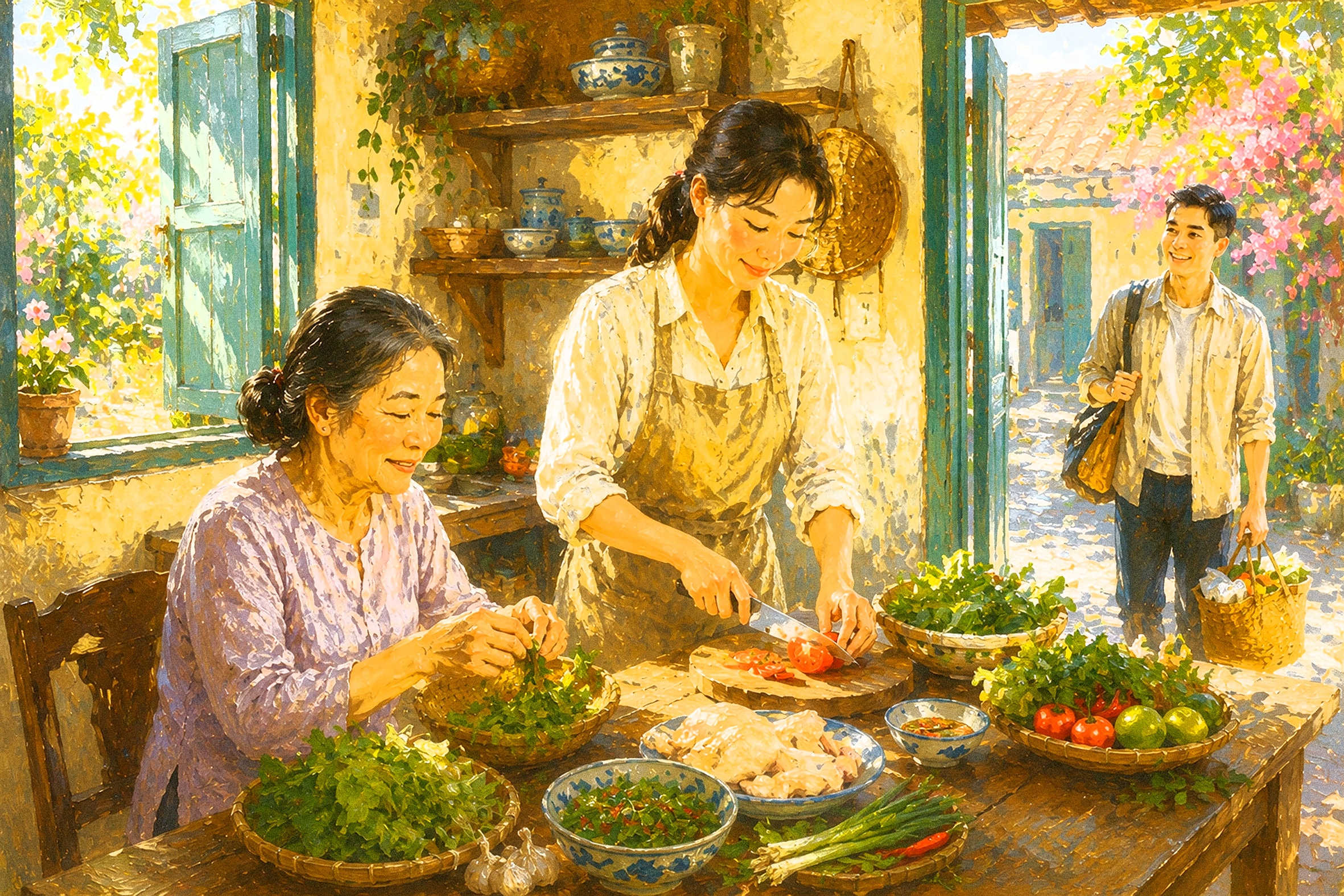
As her mother bent down to pick herbs, she suddenly froze. The basket of herbs scattered on the floor. Han quickly turned around and helped her mother sit down on a chair. Her mother was thin and frail, her back hunched, and her breathing ragged. In that moment, Han felt a sudden fear. No one can stay young forever, but why had she only now noticed how much her mother had aged? The years that had passed suddenly rushed into a single moment: the times the three siblings claimed to be busy, the times they missed ancestral ceremonies, the hurried phone calls promising to come home another time… What if one day the three siblings all returned home, but this kitchen was no longer there…? Han’s throat tightened, and it took her a while to finally speak.
Hân helped her mother upstairs to rest, but her mother worried that Hân would have a hard time cooking alone and that the dishes wouldn't suit her father's taste. There's only one anniversary of his death a year, and any mistakes would be heartbreaking for the deceased. Hân hugged her mother:
- Mom, you have to believe me. Ngân and I inherited your cooking skills; we learned how to cook after just one watch.
At eighteen, having left her mother's embrace, Han was still a clumsy, inexperienced girl. When Han went to school, her mother worried that she would be too awkward to cook a meal on her own, or that she would have to eat out, which was both expensive and unhygienic. But every child who leaves their parents has to learn to grow up. Even Ngan, the youngest child, who had been spoiled since childhood, now cooks as well as anyone else.
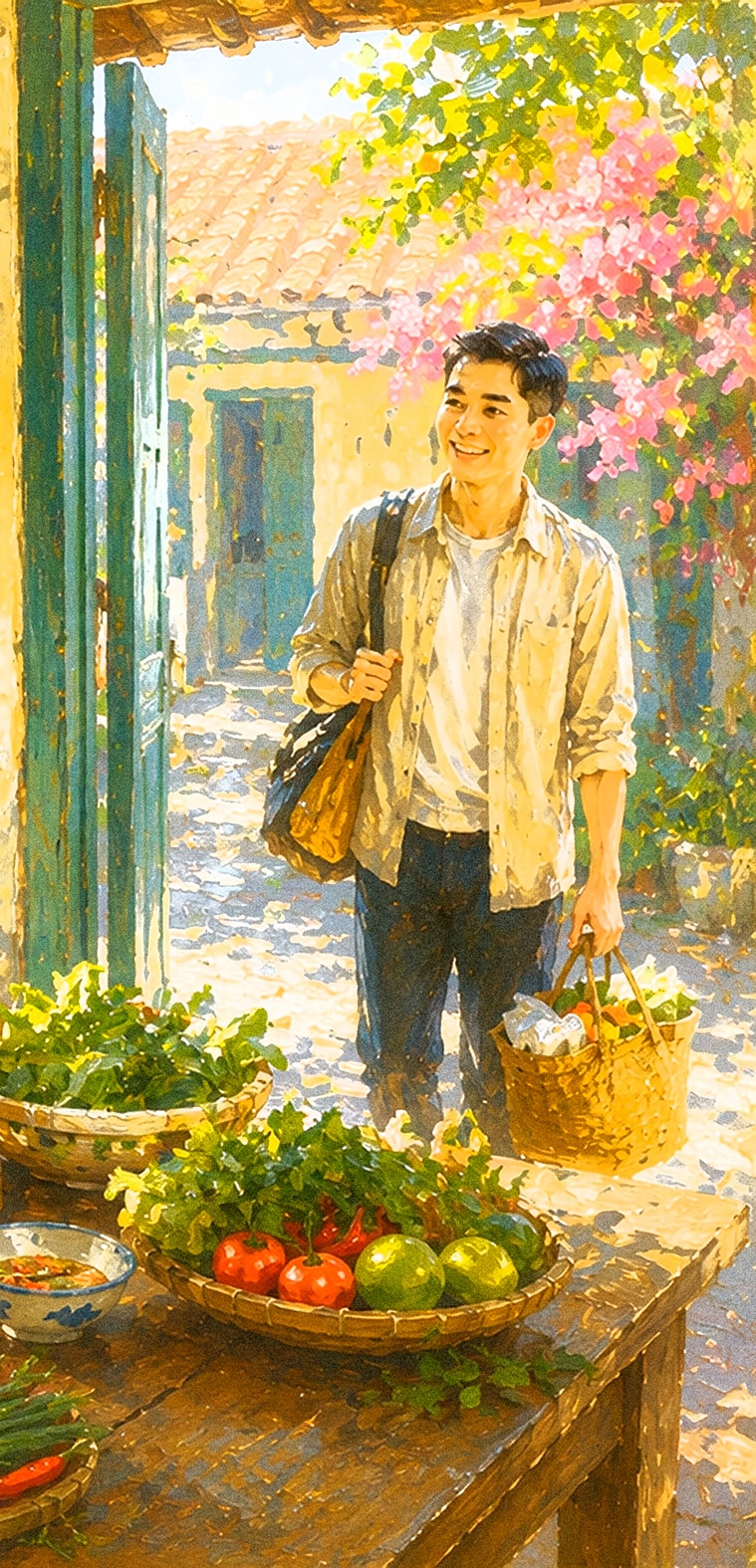
While my mother was still half-believing, half-doubting, a guest arrived. Uncle Chinh, a friend of my father's, remembered the anniversary of his father's death and came to light incense. The son drove his father there, and after lighting the incense, he eagerly went down to the kitchen to help Hân, ignoring Hân's mother's urging to go upstairs for a drink. Uncle Chinh waved his hand dismissively:
- Just leave her alone. When she's at work, she's fine, but when she's at home, she never minds cooking. She may look like that, but she's actually quite a good cook.
Uncle Chinh was a close friend of my father's from their time in the military. After leaving the army, they lived in different villages, but on every holiday, anniversary, or important occasion, Uncle and my father were always there to help and encourage each other. Despite their close friendship, Hân had never met Uncle Chinh's son. From what she vaguely heard Uncle Chinh talking to her mother, Hân knew he was an agricultural engineer who had worked abroad after graduating and had recently returned home about a year ago. He chopped up chicken, arranged it on a plate, washed fresh vegetables, and worked tirelessly like a member of the family. He did everything neatly and cleanly.
At home, Uncle Chinh and Mom were talking about Dad. Han missed her dad so much. No one thought he would leave so suddenly. Just the day before, he had called and said he would wait for Han to come home for the holiday, and he would fish in the pond to make grilled fish for her. The following evening, Tuan came to her rented room to pick her up and take her home. Dad had suffered a stroke, said he was tired, went to bed, and then passed away. That year, Tuan was in his third year of university, Han was in her first year, and Ngan was in sixth grade.
The conversation revolved around the deceased, the village, and then family matters. Uncle Chinh lamented that his son, Chính, still hadn't gotten married. Before, he worked far from home, and now that he's closer, he doesn't seem to go out anywhere, spending his time either working in the fields or taking care of the house. At his age, other children are already in school. His mother continued with the story of Tuấn. He's taking over from his father in supporting his older sibling's education, now he has to worry about the younger one. When urged, he says he'll wait until Ngân graduates. He says it's unfair to make a girl wait. He laughs and says his girlfriend is studying for her master's degree abroad, and she won't graduate until Ngân finishes. He says he has to work hard so he doesn't get rejected.
My mother turned to Han. She's almost thirty and still hasn't said anything about dating or marriage. Whenever the topic comes up, she just says she's too busy. Busy with what? Sometimes she doesn't even come home once a year.
Hân's face flushed. Glancing over, she saw that Chính's ears were also red. They tried to steer the conversation away from the topic of conversation upstairs. After a while, the conversation turned to work. Chính said that when he first graduated and went abroad to work, he was very enthusiastic. He was young, after all; he just wanted to go, to work, as long as it offered a future. But then his mother passed away. He couldn't make it back in time to see her one last time because the journey was long and the trains were difficult. After his mother's death, his father's health also declined. His older sister married and moved far away, and every time she called him, she would choke back tears. Without further hesitation, he quit his job and returned to his hometown. After years of working in high-tech agriculture in developed countries, he was now bringing that experience back to apply it in his homeland. He knew it would be difficult, but he knew that without trying, he wouldn't know if he could do it or not.
Hân listened to her brother's story, her hands busy cooking, but her mind seemed to wander elsewhere. When her father was alive, every time she saw her parents worrying and rushing around trying to earn enough money for the three siblings' tuition, Hân would always tell her father that she would definitely find a job that earned a lot of money. A lot of money would ease their family's hardship. Her father would just smile and softly say that the three of them could do any job they wanted, as long as it was honest and ethical, and that would make them happy. Even happier if the three of them found joy in the work they had chosen. Her father's words were so simple, yet Hân found them so difficult to accept.
Long working days, exhausting evenings returning home, meaningless silences she had grown accustomed to… all suddenly became vividly clear. It wasn't that she hadn't tried. It's just that the harder she tried, the more she felt lost in her own life. Sleepless nights, mornings when she didn't want to leave the house for work. Days when her mother was weary and worried sick, yet she couldn't find a way to visit her. Why couldn't she be brave just once, not only for her mother but also for herself in the days to come?
The offering meal was ready, and Chính helped Hân place it on the altar for her mother to light incense. A car pulled up to the gate. Tuấn was bringing Ngân home. He had a day off, and Ngân had two days off before her next exam. She called Tuấn and told him she dreamt of her father, with only her mother and Hân there, and that he was very sad. She said, "If you don't drive me home, I'll take a taxi myself." Then she took a taxi to school that night and still made it to the exam room in the morning. Tuấn gave up trying to convince her.
Tuan's girlfriend sent gifts to offer incense to his father. Han stood behind him, noticing how his back and bowed head resembled his father's. Han hadn't told Tuan and Ngan about her upcoming plans, but she would make them promise that in the coming years, no matter how busy they were, they would definitely arrange their schedules to come home and be with her mother. Even just sitting together for a while on her father's death anniversary would be fine. They had many plans, but their mother couldn't wait forever.
Ngân was bustling around her mother, Tuấn was chatting with Chính, Hân sat listening to Uncle Chinh recount memories of him and her father from the old days. Her father looked like he had just come from the fields, sitting on the steps enjoying the breeze, and asked Hân to get him a bowl of green tea.