

The US military's plan to modernize its nuclear triad and hypersonic weapons.
The Pentagon is accelerating a comprehensive upgrade roadmap, from the Sentinel intercontinental ballistic missile to the Dark Eagle hypersonic system, in order to maintain its advantage in the new era.
The U.S. military is entering a large-scale modernization phase for its strategic deterrence capabilities and long-range strike systems. The focus of this strategy includes upgrading the nuclear triad, developing hypersonic technology, and replacing outdated missile systems with more advanced ones, all expected to be completed by the end of this decade.
Upgrading the strategic nuclear triad
The current U.S. nuclear deterrence system is based on three main pillars: land-launched intercontinental ballistic missiles (ICBMs), submarine-launched ballistic missiles (SLBMs), and aircraft-launched nuclear weapons. Currently, approximately 400 LGM-30G Minuteman III missiles deployed since the early 1970s remain the core of the land-based system.
The Minuteman III missiles have a range of 13,000 km and are equipped with MIRV W78/W87 warheads with a destructive power of 300-350 kilotons. According to the roadmap, this system will gradually be replaced by the Sentinel LGM-35A starting in the early 2030s. The Sentinel is designed with three new fuel stages and upgraded electronics, focusing on practicality and cost-effectiveness rather than using hypersonic glide vehicles.
Strengthening underwater and air combat capabilities.
The U.S. Navy continues to maintain the UGM-133A Trident II D5 missile on its existing Ohio-class submarines and will deploy it on the new generation Columbia-class submarines. Meanwhile, the Air Force operates a diverse bomber fleet including the B-52H, B-2 Spirit, and the new B-21 Raider stealth bomber.
Breakthroughs in hypersonic technology and non-nuclear missiles.
In addition to its nuclear capabilities, the US is focusing on developing non-nuclear long-range systems and hypersonic weapons to counter modern challenges. Notably, the HACM (Hypersonic Attack Cruise Missile) project features a hypersonic jet engine, a range of 1,900 km, and speeds exceeding Mach 5.
On the ground, the U.S. Army is deploying promising new systems:
- PrSM missile:Replacing the ATACMS series, which initially had a range of 500km, the range is expected to be extended to 1,000km.
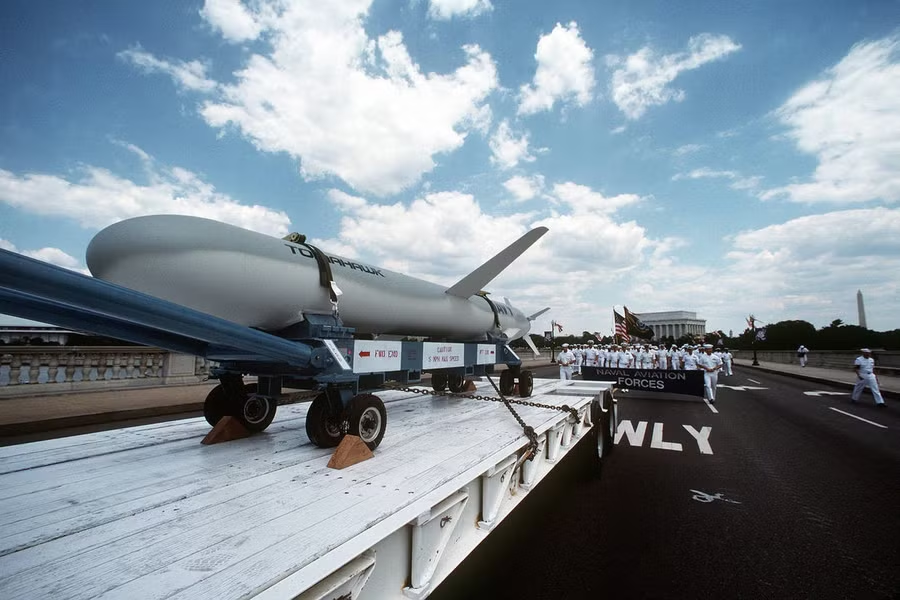
- Typhon system:It is capable of launching Tomahawk cruise missiles and SM-6 missiles (speeds exceeding Mach 5).
- LRHW Dark Eagle system:Using the C-HGB hypersonic glide warhead, it reaches speeds of Mach 17-20 and has a range of nearly 2,800 km.
New systems like Dark Eagle are expected to be fully deployed starting in 2026 in strategic areas such as Europe, Southeast Asia, and the Middle East. The successful integration of these technologies will determine the operational capabilities of the US military in this new era of confrontation.