

Lockheed Martin upgrades the Patriot system to eliminate the dead zone vulnerability.
The US military spent $61 million upgrading its Patriot system, integrating 360-degree control technology to intercept targets from all directions, following combat deployments in Ukraine.
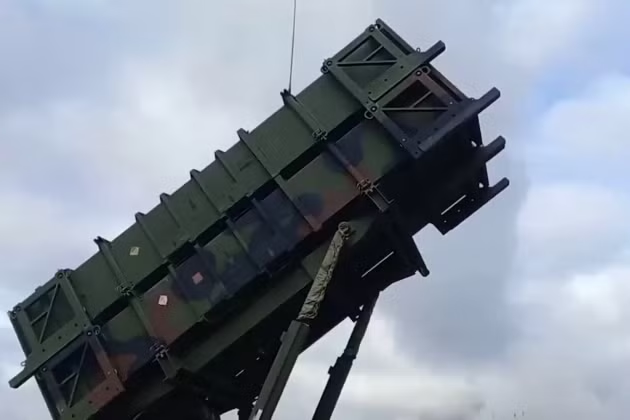
Lockheed Martin, the defense corporation, has just received an additional $61 million in funding from the U.S. Army to carry out a comprehensive modernization program for its Patriot air defense missile system. This contract focuses on addressing technical limitations arising from real-world operation in modern battlefields.
Addressing dead zone gaps in the field.
According to reports from Military Review and Defense Blog, the most important goal of the upgrade is to eliminate the "dead zone"—a critical weakness of the Patriot system. The current standard AN/MPQ-65 radar has a limited azimuth range, making it unable to detect or engage approaching targets from directions outside the radar's line of sight.
In military campaigns in Ukraine and the Middle East, Russian and Iranian ballistic missiles have thoroughly exploited this vulnerability. By directing attacks from unexpected angles, enemy weapons can penetrate air defenses before the Patriot's fixed launchers can react or are limited by the scanning angle of the main radar.
Two core components in the upgrade package
To thoroughly address the problem, Lockheed Martin will focus on developing two key technologies:
- Segmented Enhanced Missile Launch System (MSE Containerized Launcher):The design is based on standard shipping containers. This improvement not only simplifies the logistics process but also allows for faster deployment in emergency situations.
- 360-degree Remote Interception Control System (RIG-360):This is a software-controlled communication device that allows the PAC-3 missile to have comprehensive 360-degree combat capabilities. The RIG-360 helps the missile no longer rely entirely on the rotation direction of the main radar to receive control commands.
Network integration and multi-directional combat capabilities
Notably, the RIG-360 will be directly integrated into the Integrated Command and Control System (IBCS) architecture. This integration allows the Patriot to receive target data from any sensor in the connected network, instead of relying solely on the radar attached to the battery. After the upgrade, the Patriot will function similarly to a classic vertical launch system, capable of intercepting targets from any direction without requiring a complete repositioning of the entire battlefield.
The upgrade contract is expected to be completed by May 31, 2027. However, alongside efforts to improve the Patriot system, military experts have also expressed concerns about the Pentagon's larger-scale defense projects.
Challenges regarding the cost and effectiveness of defense.
Besides upgrading the Patriot missile defense system, the US "Yellow Dome" missile defense project is facing considerable skepticism. The US Congressional Budget Office estimates that the actual cost of the program could far exceed the initial estimate of $1.2 trillion.
Many experts acknowledge that, even with massive budgets, this system is unlikely to provide absolute protection. Technical analyses indicate that the current defense network is primarily effective against older generation missiles and risks being overwhelmed by the latest weapon technologies being developed by Russia and China.