

Identifying the 'echo chamber' trap on social media.
In the age of booming social media and artificial intelligence, every screen tap is not simply about receiving information, but can also be the beginning of an invisible "cognitive trap" called the "information echo chamber."
From sensational videos and inflammatory livestreams to fake news, deepfakes, and biased recommendation algorithms, social media users are increasingly caught in an emotional whirlwind where negativity is constantly amplified and repeated like an endless "echo."
"Wine room"Information" – a sophisticated method of influencing perception.
On May 20, 2026, the Hue City Police summoned 45 individuals for questioning regarding their interactions with anti-state content on social media. These individuals frequently commented on, shared, or reacted to posts from exiled reactionary accounts and groups, as well as other anti-government websites. In Nghe An, the Quynh Thang Commune Police fined an individual 7.5 million VND for sharing a distorted video manipulated by the reactionary organization "Viet Tan" using AI. Previously, similar cases of individuals being fined in other localities for posting false information about natural disasters and epidemics, insulting personal honor, slandering law enforcement, or sharing unverified information to gain views and cause public panic have also occurred.
An "echo chamber" is a closed information environment where users primarily receive viewpoints that align with their preconceived notions. In this environment, information with the same direction is constantly repeated, giving the recipient the feeling that it is "the common truth," "the opinion of the majority," or "the prevailing societal perception." Social media platforms' algorithms often record user behavior to continuously distribute content that closely resembles what they have previously seen.
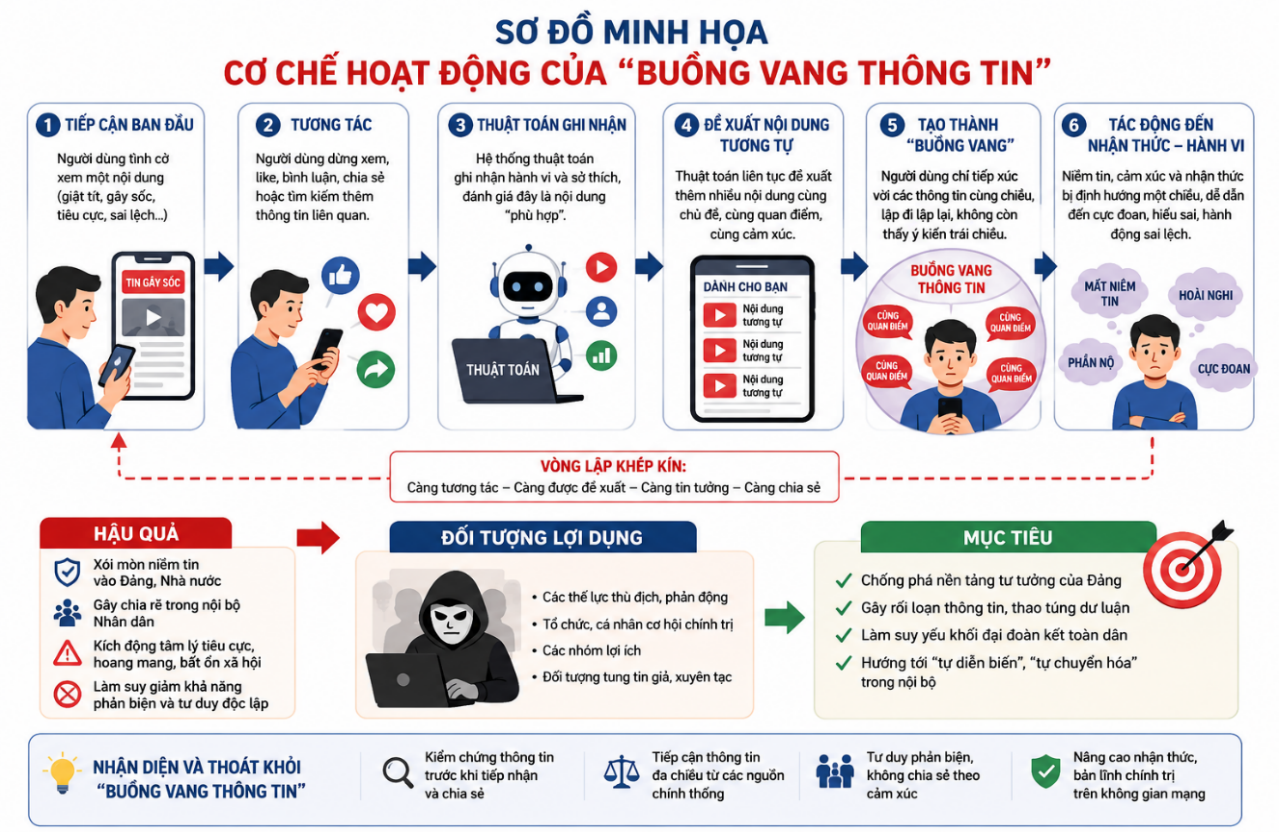
Taking advantage of this characteristic, hostile forces have built subversive "information ecosystems" with a large number of accounts, groups, video channels, and websites containing distorted, provocative, and biased content. Initially, this content is often disguised as "social criticism," "independent viewpoints," "telling the truth," "for the people," or "patriotism" to create a sense of objectivity and neutrality. However, behind it lies the goal of manipulating perceptions in a negative, extremist, and anti-government direction.
More dangerously, much of the current subversive content no longer attacks directly but employs a "slow and steady" approach. Through the repeated dissemination of biased, manipulated, or distorted information, these subversive elements gradually cultivate skepticism, dissatisfaction, and a loss of faith in the political system among viewers.
"Unusual" signs
According to DataReportal's 2025 Digital Report for Vietnam: Vietnam's population will reach 102 million by October 2025; the total number of active mobile connections in Vietnam will be 137 million, representing 134% of the population (an increase of 504,000 connections (+0.4%)). The total number of Internet subscribers in Vietnam will be 85.6 million, representing 84.2% of the population (an increase of 508,000 subscribers (+0.6%)). The number of social media accounts in Vietnam will be 79 million, representing 77.6% of the population.
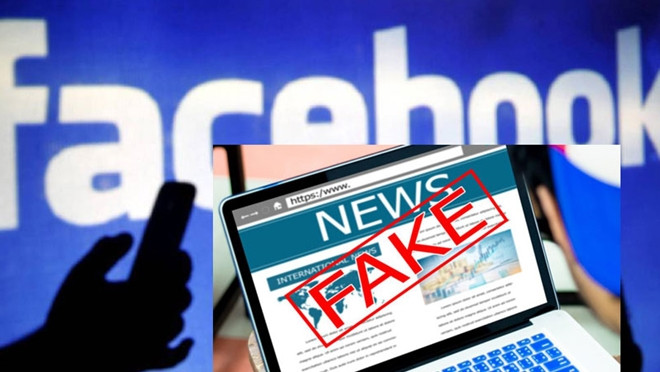
Besides maintaining a media system that guides and directs issues, reactionary forces continue to use social media platforms (Facebook, YouTube, TikTok, etc.) to conduct campaigns disseminating information against the Party, the State, and the Army, such as: Facebook pages of Western media and reactionary organizations like Viet Tan; Patriotic Diary; New Horizon Media; Thoibao.de… Currently, there are more than 3,500 websites, more than 300 YouTube and TikTok channels, and more than 100 X and Threads social media accounts that regularly post information against the Party and the State.
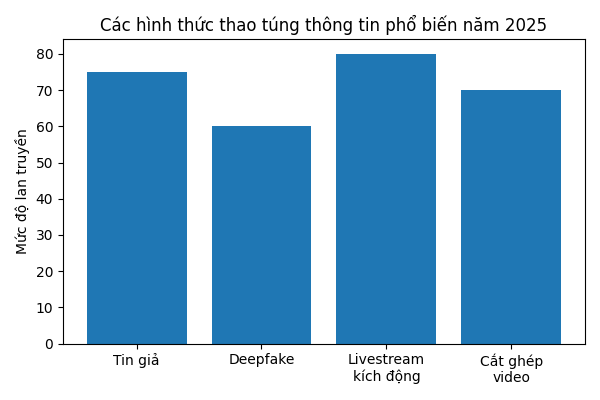
The year 2025 shows that the phenomenon of "echoing information" on social media in Vietnam shows no signs of abating, but continues to evolve in a complex and highly sophisticated manner. During the implementation of the administrative unit reorganization policy, many videos with sensational headlines such as "erasing hometown names," "citizens losing their rights," and "large-scale land reclamation" appeared on TikTok and Facebook. Many videos used AI voiceovers, manipulated images, and inflammatory comments to create the impression that "everyone is against it."
Some incidents of school violence are also exploited in an extreme way. Clips are edited to capture shocking moments, interspersed with tense music and inciting subtitles. After watching a few videos, users are further presented with similar content, gradually forming the impression that schools are full of violence and that society is in serious decline.
During periods of volatility in gold prices, real estate, or economic news in 2025, many social media groups spread videos predicting a "total crisis," "banks are about to collapse," or "withdraw your money immediately." Many people, out of anxiety, shared unverified information, inadvertently contributing to the spread of fake news and social panic.
Subversive tactics are becoming increasingly sophisticated and difficult to identify.
A notable development now is that hostile forces are no longer using only publicly available anti-government accounts, but have shifted to a more clandestine strategy, operating under various guises.
Some individuals falsely claim to be "researchers," "experts," "freelance journalists," or "independent critics" to publish misinformation. Others deliberately exploit socially relevant issues such as land, environment, people's livelihoods, and anti-corruption efforts to sow seeds of doubt and discontent among the population.
These "echo chambers" often share common characteristics: They only allow one-sided opinions, leading to one-sided and manipulative information; they constantly attack official sources; they promote discontent and extremism; they incite emotions instead of providing objective information; they glorify "conspiracy theories"; and they completely deny the country's achievements.
In particular, with the development of artificial intelligence, deepfake technology, and virtual account systems, creating "fake public opinion waves" has become increasingly easier. With just a spliced video, a distorted statement, or unverified information, subversive elements can organize mass sharing to create the impression that "the whole society is outraged."
Hostile and subversive forces are creating fake news and misinformation using advanced technology: employing bots and fake accounts to automate the dissemination of harmful and toxic information across various social media platforms. Furthermore, the dissemination of large amounts of information from numerous bots and fake accounts can create artificial trends on social media, thereby causing public confusion.
Many people, lacking the skills to verify information, have inadvertently become links in the spread of fake news, aiding and abetting false narratives without realizing the consequences. Numerous social media users, lacking the ability to check the reliability of information, have unknowingly become links in the distribution and spread of misleading content, facilitating distorted narratives. In doing so, they unwittingly contribute to the spread of false information without understanding the repercussions.
Building an "immune system" for social media users.
The ultimate goal of using information echo chambers is to manipulate social perception and to undermine public trust. In the face of the information explosion on the internet, every official, Party member, and citizen needs to proactively filter and verify information, clearly distinguishing between "malware" and: sensationalism and incitement; unverified information; deliberate accusations and inferences; outright denial; and incitement of opposition.
One of the crucial measures today is to improve digital skills and the ability to verify information among the public, especially young people, students, and university students. Social media users need to cultivate the habit of accessing information selectively, objectively, and responsibly, developing skills such as: checking sources; comparing information from multiple sources; not sharing unverified content; and not commenting based on extreme emotions.
At the same time, everyone needs to develop the habit of following information from mainstream newspapers, official agencies, and verified media sources.
Improve the legal framework and strengthen management.state
Therefore, it is necessary to continue improving the legal system regarding cybersecurity, personal data protection, digital platform management, and handling of misinformation. Cross-border technology companies must be responsible for complying with Vietnamese law, promptly removing infringing content, preventing fake accounts and accounts inciting subversive activities, and cooperating with authorities when necessary.
According to a report from the Nghe An authorities, in the past period, they have detected, verified, investigated, and compiled dossiers, issuing administrative penalties to 62 cases totaling 423.25 million VND; questioned, warned, and requested 396 individuals who posted articles with harmful or sensitive content to remove, correct, and commit to not repeating the offense; and reprimanded 4 journalists involved in journalistic activities. The Nghe An Police Department has initiated legal proceedings in 3 cases involving 3 defendants.
For websites where you can check the domain name of the source of the information, the source of harmful and malicious information is usually a website with a foreign domain (.com, .org), not a Vietnamese domain “.vn”. Use search engines to find articles on official websites (Government Information, Nhan Dan Newspaper, etc.) with similar content for comparison or seek advice from experts in the relevant field. Websites with extensions like .info, .asia, .vip, .tk, .xyz… are generally less common and have relatively low reliability. Meanwhile, websites with extensions like .com, .org, .gov (Government), .edu (education and training)… are usually more common and have a certain level of reliability; however, caution should still be exercised when accessing them if there are any suspicious signs of theft or collection of personal data. Furthermore, recently registered or relatively old domain names often carry suspicious characteristics, so caution is needed when transacting with or sharing information on them.
Building a strong "spiritual shield" in every citizen.
Ultimately, no "echo chamber" can manipulate perception if each individual possesses strong political conviction, the ability to distinguish right from wrong, and maintains composure amidst the chaotic flow of information on social media.
To achieve this, we need to continue: Strengthening political theory education, consolidating ideological resolve and stance. Enhancing education on historical traditions, culture, and patriotism for all segments of the population. Focusing on cultivating revolutionary ideals and a desire to contribute in the younger generation. Building a civilized and responsible online culture. Raising awareness and a sense of responsibility among citizens in the digital environment.

Furthermore, it is necessary to enhance the effectiveness of communication and legal education. Currently, many police forces have established numerous social media channels to disseminate legal information proactively and effectively, attracting large followings such as: Nguyen Kim Nghia's page (186,000 followers); Nguoi o ban's page (301,000 followers); A Luoi 1 Commune Police (19,000 followers); and Thuong Long Commune Police, Phu Tho Province (27,000 followers). These forms of communication have good interaction and play a significant role, earning the trust of the people.
In particular, a culture of "read slowly - think deeply - verify carefully" must be fostered in the digital society. One of the reasons for the proliferation of "information echo chambers" is the tendency to receive information emotionally, favoring sensational, extreme, and shocking content. When users only read headlines, watch short clips, and then hastily comment and share, they inadvertently become links in the chain of spreading misinformation.
At the same time, socio-economic development, continuously improving people's lives, thoroughly addressing people's welfare issues, and resolutely fighting against corruption and negative phenomena are important foundations and the best material "support" for building social trust in the Party and the State.
Practical experience shows that today's "people's support" not only directly serves the task of defending the Fatherland in war or conflict situations, but also forms the fundamental basis for maintaining political and social stability, creating a peaceful, safe, and healthy environment for rapid and sustainable national development. This is a vivid manifestation of the dialectical unity between national construction and defense, between socio-economic development and strengthening national defense and security, and between ground strength and digital space strength in the Party's new strategic thinking.