

E10 biofuel officially goes on sale: Reduces 2.5 million tons of CO2 annually.
The introduction of E10 gasoline from June 1st is expected to help Vietnam reduce hydrocarbon emissions by 10.9%, diversify energy sources, and move towards the Net Zero target by 2050.
From June 1st, E10 bioethanol fuel will be officially distributed nationwide. According to data from the Ministry of Industry and Trade, this transition is expected to reduce approximately 2.5 million tons of CO2 emissions annually, playing a crucial role in the transportation sector's greenhouse gas emission reduction strategy.
The carbon neutralization mechanism of E10 bioethanol
E10 gasoline is a fuel blend consisting of 10% ethanol (bioethanol) and 90% traditional mineral gasoline. Ethanol is produced from renewable resources such as cassava, sugarcane, and corn. Although the combustion of bioethanol still produces emissions, the amount of CO2 is equivalent to the amount of gases absorbed by the raw material plants during their growth, creating a sustainable carbon cycle.
Mr. Dao Duy Anh, Deputy Director of the Department of Innovation, Green Transformation and Industrial Promotion (Ministry of Industry and Trade), analyzed: Each liter of mineral gasoline consumed emits approximately 2.3-2.5 kg of CO2. Blending with 10% ethanol helps reduce the proportion of mineral gasoline by a corresponding amount on a total scale of about 1 billion liters per year, thereby significantly reducing pressure on the environment.
Operating performance and fuel efficiency
Real-world test results conducted by Hanoi University of Science and Technology in collaboration with Toyota and Vietnam National Petroleum Corporation on the Corolla Cross model show positive environmental and technical indicators:
| Evaluation index | The degree of change compared to mineral gasoline. |
|---|---|
| Hydrocarbon (HC) gases | 10.9% reduction |
| Carbon monoxide (CO) | Nearly 15% off |
| Fuel efficiency (during peak hours) | 0.3 liters/100 km |
| Fuel saving (off-peak hours) | 0.1 liters/100 km |
In particular, E10 gasoline has proven to be more efficient when used in hybrid vehicles, resulting in significant fuel savings under the challenging urban driving conditions in Hanoi.
Ensuring national energy security
Amidst the Middle East conflict destabilizing the global energy market, biofuels are seen as a crucial "shield." Mr. Bui Ngoc Bao, Chairman of the Vietnam Petroleum Association, stated that the use of E10 helps diversify supply sources and reduce geopolitical risks, as Vietnam currently imports 70-80% of its ethanol for blending.
Currently, domestic ethanol production capacity is approximately 25,000 m3 per month, meeting 25% of actual demand (around 100,000 m3). Expanding the biofuel market will create momentum for businesses to gradually increase their self-sufficiency in raw material sources and domestic production.
Global trends in green fuel development.
According to the World Energy Statistics 2025 report, the US is currently the world's largest producer of biofuels (accounting for 37%), followed by Brazil (22%). Many countries are accelerating this process, such as Sweden (up 62%), Canada (39%), and China (30%).
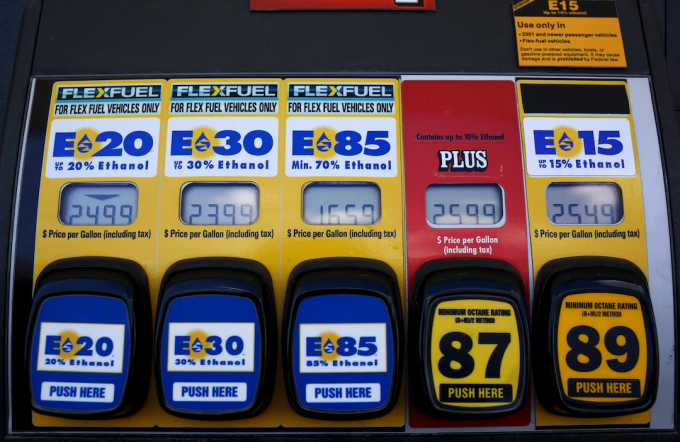
In the US, the Renewable Fuel Standard (RFS) has helped make E10 gasoline a popular fuel since 2010. The US Environmental Protection Agency (EPA) confirmed that the whole-cycle emissions of fossil fuels are 21% higher than those of ethanol with equivalent energy density.
Although there are still discussions about the environmental impact of farming and fertilizers, scientists are focusing on developing next-generation biofuels from straw, waste oil, and algae to optimize emission reduction without compromising food security.