

Cash flow is shifting towards mid-cap and small-cap stocks.
Cash flow remained cautious during the morning trading session on June 25th, while banking and securities stocks began to show positive signs.
Opening the trading session on the morning of June 25th, the VN-Index started positively, continuing its previous upward trend. However, the euphoria quickly subsided as the flow of money did not show a clear improvement, while leading stocks, especially those in the Vingroup group, underwent a simultaneous correction.
At the same time, slight fluctuations in the banking and securities sectors caused the VN-Index to reverse course and fall early. After more than an hour of trading, market breadth was fairly balanced between the number of rising and falling stocks; however, the VN-Index still lost more than 10 points, mainly due to the impact of VIC and VHM.
The banking and securities sectors are seeing more stocks rise, gradually giving way to green in each sector. These are considered to be the groups of stocks that have the potential to lead the market in the coming period, as Circular 25/2026/TT/NHNN of the State Bank of Vietnam officially comes into effect, providing further impetus to support the banking sector.
The overall market sentiment remains quite cautious, with capital tending to shift towards small and medium-sized stocks in search of opportunities. YEG stands out, having surged to its ceiling price and currently having over 1.4 million units remaining in buy orders at the ceiling price.
In addition, TVS, ANV, and SVD also hit their ceiling prices during the session and are currently maintaining gains of over 5-6%. Among smaller banks, VAB increased by 3.2%, while KLB, OCB, and NAB all recorded gains of around 2.5%.
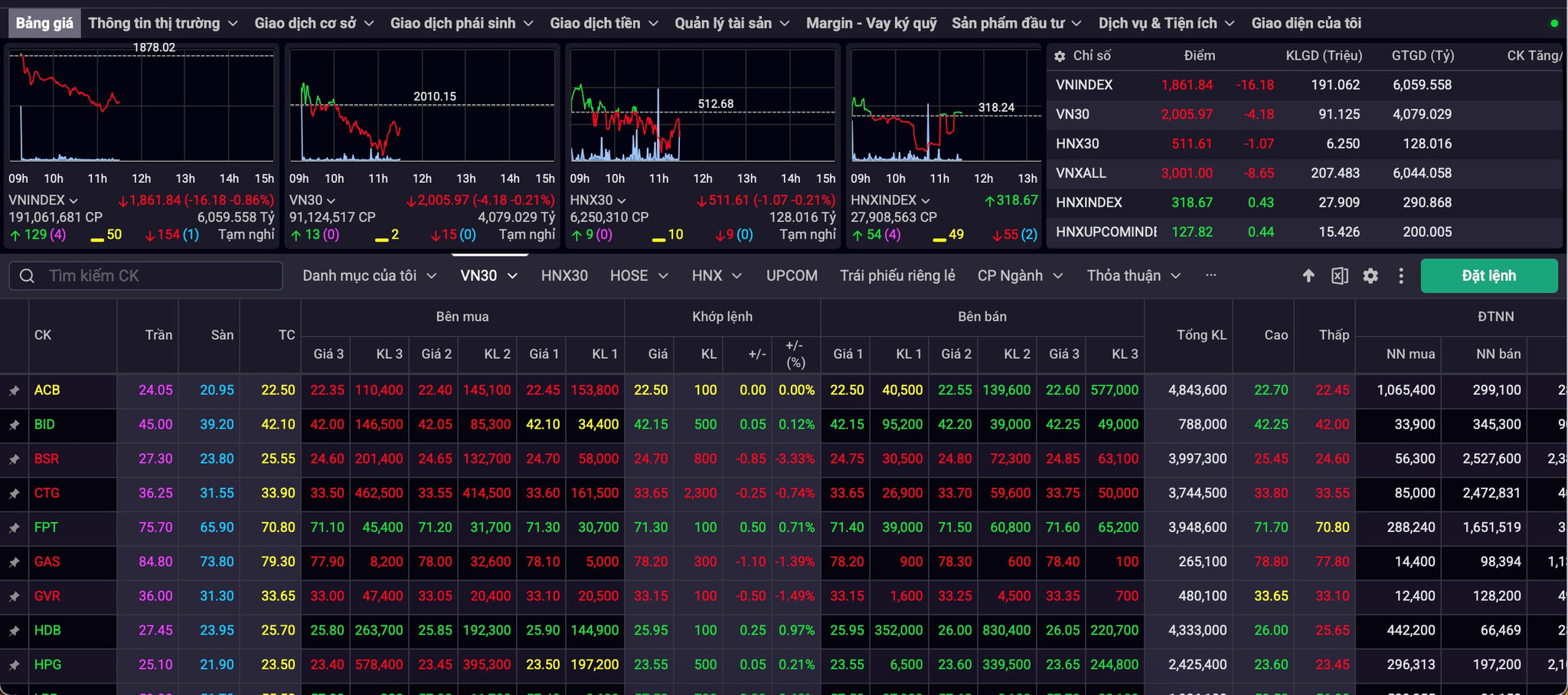
Red dominated the real estate sector with VIC (-3.25%), VHM (-1.88%), VRE (-1.65%), NVL (-1.93%), and KDH (-0.68%). Similarly, the oil and gas sector saw declines of BSR (-3.33%), PVD (-0.78%), PVS (-1.55%), PLX (-1.32%), PVC (-2.24%), and OIL (-0.08%).
The banking sector received positive signals, with TCB (+1.38%), LPB (+2.88%), HDB (+0.78%), STB (+0.84%), and OCB (+2.43%).
At the close of this morning's trading session, the VN-Index fell 16.18 points to 1,861.84 points (-0.86%) compared to the previous session. Meanwhile, the HNX-Index rose 318.67 points (+0.14%), equivalent to 0.43 points, and the UPCoM-Index increased 127.82 points (+0.35%), equivalent to 0.44 points.
Market liquidity reached VND 6,059.56 billion, with 191,000 shares traded. Across the sector, 129 stocks increased, 154 decreased, and 50 fell to their reference price.
According to experts at Kien Thiet Vietnam Securities Company, the VN-Index continued its upward trend for the third consecutive session, with the increase dominated by large-cap stocks such as VIC and VHM. Liquidity decreased compared to the previous session, with the trading volume nearly 9% lower than the 20-day average.
Cash flow was allocated to rising stocks more actively during the session compared to the previous session, rather than to falling stocks.
Market divergence remains high; upward momentum has not spread to many sectors but is concentrated in only a few stock groups, while liquidity remains low.
Therefore, although the overall market trend remains positive, investors need to maintain a cautious stance and patiently wait for more optimistic signals to spread before resuming net buying positions.
According to experts at Asean Securities Company, in this context, the optimal strategy for short-term investors is to maintain an average portfolio weighting, avoid chasing prices, and focus on trading within specific zones.
At the same time, closely monitor stock groups with unique stories, such as state divestment, economic development resolutions, market upgrade roadmaps, and the offshore oil and gas cycle.
Simultaneously, medium- and long-term investors should take advantage of corrections to support levels to gradually disburse funds into sectors with strong fundamentals and high liquidity such as Banking, Securities, Retail, and Public Investment.