

Graft
Mr. Ha cut across the trunk of the original tree, then used a knife to make a vertical slit down the middle of the cut. Next, he beveled the end of the scion and inserted it into the slit in the original trunk...
Ny AnJuly 9, 2026
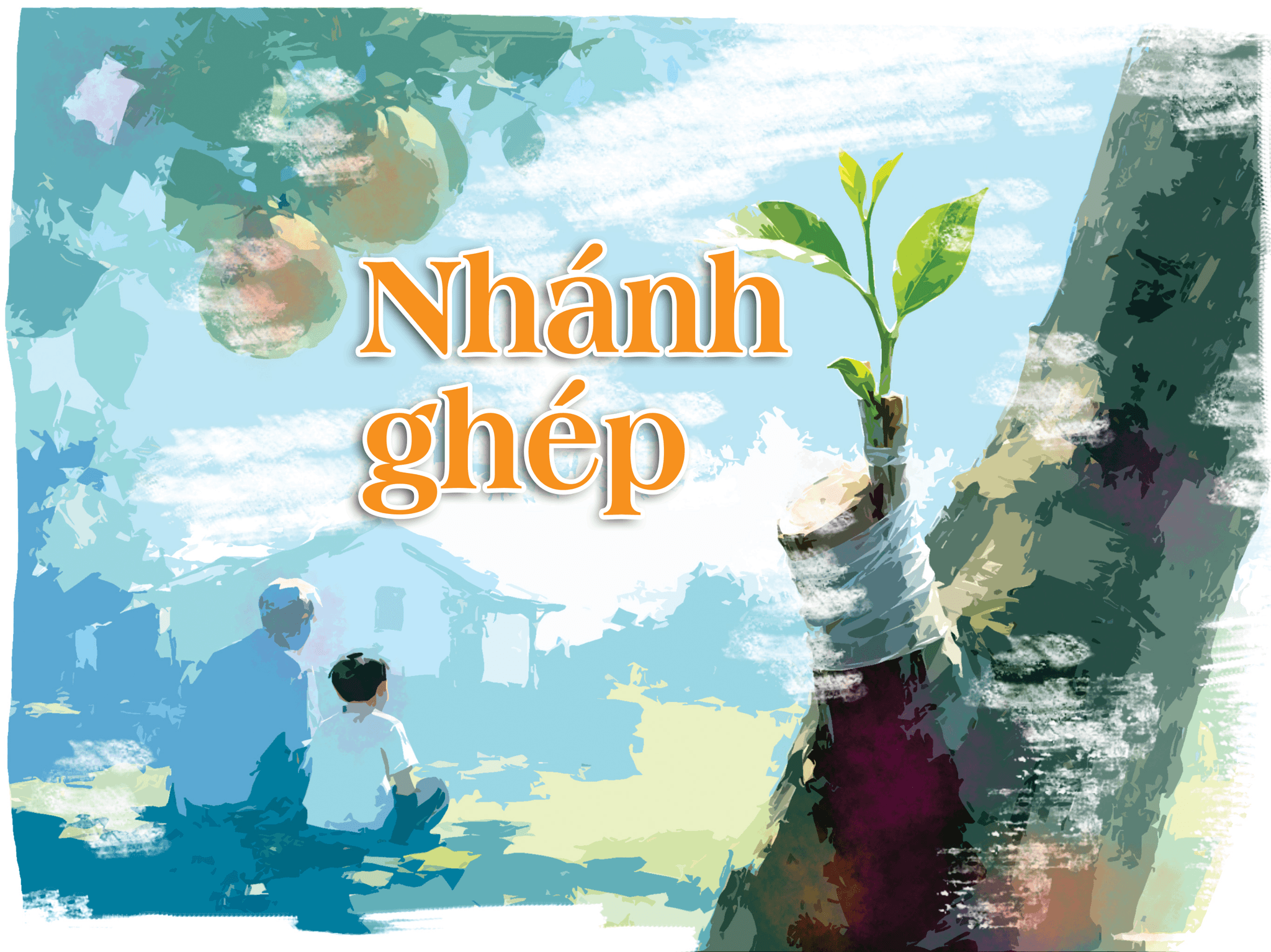
Mr. Ha cut across the trunk of the original tree, using a knife to make a vertical slit down the middle of the cut. Then he beveled the end of the scion and inserted it into the slit in the original trunk. He explained that for the pomelo tree to survive, the bark of the scion must be in contact with the bark of the original tree, so that sap from the original tree can flow through the scion via the meristematic tissue between the bark and the core. He tightly wrapped the graft with nylon string to help the two parts gradually fuse together and protect them from sun and wind.
While grafting pomelo branches, Mr. Ha hummed a folk song that Sao had heard so many times he'd worn out his ears:
"At the beginning of the year, eat pomelo fruit."
"We eat pomelos at the end of the year, that's why we carry pomelos on our shoulders."
Sao knew he was talking about his father, but his mind was focused only on the grafted branch. Sao closed his 9th-grade Technology textbook. Mr. Ha didn't need any textbooks. Sao's difficult Technology practical exercises were as easy as pie for him. It's true, sometimes textbook theory can't compare to the practical experience of grandparents.
Mr. Ha's pomelo orchard is older than Sao. In the arid region, the stubborn pomelo trees cling to the soil, bearing fruit as large as Mrs. Lam's fish stew pot. The scorching sun withers the leaves, but the unripe green fruits stubbornly grow. About three or four months later, by the time Sao starts school, the pomelos ripen to a golden yellow. The skin is thin, the segments are juicy, and the taste is pleasantly sour and slightly sweet, rarely astringent or bitter.
From the time he was a toddler following behind his grandfather like a little tail, Sao had been friends with the pomelo trees. When his legs were tired or he was bored, he would plop down and lean against the trunk, his eyes fixed on his grandfather. His father was always working outside, so Sao didn't know anyone else to play with besides his grandparents. But Mrs. Lam was so quick; one moment she'd be seen chopping vegetables for the pigs, the next she'd have the dishes washed. The next moment she'd been mixing flour, and in the blink of an eye, a dozen molds of rice cakes had been baked. Only Mr. Ha leisurely fed the hens while waiting to collect the eggs, slowly carried buckets of water to water the sweet potato vines, or leisurely walked around the base of the pomelo trees, checking for insects and spiders. He also wanted to do this and that quickly and decisively, but unfortunately, the doctor told him not to overexert himself. It seemed that the more gray his hair became, the more his ailments increased—high blood pressure, rheumatism, and diabetes. But he was still very healthy, and would live for another few decades, until Sao got married and had grandchildren for him to hold.
***
Sao ran out to check on the grafted pomelo branch dozens of times a day, afraid it would fall or wither and die. It looked so fragile, as if it didn't belong together. Mr. Ha told Sao to rest assured, to stop being so wary, that the tree wouldn't run away. Nature is miraculous; even a dry branch can sprout new shoots, let alone a branch nourished by the sap of the trunk. Sao was half-believing, half-doubting, but mostly believing. Because Sao herself was growing day by day thanks to the two frail old people.
I heard that my parents went to the same school. My grandmother beat my father so badly that his thighs were bruised, and forbade him from having any frivolous romantic relationships. At an age when he should be eating and studying, he was acting like an adult. Only an indecent girl would neglect her studies, spending all day focusing on her appearance, clothes, and hanging out with boys. In the school photo, my mother has a messy lion's mane haircut, her face slightly bowed, her big, round eyes looking up, and her lips pouting playfully.
The advice of the adults was like water off a duck's back; it didn't even wet the feathers of my father's feathers. Before he even finished his high school graduation exams, my mother gave birth to another child. My father stuffed his high school diploma into his pocket and went out into the streets to earn money to buy milk for Sao. Two children had to raise another child, a struggle in every way. Life always teaches us harsher lessons than school. My father was cheated out of his wages by a terrible contractor, and my mother worked as a hairdresser, cutting and washing hair until her hands were raw, but still couldn't afford diapers. Sao lay in a hammock with a thin cloth lining, listening to my grandmother's folk songs until she fell asleep hungry. If she woke up in the middle of the night, all she could do was grab a leg and gnaw on it, because there was no one to comfort her.
While my father was covered in dust, cement, and paint, my mother had red lips, blonde hair, and purple fingernails. Before I could even take my first steps, she had already left home for the city, chasing after the glittering lights. Without a formal wedding, my father had no choice but to let go. My paternal family was dirt poor, and my father had to shoulder the burden of raising another child. He was exhausted from working so hard, barely having time to breathe, let alone cling to an irresponsible woman. But every evening, he would come home reeking of alcohol. Overworked and drunk, he would crash into an oncoming truck. My paternal grandparents lost their son, barely twenty years old, and had to pay hundreds of millions of dong in compensation to the truck driver, who was hospitalized. Misfortune piled upon misfortune, debt upon debt; even the two elderly parents, working themselves to the bone, couldn't pay it all off.
People often say that poverty is often accompanied by bad luck. It seems that misfortune and misfortune aren't distributed equally to everyone. My grandfather died of tuberculosis with hemoptysis (coughing up blood), and a year later, my grandmother passed away tragically. Perhaps illness had eaten away at their aging bodies like a fat, white caterpillar silently burrowing into a tree trunk. My grandparents had no money for medical treatment! My five-year-old son, Sao, was left bewildered and alone, like a scarecrow stuck in a desolate field. Thankfully, he still had Mr. and Mrs. Ha and Lam.
***
Sometimes God is quite funny. Whenever He sees someone about to drown, He'll drop a rotten piece of wood for them to cling to. There's always a way to survive. Mr. Ha was my grandmother's neighbor, and he had a lush green garden, which Sao loved. From playing there, stealing unripe pomelos and getting chased around the yard with a stick, to being given a rice cake to stave off hunger while waiting for her father to come home from work, and then sitting around eating a bowl of rice with fish stewed with turmeric leaves – in the end, Sao became a grandchild, not related by blood, to the elderly couple who had struggled with infertility.
One day, while napping in a hammock under a pomelo tree, Sao overheard Mr. Ha sighing to Mrs. Lam. “A legless snake can roam five forests and seven mountains / A hen without breasts can raise nine or ten chicks.” Yet, a human being, with only one child, is abandoned by her mother. Because they pitied Sao for being abandoned by her mother, the elderly couple, despite their frugal lifestyles, couldn't bear to let Sao go hungry. Besides a tray of rice cakes, Mrs. Lam also carried a stack of lottery tickets, walking to sell them under the scorching sun of Central Vietnam. Many times, she looked at Sao with sorrow. “Poor child, all the inheritance we can leave you is probably just this fruit-laden pomelo orchard. You must study hard and find a way to support yourself.”
Mr. Ha would often point to the pomelo tree and advise Sao. A tree that isn't big enough, with shallow roots and a sturdy trunk, cannot bear flowers or fruit. Similarly, a person who isn't mature and sensible shouldn't try to shoulder worldly burdens. A heavy load will eventually break their back.
Sao was a diligent student, receiving certificates of merit and awards all over the house. Despite being in her adolescence, she wasn't rebellious at all. The child lived relying on the kindness of strangers, often learning to be humble early on. Ten years have passed since then. Ten years Sao mixed hair dye for her grandmother, ten years Sao read books and newspapers for her grandfather. Ten years of just the two of them, the old and the child, relying on each other.
The windless night was suddenly broken by dark clouds, and lightning tore across the horizon. Mother came home. Her high-heeled shoes clattered sharply on the cement floor. It felt like someone was cutting into her ears. Mother looked almost exactly like the only picture Sáo had. In fact, she looked more beautiful, more stylish in her short, tight-fitting, backless denim dress. Sáo should have been happy to see her mother. Or maybe she shouldn't have forced herself to be happy? It was so sudden, something her teachers hadn't taught her. Her grandparents had never mentioned it either. Besides glancing at her mother's appearance, Sáo's mind went blank, like a computer with a malfunctioning hardware.
***
Since her mother returned, Mrs. Lam has been restless, as if afraid the charcoal stove will burst into flames and burn the batch of fragrant rice cakes that are just starting to cook. She's probably afraid that Sao will follow her mother. Her mother wants to take Sao to live in the city permanently. "And who knows if she'll let the boy continue his studies?" Mrs. Lam whispered to Mr. Ha. She was restless, wanting to dissuade him, but hesitating, unable to find the right words. Mr. Ha calmly went to the garden to prune the pomelo trees. The leaf-rolling caterpillars had shriveled and curled the leaves. The caterpillars had drawn winding, silvery-white lines on the fresh green leaves. He cut off all the damaged branches and excess twigs to concentrate nutrients on the tree's fruit. Then he mixed garlic and chili water and sprayed it on the young shoots.
Normally, Sao would help Grandpa repaint the base of the pomelo tree. But lately, Sao has felt a terrible, suffocating sensation. Waking up in the morning, she sees her mother painting her nails in the living room, a strange and unfamiliar sight. The house, worn down by ten seasons of rain and sun, once occupied by only one person, is now filled with the deafening, chaotic music blaring from her mother's smartphone. Sao wants to run to the neighbor's pomelo orchard, separated by a row of tea bushes, but her legs feel heavy as if weighed down by stones. Her mother's return has turned Mr. Ha into a neighbor, even though the path between the two houses had never been blocked before.
Hearing the village loudspeaker announce that needy families could go to the park to receive free textbooks, Sao hurriedly gathered her stack of 9th-grade books, preparing to donate them. While her hands busily arranging them, thoughts raced through Sao's mind. These books were bought with the money from selling pomelos in Mr. Ha's garden last year. The year before that, and the year before that. The pomelo season coincided with the start of the school year. Sao had just passed her high school entrance exam with very high scores. Having eaten all the rice and fish, studied everything she knew, how could she possibly turn her back on it?
Sáo dashed across the street to the next house, straight down to the kitchen and hugged Mrs. Lam. “I’m not going anywhere. If I leave, who will eat the leftover rice cakes for you, who will eat the leftover pomelos for Grandpa?” Then Sáo ran back out to the garden. The pomelo tree looked so sturdy, but it was amazing. Or maybe it was because Mr. Hà was so skillful. After only a few days, the grafted branch was almost fused with the main trunk, and a tiny green leaf had already sprouted above, fluttering in the morning sun. Truly miraculous!