
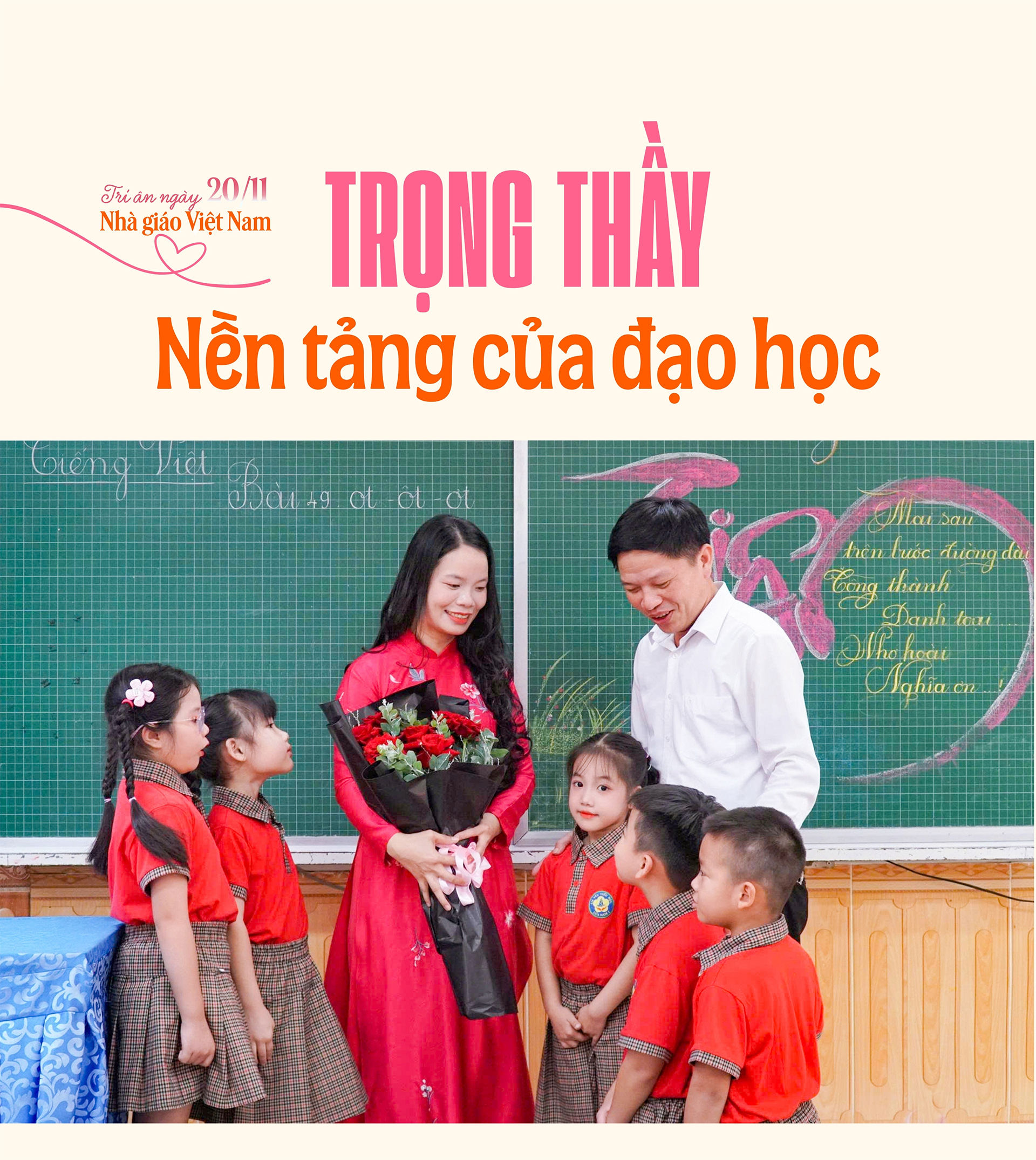
Respecting teachers - The foundation of learning.
As November arrives, bouquets of flowers and expressions of gratitude are once again dedicated to those who teach. Policies concerning teachers receive more attention, and society places high expectations on them. Yet, somewhere, teachers are still threatened and assaulted, students suffer violence, and some are treated unfairly even within their own schools. These sad stories don't represent the entire education sector, but they prompt us to ask: Is honoring teachers truly complete when respect is sometimes absent in the way people treat each other?
Dr. Hoang Ngoc Vinh
(Former Director of the Department of Professional Education, Ministry of Education and Training)
******
As November arrives, bouquets of flowers and expressions of gratitude are once again dedicated to those who teach. Policies concerning teachers receive more attention, and society places high expectations on them. Yet, somewhere, teachers are still threatened and assaulted, students suffer violence, and some are treated unfairly even within their own schools. These sad stories don't represent the entire education sector, but they prompt us to ask: Is honoring teachers truly complete when respect is sometimes absent in the way people treat each other?
The teacher's character, the student's loyalty.
In traditional Vietnamese villages, teachers not only taught literacy but also imparted moral values, upheld the tradition of learning, and contributed to shaping behavior within families and communities. Their teachings stayed with students throughout their lives, passed down to future generations. While not all old customs remain relevant, love of country and homeland, a thirst for knowledge, integrity, and the bond between teacher and student remain valuable aspects of Vietnamese culture.
Nghe An province, a land with a tradition of valuing education and respecting teachers, still preserves the story of Teacher Nguyen Thuc Tu in Nghi Loc. Among his students were Phan Boi Chau, Nguyen Sinh Sac, and many other patriotic intellectuals. In 1900, when he turned 60, his students made a congratulatory banner with the signatures of 36 people. After his death, in his eulogy, Phan Boi Chau mentioned the rarity and preciousness of a teacher who could educate his students to become virtuous individuals. The reputation of Nghe An's scholarly land is therefore not only due to its academic achievements, but also to the character of its teachers and the camaraderie among its students.
Today's teachers continue that mission in a different era. Teaching Vietnamese language, history, literature, or science can all foster patriotism, independent thinking, and a sense of preserving national identity. Teachers also awaken untapped potential and support struggling students so they can grow. Not every talented person was at the top of their class; many talents are recognized thanks to a teacher who sees beyond grades.
The Law on Teachers, effective from the beginning of 2026, recognizes the role of teachers in developing human resources and building an advanced culture rich in national identity. History shows that this contribution does not end after a single lesson but continues in the qualities and actions of generations who have grown up in schools.

Dignity belongs to the individual, not to titles awarded for achievements. Teachers, even if they make mistakes, must be treated fairly, have the right to explain themselves, and have their honor protected; while the respect of students and society must be built on competence, character, and responsibility. Protecting teachers does not mean covering up their shortcomings, nor does addressing misconduct allow anyone to humiliate others.
A single comment can boost a child's confidence, or it can leave them with feelings of inferiority for years. Strictness is necessary, but yelling and ridiculing are not education; love does not mean leniency. Teachers should set an example through their daily actions: preparing lessons thoroughly, grading honestly, not discriminating between poor and well-off students, not embellishing achievements, and having the courage to admit their own mistakes. If we want students to respect others, they must first be treated with respect.
Teachers cannot rely solely on kindness; they must constantly update their expertise. Knowledge is constantly changing, and students need to know how to question, verify information, and debate instead of just memorizing answers. Dedication without understanding will hinder students' progress; degrees and awards without compassion will also fail to maintain trust. Exemplary educators need genuine knowledge, sincerity, and integrity.
These values are also challenged by a pragmatic lifestyle. As some social relationships become increasingly focused on money, some parents treat tuition fees as a service purchase, students as "gods," and demand that teachers fulfill all their wishes; some educators allow material gain to infiltrate their teaching and student evaluation. Blaming everything on the market economy is easy, but incorrect: Families have the right to demand quality, and teachers must be fairly compensated, but education is not a purely commercial transaction. Money can buy equipment, books, and better learning conditions, but it cannot buy the integrity, dedication, and inspiring power of an exemplary teacher. Therefore, maintaining integrity is a daily responsibility of those in the profession, not something to be reminded of only on November 20th.
Preserving the dignity of the teacher.
The law recognizes the status of teachers, but those in the classroom feel respected through concrete actions. A teacher who receives flowers on a holiday but doesn't dare speak the truth in a meeting for fear of retaliation, a dedicated teacher who is excluded from opportunities for training or awards because of personal connections, or who is accused before being allowed to explain themselves, will find it difficult to feel appreciated. Schools may display the slogan "First learn manners, then learn knowledge," but if incidents of student bullying, physical abuse, threats, and assaults against teachers still occur, then the concept of "manners" has not truly become ingrained in daily life.
The governing body must translate policies into actual working conditions. This includes income that fosters job security, fair career development opportunities, transparent recruitment, accurate performance evaluation, rewarding the right people, and disciplining the right mistakes. Teachers need the right to receive professional feedback, to explain themselves, to appeal, and to be protected from violence and abuse.
In schools, responsibility is most evident in the leadership. A principal who listens to dissenting opinions, assigns tasks fairly, and doesn't shy away from teachers being abused or students being harmed will build more trust than mere speeches of gratitude. Unions and other organizations must speak out when the legitimate rights of teachers are violated, helping to resolve conflicts early on, instead of just organizing campaigns. The way complaints are handled and those who dare to speak the truth can sometimes be more meaningful than slogans on the wall.
Parents have the right to question the quality of teaching and protect their children, but paying tuition fees does not give them the right to insult or pressure teachers to change grades or alter disciplinary decisions. Students need to be taught gratitude and to speak up when they see injustice; teachers also need to know how to listen. When conflicts escalate on social media, it is even more important to calmly verify the facts, without hastily condemning teachers or ignoring students' voices. Violence from either side must be prevented and dealt with fairly.
Preserving the dignity of teachers is both the duty of every teacher and the responsibility of families, schools, management agencies, and the community. When teachers are respected, students are protected, and wrongdoings are handled fairly, the people's trust in the education system that the Party, the State, and the entire society care for is also strengthened.
November 20th has passed, the flowers will fade, but the mark of the teacher remains. Some teachers don't hold any titles, yet they help their students discover their potential, overcome failure, and live upright lives. Those students may become successful, traveling far and wide, but they will always remember the teacher who was once strict yet compassionate, who taught them both literacy and how to be a good person. That is the true and lasting honor, something no gift can measure.
Dr. Hoang Ngoc Vinh - Former Director of the Department of Professional Education, Ministry of Education and Training