
Rural waste management in Dien Chau
(Baonghean) - Previously, due to the large amount of household, industrial, and handicraft waste that was not collected, Dien Chau district had many environmental pollution hotspots. To overcome this, the district directed 32 communes to build centralized waste disposal sites, organize the collection of environmental sanitation fees, and form waste collection and transportation teams, with an average waste collection rate of 83%.
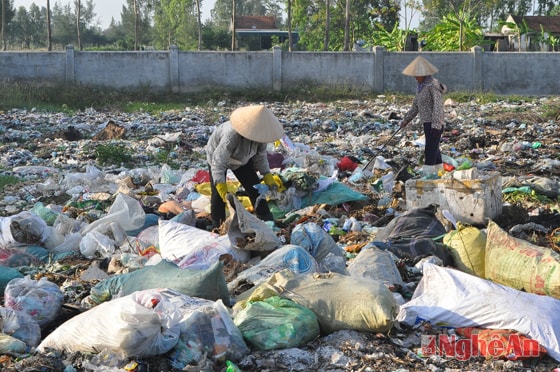 |
| Waste sorting after collection in Dien Bich commune (Dien Chau). |
Dien Tho commune has Nho Lam market, a wholesale hub for communes in the southern cluster of Dien Chau district. The high population density creates a significant amount of waste. Furthermore, the need for waste collection and treatment is urgent. However, the commune lacks the necessary budget for investment. Therefore, the commune held a meeting with residents and the People's Council to approve a contribution of 30,000 VND per household per year, totaling nearly 7 million VND; the commune also allocated funds for support. Thanks to this, since 2004, Dien Tho has had a 2,000m2 landfill built, with a total investment of over 11 million VND. Initially, the commune People's Committee collected waste fees and established a collection team, but after a while, this approach proved problematic. Because the collection team was under the direct control of the commune People's Committee, it failed to promote the self-management role of the hamlets.
Furthermore, due to a localized mentality of "each man for himself," people from one neighborhood sometimes throw garbage into another, leading to conflicts between residential areas. Therefore, the commune has assigned each neighborhood to collect fees and pay for garbage collection and transportation to a centralized landfill, with the commune only supervising and monitoring. Each neighborhood only has to contribute 10% of its environmental budget to the commune to cover the costs of sorting and processing garbage, as well as supplies (fuel, solutions for environmental treatment) at the centralized landfill. The amount of waste generated in the commune is nearly 200 m³/month, but because of proactive sorting and processing, the quantity is kept to a minimum. As the person who proposed and developed the plan to build a centralized garbage dump, Mr. Dang Quang Trung - Vice Chairman of the People's Committee of Dien Tho commune, said: "Before implementing the current garbage collection schedule of once every 10 days, the commune calculated that if garbage were collected 2-3 times a week, people would have to pay a higher fee than the current rate of 40,000 VND/household/year. Therefore, people must be conscious of proper waste disposal and need to sort waste at the source to reduce the amount of waste." Walking along the clean village road, Mr. Doan Van Be, Head of Hamlet 2, Dien Tho commune, happily said: "Since the centralized garbage dump was established and the garbage collection schedule was implemented, the village roads and alleys are much cleaner. Each section of road is assigned to the hamlet's organizations for supervision and monitoring, so the hamlet doesn't have to remind people much. Collecting environmental sanitation fees is also simpler; as long as the hamlet announces it, people fully comply."
Coastal communes such as Dien Bich, Dien Kim, and Dien Ngoc have also made significant progress in waste management and environmental sanitation. Dien Bich commune, for example, was the most problematic area before 2012 due to the large and small bags of garbage scattered along the village roads to the Dien Kim bridge and the embankment, even including animal carcasses, causing severe environmental pollution. This situation forced the commune's Party committee and government to take action. Based on the district's directives, Dien Bich commune registered to develop a model of "effective public mobilization" for environmental sanitation to focus on raising awareness and encouraging people to change their habits of littering. Simultaneously, they sought solutions to plan temporary markets and invest in a centralized waste disposal site within the commune. To date, after nearly three years of implementation, Dien Bich has completed a fairly modern market, relocating households from the temporary market along the inter-commune road, contributing to traffic safety and environmental sanitation.
Regarding the landfill, after three years of preparation and mobilization (from 2011 to 2014), with a collection rate of 40,000 VND per worker per year, Dien Bich commune successfully constructed a centralized waste disposal site in accordance with planning regulations, covering an area of over 4,000 square meters and costing 670 million VND. Mr. Nguyen Viet Man, Secretary of the Dien Bich Commune Party Committee, happily stated: “Since June 2014, when the centralized landfill became operational, all eight hamlets have established waste collection teams, collecting waste twice a week, on Tuesdays and Saturdays. Currently, the commune has assigned the hamlets to collect waste collection fees of 15,000-20,000 VND per household per year. The commune only collects 10% to cover the costs at the centralized landfill, leaving the rest for the hamlets to cover collection expenses. Currently, the daily amount of waste is very large, nearly 2 tons per day, so the commune is continuing to consider options to ensure the landfill is used effectively.” In addition to investing in centralized waste disposal sites, with the support of associations and organizations, residents of Dien Bich, Dien Ngoc, and Dien Kim communes have boldly borrowed capital to build sanitary facilities. To date, over 60-70% of households in these coastal communes have sanitary facilities. As a result, the quality of environmental sanitation in residential areas has improved significantly. The sea dike in Dien Bich and Dien Kim communes, once a hotspot for waste, has now become a cool, clean pedestrian walkway.
After three years of implementing the Project accompanying Decision No. 16 "Expanding the model of waste collection, transportation, and treatment for environmental sanitation in the area," 32 out of 39 communes in Dien Chau district have established centralized waste disposal sites and formed relatively well-functioning waste collection teams. The remaining seven communes without waste disposal sites – Dien Nguyen, Dien Phuc, Dien Xuan, Dien Truong, Dien Tan, Dien Loi, and Dien Ky – are either lacking land allocation and funding or are still under construction. Mr. Ngo Dinh Tuu, Deputy Head of the Department of Natural Resources and Environment of Dien Chau district, stated: Since the implementation of Project 16, despite budgetary difficulties, to encourage localities and communes that build waste disposal sites exceeding 500m2 that meet standards, in addition to land allocation support, the district provides an additional 50 million VND; and annually provides additional support in terms of garbage bins and carts, which has led to greater enthusiasm among the communes. To date, the environmental situation and waste management in the area have been fundamentally improved.
However, from studying the practical aspects of constructing and operating centralized waste disposal sites in the communes, we have found that, along with infrastructure development, the communes need guidance on scientific waste collection methods, moving towards sorting and processing waste on-site, thereby minimizing pollution and increasing the capacity of the landfills. In reality, besides communes like Dien Tho and Dien Kim, where waste is sorted and processed after arrival at the centralized site, some communes still dump waste haphazardly, without following any planned areas, leaving it entirely to the waste collection teams. The average waste collection rate for the entire district reached 63%, 8% higher than the same period last year, but there is still a significant amount of uncollected waste. Therefore, Dien Chau needs to be more decisive in this area. Dien Chau also lacks a centralized district-level waste disposal site and advanced, scientific waste treatment solutions. The "effective community mobilization" model in environmental management in Dien Chau needs to be encouraged and improved.
Nguyen Hai


