
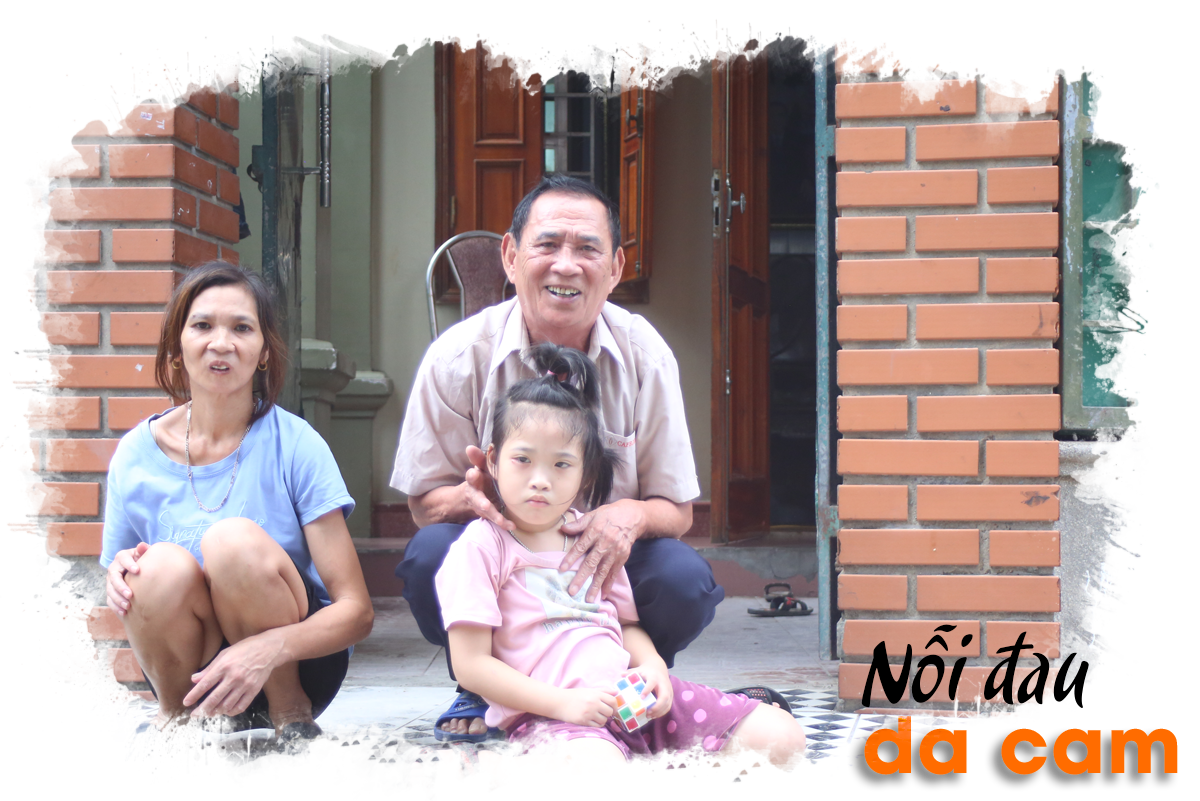
Mr. Hoa rubbed his eyes throughout the conversation. For the past few years, his eyesight had been gradually deteriorating, and now, day or night, all he could see was a thick fog. His third of four children dragged his feet toward the table, muttering that he wanted water. His eldest grandson, twelve years old, lay curled up on the bed like a five-year-old, his head tilted as he looked at the strangers visiting the house. Behind the door, locked with chains, Mr. Hoa said, were his two daughters. “They’re mentally ill,” he said.
Sometimes, what is left behind after a war is more terrifying than everything it took away in the battle. Like tens of thousands of other "Agent Orange families," Mr. Hoa's family is a poor household in the commune. Their regular meals consist of vegetables dipped in soup, boiled water with lemon juice, and a bowl of peanuts mixed with fish sauce. What can they do? Nine mouths to feed depend solely on the Agent Orange victim allowance, and even his wife's hard work selling goods at the market doesn't bring in much. "But only my father and I benefit, the grandchildren don't," Mr. Hoa explained specifically to the journalist. He believes that Agent Orange has left its mark on the third generation, and possibly even the fourth or fifth. However, that's just his personal belief; in terms of policy, the grandchildren of resistance fighters exposed to chemical toxins are not eligible for preferential treatment.

Across the country, there are millions of Agent Orange victims like Mr. Hoa's family. In Nghe An province, more than 30,000 people who fought or served on battlefields were exposed to chemical toxins; 14,486 victims, including more than 9,500 direct victims and over 4,900 indirect victims. Finding "Agent Orange status" for the next generation of grandchildren and great-grandchildren remains a long story. Mr. Hoa – after several visits to the commune office to inquire about policies for his grandchildren and receiving the same answer – has long since stopped thinking about it. He thinks about something else. He blames himself.
In countless silent moments sitting at the rickety table, amidst the meaningless screams of his two daughters, in a house constantly reeking of foul odors from his children and grandchildren's uncontrollable behavior, Mr. Hoa thought about many "what ifs": What if I hadn't married, she wouldn't have suffered so much! What if I hadn't fathered them, their lives wouldn't be this miserable! What if I hadn't arranged a marriage for my eldest son, who would have thought it would be passed down to my grandson!
Yet, the man never once considered the alternative: what if he hadn't participated in the battle, what if he hadn't traversed those barren forests, what if he hadn't more than once bent down to gulp down water from those murky, chemical-reeking rivers… He knew that if time could be turned back, he would still make the same choice. In the midst of national peril, on the thin line between life and death, he and his comrades would only press forward.
The small radio was playing the news. In August, amidst many important national events, the press also dedicated time to publicizing the Day for Victims of Agent Orange in Vietnam on August 10th. Mr. Hoa turned up the volume. He listened intently to the story of Mrs. Tran To Nga – a French woman of Vietnamese origin, born in 1942, a former reporter for the Liberation News Agency. She lived and worked during the war years in many areas heavily affected by Agent Orange, such as Cu Chi and Binh Long… One of her children died in infancy from congenital Tetralogy of Fallot, and another suffers from the inherited hemolytic anemia alpha thalassemia. She herself suffers from many serious illnesses, yet she has never wavered in her more than 10 years of persistently filing lawsuits against 14 chemical companies that supplied Agent Orange to the US military for use in the Vietnam War. She said: "I sue because I am Vietnamese." I'm not suing for myself, but for all the victims of Agent Orange in Vietnam. I believe in justice and truth.
Mr. Hoa was deeply moved when he heard that. A belief that had seemed to have faded away seemed to come alive again within him…

Illustrative image: Source material