

A brief overview of Tiananmen Square and the Forbidden City.
(Baonghean.vn) -Tiananmen Square consists of a large square in Beijing, symbolizing the center of China, and a city gate north of the Forbidden City. During the Ming and Qing dynasties, Tiananmen Square served as the imperial court's base; there was no square there, it only came into existence after the Boxer Rebellion.
According to Chinese history, the square was built in 1417, measuring 880 meters from north to south and 500 meters from east to west (covering an area of 440,000 square meters).
In ancient times, the square was called Thừa Thiên Môn. During the Qing Dynasty in 1651, the gate was renovated and renamed Thiên An Môn. A highlight that attracts visitors' attention is the very large portrait of Chairman Mao Zedong hanging above the north gate. In 1949, after China's liberation, the square was expanded to its current size. In the center of the square are the Monument to the People's Heroes and the Mausoleum of Mao Zedong. The two massive ancient gates are Thiên An Môn to the north and Tiền Môn to the south. Along the west side of the square is the Great Hall of the People, and to the east is the National Museum of Chinese History. Chang'an Avenue, used for parades, runs between Thiên An Môn and the square.
Here are some pictures of Tiananmen Square and the Forbidden City.
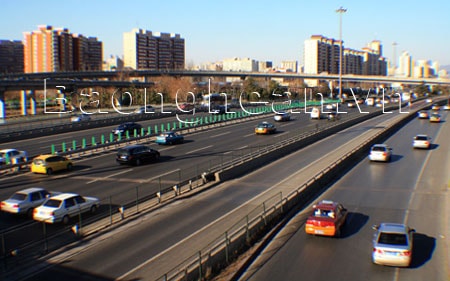
Beijing streets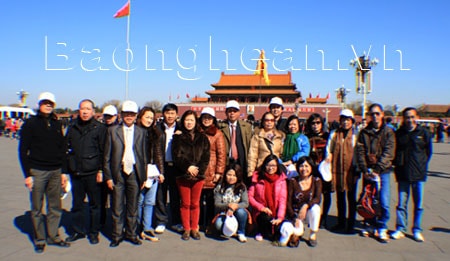
The Nghe An Newspaper delegation and Vietnamese tourists, organized by Hoang Viet International Travel Center and Hong Gai Travel Company, took a commemorative photo at Tiananmen Square.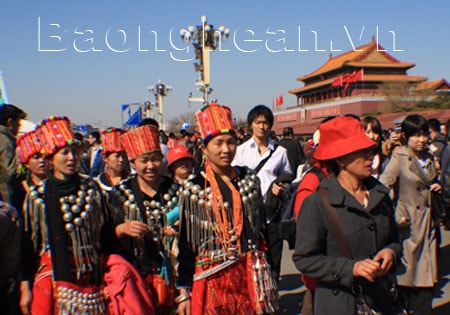
Domestic tourists, mostly ethnic minorities from China, visit Tiananmen Square.
Visit the Forbidden City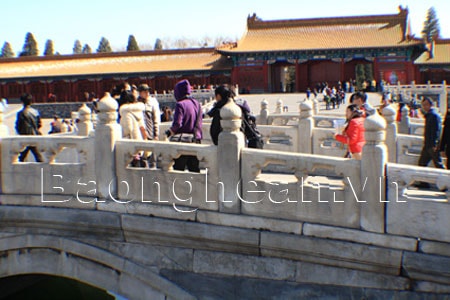
The path for a fourth-rank official to ascend to the imperial court.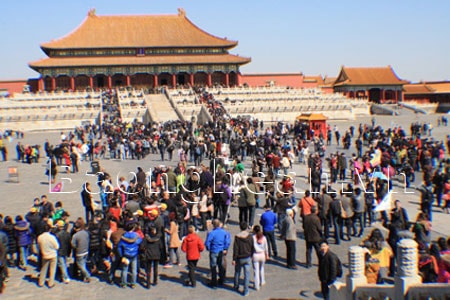
Thai Hoa Palace - where the royal court was held.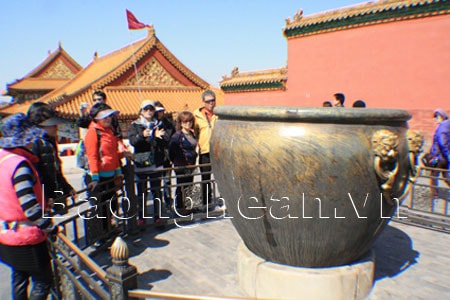
Bronze cauldrons containing water are placed on either side of the main hall.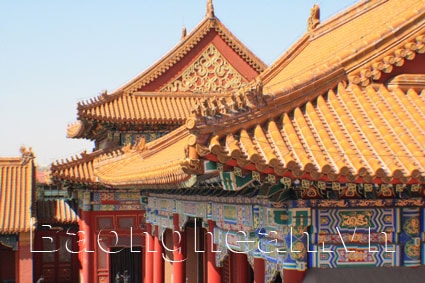
The distinctive architecture of the Forbidden City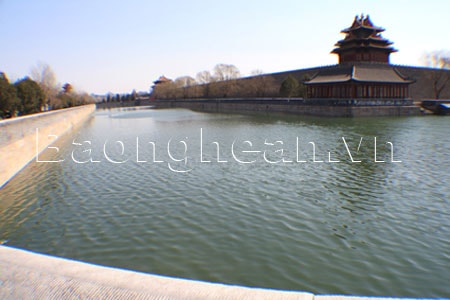
The moat surrounding the Forbidden City is 52 meters wide and 7 meters deep.
Phan Nguyen