
Techniques for raising purebred wild boars
In recent years, in some provinces in the Southeast region such as Binh Phuoc, Tay Ninh, Dong Nai, and Ho Chi Minh City, there have been many large-scale wild boar farms, with some raising hundreds of animals; and there are also many households raising a few as pets. Market demand and prices have attracted many investors. I. Breed and Breed Characteristics
In recent years, in some provinces in the Southeast region such as Binh Phuoc, Tay Ninh, Dong Nai, and Ho Chi Minh City, there have been many large-scale wild boar farms, with some raising hundreds of animals; and there are also many households raising a few as pets. Market demand and prices have attracted many investors.
I. Species and breed characteristics
Name: Wild boar is a wild pig breed that is being domesticated in Thailand and Vietnam. Wild boars are generally divided into two groups: the long-faced group and the short-faced group.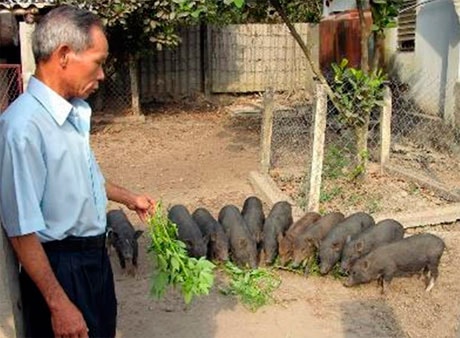
(Illustrative image: Nongnghiep)
Body shape:
Wild boars are well-proportioned, agile, and move nimbly. They are slightly lean, long-bodied, with a straight back, slender belly, long, small legs with sharp hooves, a long neck, a small head, a long and pointed snout, small, erect, and sensitive ears, a very keen and strong sense of smell, and fur that is reddish-brown, reddish-black, or dark gray. Each hair follicle has three tips, and the hair along the spine and neck is thicker, longer, and stiffer. The shoulders are usually higher than the rump, and the tail is small and short, only reaching the hock. Males have well-developed tusks, while females have two rows of teats, each with five well-developed and prominent nipples.
Growth, development, and reproduction:
Wild boars typically give birth twice a year, with 5-10 piglets per litter. The first litter (firstborn) has 3-5 piglets, while subsequent litters (more than 7-10 piglets) are larger. The average weight of newborn piglets is 0.5-0.9 kg. Piglets have striped coats (yellow stripes running along the body against a black or brown background). These stripes disappear when the piglets are over 3 months old. The average adult weight is 80-100 kg for males and 50-70 kg for females.
Wild boars are 7-8 months old, weighing 30-40 kg (female boars can be bred at this age, while male boars can be bred 1-2 months later). The gestation period is similar to domestic pigs (approximately 114-115 days). The birthing time (from the first to the last piglet) is 1-2 hours. The birthing process occurs naturally, without human assistance or intervention.
II. Breed Selection and Mating
Select the breed:
Select animals with a slender head, deep chest, broad body, lively, straight back, compact abdomen, strong legs, and well-developed and functioning reproductive organs. If possible, selection should be based on ancestry (lineage, parents, grandparents...), the animal itself (appearance, adaptability, production capacity...), and subsequent generations.
Phối giống và thời điểm phối giống thích hợp:
Chu kỳ động dục của heo rừng là 21 ngày, thời gian động dục kéo dài 3-5 ngày. Thời điểm phối giống thích hợp vào cuối ngày thứ 2 hoặc đầu ngày thứ 3 (tùy theo giống, tuổi) cho nên cần theo dõi biểu hiện của heo lên giống. Khi âm hộ chuyển từ màu hồng tươi sang màu hồng tái, có nếp nhăn và dịch nhờn tiết ra nhiều, tai chĩa về phía trước, có phản xạ đứng im (mê ì) là thời điểm phối giống thích hợp nhất.
Bỏ qua 1-2 lần động dục đầu tiên, vì cơ thể chưa hoàn thiện, trứng rụng ít, phối giống, đậu thai hiệu quả thấp. Khi heo cái có dấu hiệu động dục ta cho heo đực tiếp xúc với heo cái. Heo đực sẽ phối giống liên tục, bất kể ngày đêm đến khi nào heo cái không chịu nữa mới thôi. Có thể cho phối kép 2 lần vào lúc sáng sớm và chiều mát (hoặc ngược lại). Sau 21 ngày, heo cái không động dục trở lại, có thể heo cái đã có bầu.
III. Livestock housing
Chuồng trại rất đơn giản, tuy nhiên, phải nắm vững một số đặc điểm và tập tính của heo rừng để bố trí chuồng trại. Nên chọn chỗ đất cao và thoát nước tốt để nuôi. Chỗ nuôi nên có nguồn nước sạch, không những cung cấp đủ nước cho heo uống mà quan trọng hơn là nó sẽ duy trì được hệ thực vật phong phú và giữ được độ ấm thích hợp cho heo rừng.
Chuồng trại càng cách xa khu dân cư và đường sá càng tốt. Bản năng hoang dã đã đưa chúng vào tình trạng hết sức cảnh giác và luôn hoảng hốt bỏ chạy khi nghe có tiếng động.
Ta có thể nuôi heo rừng theo kiểu thả rông trong những khu vực có cây xanh, có rào che chắn xung quanh. Điều quan trọng là hệ thống hàng rào phải hết sức chắc chắn. Ta có thể vây lưới B40 thành các vườn nuôi tự nhiên, có móng kiên cố (vì heo rừng hay đào hang), mỗi vườn nuôi rộng 50-100m2 (tùy theo khả năng đất đai) trong đó có chuồng nuôi rộng 20-30m2 nuôi khoảng 4-5 heo cái trưởng thành, chúng sẽ sống và sinh sản trực tiếp trong khu vực này. Heo đực giống nuôi riêng, mỗi con một vườn, mỗi vườn nuôi rộng 40-50m2 trong đó có chuồng nuôi rộng 5-10m2. Chuồng nuôi, có mái che mưa, che nắng, cao trên 2,5m, nền đất tự nhiên, có độ dốc 2-3%... đảm bảo thông thoáng, sạch sẽ, mát mẻ về mùa hè, ấm áp về mùa đông, tránh nắng nóng, mưa tạt, gió lùa...
Với quy mô ban đầu nuôi 10 con (2 đực/8 cái) cần có 3 vườn nuôi. Hai vườn nuôi heo cái sinh sản, mỗi vườn rộng 50-100m2 trong đó có 2 chuồng nuôi, mỗi chuồng rộng 20-30m2. Một vườn nuôi heo đực giống rộng 40-50m2 trong đó có chuồng nuôi rộng 5-10m2...
IV. Food and food rations
Bao gồm, thức ăn thô xanh (các loại cỏ, cây, mầm cây, rễ cây ), thức ăn tinh (hạt ngũ cốc, củ quả), thức ăn bổ sung muối khoáng như tro bếp, đất sét, hỗn hợp đá liếm... Thực tế cho thấy, heo rừng thường tìm đến nương rẫy mới đốt kiếm tro, đất sét để ăn...
Khẩu phần thúc ăn cho heo rừng thông thường: 70% là rau, củ, quả các loại (có thể sản xuất tại trang trại), 30% là cám, gạo, ngũ cốc các loại, hèm bia, bã đậu... Mỗi ngày cho ăn 2 lần (sáng, chiều), một con heo lai trưởng thành tiêu thụ hết khoảng 2-3 kg thức ăn các loại.
Thức ăn cho heo rừng, do con người cung cấp có thể thiếu dinh dưỡng, nhất là đạm, khoáng và sinh tố... cho nên ngoài việc bổ sung thức ăn tinh giàu đạm, muối, sinh tố, cần thiết phải bổ sung thêm đá liếm cho heo rừng liếm tự do (lưu ý để nơi khô ráo, mát mẻ). Hỗn hợp đá liếm bổ sung khoáng có thể mua hay tự trộn theo tỷ lệ (muối ăn 100g; sắt sun phát 100g: đồng sun phát 50g; diêm sinh 100g; vôi tôi 1.000g... đất sét vừa đủ 3kg) cho heo liếm tự do cũng chỉ hết khoảng 20- 25 gam/con/ngày.
Wild boars primarily feed on plants. It's important to avoid overfeeding them with nutrient-rich feed, as this can alter the quality of their meat and sometimes lead to digestive disorders like diarrhea.
Pigs eat fresh green fodder and drink little water; however, they still need sufficient clean, cool water for free access. The pens must be cleaned daily, leftover food removed, and feed and water troughs washed thoroughly.
V. Care and Nurturing
Boar:
It is crucial for breeding. With proper management and care, one boar can mate with 5-10 sows. Breeding boars should be kept separately and given a nutritious diet, especially with concentrated feed rich in protein, minerals, and vitamins. On breeding days, supplementary nutrient-rich concentrated feed, 1-2 chicken eggs, salt, and vitamins should be given freely.
Female breeding pigs:
Wild boars are prolific breeders and excellent mothers (they are very good at raising their young). In the wild, when a sow gives birth, she takes care of and nurtures her piglets herself and separates from the herd when they grow up.
Wild boars breed naturally year-round. The gestation period is also 3 months, 3 weeks, and 3 days (114-115 days) before giving birth.
For pregnant sows, during the first two months of pregnancy, feed them a normal diet of vegetables, fruits, grains, etc., supplemented with mixed concentrate feed, 15g of salt, and 20g of minerals daily. After two months until farrowing, it is necessary to supplement with nutrient-rich concentrate feed, especially protein, minerals, and vitamins. On the day of farrowing, feed the sow thin porridge with little salt and few green vegetables to prevent milk fever.
For lactating sows, the feed ration must ensure the quantity, quality, and variety of feed... When piglets are 1.5-2 months old and can eat feed provided by humans, the mother should be fed a normal ration. It is not advisable to breed sows in estrus during the lactating period, as this makes conception difficult or results in unsatisfactory piglet numbers and quality.
Piggy:
Piglets don't need assistance at birth or umbilical cord cutting; within about 30 minutes to an hour, they can stand up and nurse. At 15-20 days, they start toddling around and begin eating grass and plants. When piglets are 1.5-2 months old and strong enough to eat food provided by humans, they are weaned and separated from the litter for breeding.
Newborn piglets can weigh 300-500 grams each, reaching 3-5 kg at 1 month old, 8-10 kg at 2 months old, 25-30 kg at 6 months old, and 60-70% of their adult weight at 12 months old. With normal feeding methods and diets, piglets can reach 25-30 kg after 6 months and be ready for slaughter. To ensure good growth and development, piglets should be given colostrum as early as possible, ideally within 1-2 hours of birth. They should also be given daily exercise and close contact with humans.
VI. Veterinary Work
Wild boars are relatively new domesticated animals, so they have high resistance to disease and are less prone to outbreaks. However, wild boars are still susceptible to some diseases such as swine fever, diarrhea, hemorrhagic septicemia, foot-and-mouth disease, liver fluke disease, scabies, and other common ailments.
Gastrointestinal diseases (such as bloating, flatulence, abdominal pain, diarrhea, food poisoning...): When wild boars suffer from certain gastrointestinal diseases, you can use medications for abdominal pain, bloating, flatulence, and indigestion by oral or injectable forms. Alternatively, you can feed them 5-10 kg of wild coconut leaves, or supplement their diet with bitter or astringent foods and drinks such as green guava, carrots, betel nut roots, coconut roots, etc., which can also help. To prevent disease, feed must be hygienic, nutritious, and free from foul-smelling or moldy food.
Mechanical injuries: For minor injuries, clean and apply antiseptic; for major injuries, clean and disinfect before and after suturing, and inject a combination antibiotic such as Ampicillin, Tetracycline, or (Penicillin + Streptomycin)... Wild boar skin has a rapid regeneration ability, so it heals quickly.
Pneumonia: Pigs with pneumonia usually have a high fever, loss of appetite, or refuse to eat. Treatment involves broad-spectrum antibiotics.
Constipation: You can give laxatives or give foods that promote bowel movements...
Intestinal parasites: Pigs infected with intestinal parasites are often stunted, slow-growing, and have worm and fluke larvae in their feces. Deworming is necessary for these pigs.
External parasites: Ticks, mites, scabies, flies, mosquitoes, etc., attach to the skin, suck blood, and transmit diseases, but this rarely happens. Due to their wild nature, wild boars are not afraid of mosquito or other insect attacks. However, when wild boars are infected with external parasites, antiseptic ointments or sprays can be effective. To prevent external parasitic diseases, regular cleaning and disinfection of the enclosures and surrounding environment is recommended.
Value and market:
This pig breed has several advantages: its meat is delicious and distinctive, its skin is thin and crispy, it's lean with little fat, and has low cholesterol content, making it very popular with consumers and therefore fetching a high price. It also has low investment costs, consumes little feed, has a short rearing time, is easy to raise, reproduces well, has a high survival rate, and is less prone to disease.
According to the National Agricultural Extension Center - LY