

Dong Ha and Xuan Bac confectionery villages
(Baonghean)When talking about traditional craft villages in Nghe An known for producing peanut brittle, peanut candy, and other confectionery, one cannot fail to mention the two traditional craft villages of Xuan Bac and Dong Ha in Dien Van commune (Dien Chau district). From autumn to spring, these two villages become bustling and busy as they enter their peak production season.
Even before reaching the entrance of Dong Ha village (Dien Van), the aroma of various sweets and candies wafted through the air. The fragrant scent of peanuts and sugar in the process of melting, mingled with the pungent spiciness of ginger... It's unknown exactly when the confectionery making craft originated, but according to the elderly villagers, it has been developing and preserved to this day for 50-70 years. Guided by Mr. Tran Dinh Thanh, the village head of Dong Ha hamlet, we visited the production facility of Mr. Vu Chinh – one of the households practicing this traditional craft, specializing in the production of delicious "cu-do" candy and sesame candy, renowned throughout the commune.
Mr. Vu Chinh said: "To ensure our candy products are competitive and successful in the market, from the very beginning of my career, I have determined that the first factor is to guarantee quality and food safety. All the 'input' ingredients such as peanuts, sesame seeds, malt, sugar... must be of high quality, ensuring crispness, aroma, and richness. To get a delicious piece of 'cu-do' candy, the makers must adhere to strict procedures."
First, the molasses must be pure, clear, golden-yellow sugarcane molasses sourced from hilly areas, not riverside regions. The molasses container must be a smooth, polished earthenware jar to prevent spoilage. The peanuts must be small, free from shriveled, rotten, insect-infested, or damaged outer skin. Finally, the rice paper wrappers must be smaller than usual, with evenly curled folds, and must not be punctured during baking and must cook evenly. The most difficult part of making this candy is timing the addition of peanuts when the molasses boils, ensuring the candy is neither overcooked nor undercooked; a slight mistake can ruin the entire batch. The time it takes for the molasses to reach the right consistency—too little or too much—can be measured in seconds, so the cook must pay close attention to both the cooking time and the color.
"The key factor determining the appearance and quality of the candy is the stirring of the syrup and sugar in the kitchen. Therefore, the cooks must always have a high level of experience. In addition, the candy rollers are also very important; if they don't roll the candy quickly enough to harden it, the batch is considered unsuccessful. Only then does the packaging come in." - "From around the beginning of October, the facility's production increases threefold compared to normal days; on average, one truckload of about 3 tons of candy is shipped every four days; mainly to the markets of Bac Thai, Thai Nguyen, and Cao Bang," added Mr. Vu Chinh.
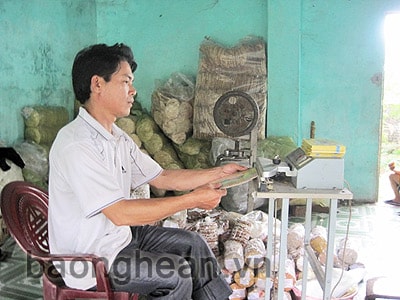
Packaging of "cu-đơ" candy and sesame candy at Mr. Vu Chinh's production facility.
in Dong Ha craft village.
According to Mr. Vo Canh Tuyen, Vice Chairman of the People's Committee of Dien Van commune: "The craft of producing peanut candy and peanut brittle in Dien Van has been maintained and developed for over 50 years, weathering many storms, periods of prosperity and decline, but no one has dared to abandon the craft. By the end of 2009, Dong Ha and Xuan Bac hamlets received recognition as Traditional Confectionery Villages from the Provincial People's Committee. Dong Ha village currently has 121 out of 230 households engaged in the craft with over 300 workers. Xuan Bac village has 96 out of 188 households with 228 workers. The revenue of the two craft villages in 2012 reached over 8 billion VND."
Despite the wide variety of confectionery products from modern factories flooding the market, traditional confectionery products from Dien Van (especially peanut brittle and pressed peanut candy) have still managed to penetrate urban markets and gain consumer acceptance. Trading activities have also been streamlined and made more convenient; most transactions are conducted via telephone and online.
Recognizing this as a key direction in the commune's labor restructuring, the Party Committee and the commune government have paid close attention to and actively participated with the villagers in the craft, determined to build the Dien Van confectionery brand. In the immediate future, the commune will continue to promote the role of production and business groups and associations. They will definitively address the pollution issues in some areas of the craft villages, overcome the fragmented and small-scale production practices of individual households, and strengthen efforts to introduce and promote craft village products.
In Dong Ha and Xuan Bac hamlets, besides peanut brittle and pressed peanut candy, sesame candy, sticky rice candy, elephant ear-shaped cakes, etc., are also very popular with customers from cities to rural areas. Not only during Tet (Lunar New Year) but also on ordinary days, Dien Van's confectionery is still purchased by many customers as gifts for each other when traveling far away. The market has expanded to almost all northern provinces; from Thai Nguyen and Vinh Phu to Cao Bang and Tuyen Quang...
The confectionery industry is characterized by its seasonal nature, thriving only in late autumn and early spring, as these months coincide with the Lunar New Year and the Spring Festival. On average, each household has one or two kitchens. During peak months, every kitchen operates all day, and if demand is high, overtime may be necessary to meet customer orders. Each kitchen requires approximately 10 workers: one cook, two or three cutters, and the rest are packers. The average daily income for cooks is currently stable at 100,000 VND per person for cooks and 50,000 VND per person for packers. Besides providing employment for family members, the developing craft village also creates jobs for hundreds of workers in the commune.
Confectionery products from Dien Van production facilities boast delicious, distinctive flavors and affordable prices. Along with the adoption of machinery replacing traditional manual methods such as mixing ingredients, cutting, and sealing bags, production facilities have also paid more attention to food safety and hygiene. Some facilities have registered trademarks for their products to compete in the market. And to achieve this transformation, besides the efforts of Dien Van officials and residents, the sound solutions of the commune government must also be mentioned. The commune consistently facilitates access to bank loans for households to expand production... As a new season begins, Dien Van once again offers sweet treats to customers during Tet and other festive seasons.
Text and photos: Ngoc Anh