

Vietnamese people are wasteful: They prioritize style over usefulness.
Many Vietnamese consumers have wasted a lot of money chasing after new products with many modern features, only to buy them and then leave them unused for a long time.
This is the general observation of market experts when studying the purchasing and usage habits of Vietnamese people for household products.
Smart TVs are a waste of money: 3D and 4K.
The most concrete example is the television. Nowadays, TV manufacturers have released a wide range of Smart TVs that integrate many modern features such as 3D, internet connectivity, smart share, gaming, etc.
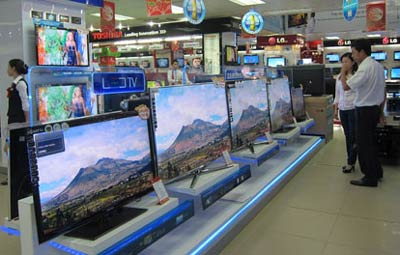 |
When buying a TV, many customers like and choose these models. However, after buying them, they use them like any other TV, only changing channels or adjusting the volume daily, without fully utilizing its new features.
Many families, when asked, said that most of the time they buy smart TVs, they mainly use them to watch news programs and movies from television channels. The 3D feature was initially used. However, the need for glasses, along with the limited content, led to a decline in interest. Some customers said they only watch when a new movie is released or on weekends. Many admitted that after only six months, this function is almost never used, except when guests come over and they show it to "show off."
The 2D-to-3D conversion feature works similarly. This feature converts all 2D input sources into 3D to provide a 3D experience. However, the images are considered unrealistic, and it requires wearing glasses, so few people use it.
Smart Share, a feature that allows wireless data sharing between computers, tablets, and smartphones, can be used to stream images, music, or movies from phones, computers, and tablets to TVs and vice versa. When asked, many families admitted they had never used this feature before. Most users are tech enthusiasts. Similarly, the gaming feature is also rarely used by families.
Perhaps the most frequently used feature is connecting the TV to the internet to watch online movie libraries. With a wealth of regularly updated HD movies and high-quality images, it's a popular alternative to boring television programs. However, accessing other content and programs online is less common because, despite being a smart TV, it still can't compare to a laptop due to its difficult controls.
Currently, a TV with full 3D, internet, and smart share features costs 20 million VND or more, while a 2D TV with internet connectivity costs only half that price and is considered more efficient, allowing for a replacement after a while.
However, many people probably still dislike such a TV because it is considered to lack class and modernity, and they are wasting tens of millions of dong on features they rarely use.
Buying a car: Go for a big car regardless of your needs.
The same applies to cars; many Vietnamese people have wasted hundreds of millions of dong buying vehicles that don't suit their purpose and usage conditions. Quite a few people buy large SUVs primarily to transport their children to school or work in the city, instead of choosing a compact, fuel-efficient model.
Many car manufacturers have been surprised by Vietnamese customers' behavior, realizing that despite having limited funds, they are unwilling to buy inexpensive cars. Cheap cars are often only for viewing; when it comes to purchasing, consumers tend to choose higher-priced models.
For example, when launching the new 2012 Camry, Toyota Vietnam added a 2.0 E version and had high expectations for this more affordable option. However, sales after more than a year showed that consumers bought more of the most expensive version, the 2.5G, followed by the 2.5V, and the 2.0E was the least popular. Similarly, the Ford Fiesta, a small car with three versions, had the cheapest version with a 1.4L engine that was highly anticipated but was the least popular and was soon discontinued. Conversely, customers preferred the top-of-the-line Sport version with a 1.6L engine and 6-speed automatic transmission, even though it cost tens of millions of dong more.
Furthermore, many customers prefer imported cars because of their modern features, regardless of whether they are suitable for Vietnam. For example, lane departure warning technology. In the US and European markets, this device is considered very useful. This warning system uses a camera to detect white or yellow lane dividers. If the car crosses these dividers without a turn signal, the system will emit an audible warning to the driver. Given the urban traffic conditions in Vietnam, with its congested streets and frequent traffic jams, this warning system might not be ideal, but many people still prefer to have it in their cars.
The same applies to motorcycles. In 2013, many new models were launched in Vietnam at quite good prices. However, many consumers still chose imported motorcycles, or even used imported motorcycles, at much higher prices, instead of domestically produced ones.
This consumption habit isn't limited to the wealthy; it's very common even among those with limited budgets. Many Vietnamese consumers are throwing money away without any regrets.
Is this a huge waste?
According to dantri.com