
Anh Son develops clean industries.
(Baonghean) - From now until 2020, with a vision to 2030, Anh Son district aims to promote industrial development with preferential policies to attract investment and support industrial enterprises in the area. Industrial development will focus on key sectors such as sugar, cement, tea, fired bricks, etc., in a clean and environmentally friendly direction.
(Baonghean) - From now until 2020, with a vision to 2030, Anh Son district aims to promote industrial development with preferential policies to attract investment and support industrial enterprises in the area. Industrial development will focus on key sectors such as sugar, cement, tea, fired bricks, etc., in a clean and environmentally friendly direction.
Motivation from the new factory
Anh Son is a low-lying mountainous district located in the southwest of Nghe An province, possessing many advantages for industrial, handicraft, and commercial development. Currently, the district has numerous factories and construction projects, producing many industrial products such as cement, bricks and tiles, stone, sand, gravel, sugar, tea, and export clothing. The entire district has over 100 operating businesses and 21 rural markets. In particular, since the Song Lam 2 Cement Plant began production, it has created a strong impetus for the district's development.
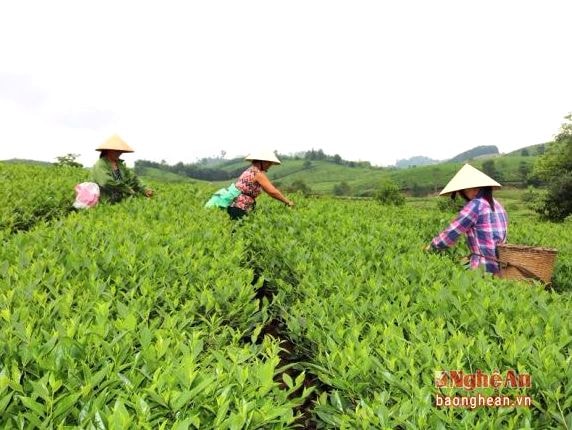 |
| Harvesting clean tea leaves in Hung Son commune. |
Mr. Dinh The Quyen, a technician at Song Lam 2 Cement Plant, shared: “I was fortunate to be hired at the plant and receive further training to effectively use the new production line. The work is piecework with an average salary of about 5 million VND per month. While working here, all employee benefits and policies are guaranteed by the company, so I feel very secure in my job.”
Nguyen Dinh Hau from Tru Son (Do Luong), a graduate of Vinh University of Technology and Education, also said: “Before officially starting work, I was sent by the factory to study cement production techniques at Vissai Ninh Binh for 3 months. After that, I was hired to work in the raw materials workshop, specializing in supplying raw materials to the rotary kiln. The work in this department is relatively hard, but the income is stable, averaging over 5 million VND per month. For me, having a job near home is also a blessing.”
The Song Lam 2 Cement Plant has a capacity of 600,000 tons of cement per year, producing PCP30, PCP40 cement and PCP50 clinker. In the first 10 months of 2016, the plant produced nearly 50,000 tons of clinker, 40,884 tons of bulk PCB 40 cement, and 30,658 bags of bagged PCB 40 cement, generating revenue of nearly 60 billion VND and paying 41 billion VND in taxes. The plant utilizes advanced technology, ensuring environmental hygiene. Since its operation began, the plant has significantly boosted the development of services and transportation in the surrounding town and area.
Mr. Nguyen Huu Dung, Chairman of the People's Committee of Hoi Son commune, said: After two years of operation, the Song Lam 2 Cement Plant has contributed to solving the problem of local labor shortages, providing employment for 120-150 people at the plant with stable salaries, and also employing many seasonal workers. Along with that, service activities in the area have become more vibrant, especially shops, businesses, and workshops for mechanical repairs and welding.
Currently in Anh Son district, cement is the district's main industrial product, with the Song Lam 2 Cement Plant of The Vissai Group and the Thanh Son One-Member Limited Company's plant having a designed capacity of 88,000 tons/year. These plants are now operational, producing cement and creating jobs for thousands of local workers. In addition, in Cam Son and Hoi Son communes, there are two businesses involved in the production of fired clay bricks, supplying the market with over 15 million bricks per year.
Direction of clean industry development
The Anh Son district prioritizes industrial production sectors and organizes the signing of commitments with factories to ensure environmental protection. The district records the production of refined sugar by Song Lam Sugar Company, with an annual output of 7,000-8,000 tons. Currently, the company has 3,000 hectares of sugarcane; the factory is upgrading its equipment, increasing its capacity from 1,500 tons of sugarcane per day to 3,000 tons of sugarcane per day by 2020.
To produce clean sugar, the company invested 8.2 billion VND in building a bio-fertilizer production plant, a system for treating flue gas and dust from the alcohol distillation boiler, and a wastewater treatment system for alcohol production. Notably, the company has utilized sugarcane bagasse ash to produce 5,000 tons of bio-fertilizer per year. This utilization of waste sludge for bio-fertilizer has effectively treated approximately 100 tons of waste per year, reducing odor pollution at the factory and in the surrounding environment. Wastewater (100 m³/day) has also been treated to meet environmental standards.
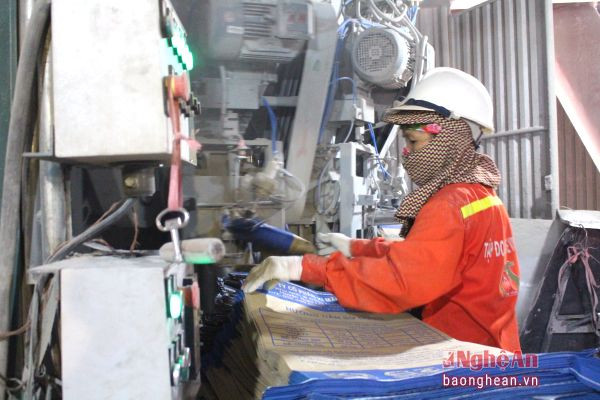 |
| Packaging cement at Song Lam 2 Cement Plant. |
Another product from Anh Son that operates under a clean production model is the industrial processing of tea based on tea buds grown in many communes throughout the district, including Long Son, Phuc Son, Hoi Son, Hoa Son, Cam Son, Hung Son, Duc Son, Dinh Son, Tuong Son, Tam Son, etc. To meet the demand for processing fresh tea buds, in addition to the three enterprises that produced tea before 2010 (Dinh Son Tea Factory, Black Tea Factory, Hung Son Tea Factory), three more private enterprises have now joined the tea processing industry. Industrial tea production maintains a fairly high growth rate, averaging 4,000 - 5,000 tons per year. Anh Son tea products, with established brands like Mac Dien tea and Hung Son tea, are favored by customers nationwide.
Mr. Son is striving to increase the contribution of the industrial sector to the district's GDP; the proportion of the industrial sector in the district is expected to reach 40% by 2020. The annual industrial growth rate is projected to be 15% during the 2015-2020 period and 12-15% during the 2020-2030 period. The value of industrial production (industry, handicrafts, and construction) is expected to reach approximately 2,100 billion VND by 2020.
Pearl - Xuanzang
| RELATED NEWS |
|---|