

Developing key crops and livestock in the new era.
(Baonghean.vn) - In recent years, rubber and sugarcane have been the main crops providing employment for farmers in Tan Ky, contributing significantly to poverty reduction and helping them achieve legitimate wealth. Continuing to capitalize on these advantages, Tan Ky's future plan is to expand rubber plantations, increase sugarcane yields, promote cattle breeding, and boost farm-based economic development.
(Baonghean.vn) - In recent years, rubber and sugarcane have been the main crops providing employment for farmers in Tan Ky, contributing significantly to poverty reduction and helping them achieve legitimate wealth. Continuing to capitalize on these advantages, Tan Ky's future plan is to expand rubber plantations, increase sugarcane yields, promote cattle breeding, and boost farm-based economic development.
Expand rubber plantation area.
Tan Ky district has 20,000 hectares of agricultural land. Over the years, thanks to the active participation of the government and the people, the entire district has planted more than 2,000 hectares of rubber trees, 5,000 hectares of sugarcane, and the rest are other crops such as rice, corn, and cassava. Rubber trees in Tan Ky have proven their role in socio-economic development. Currently, many families in the district have invested in rubber tree plantations, earning over 1 billion VND per year.

Comrade Pham Van Hoa - Vice Chairman of Tan Ky District People's Committee
Mr. Pham Van Hoa, Vice Chairman of the Tan Ky District People's Committee, affirmed: Rubber trees were introduced to Tan Ky district in 2003, mainly concentrated in three plantations: Song Con, Vuc Rong, and An Ngai. By 1999, the entire district had planted 707 hectares. However, from 2000 to 2005, due to various reasons, the rubber area in Tan Ky decreased to only 581 hectares. In the early years of exploitation, latex yield only reached 6-7 quintals/hectare, but after farmers recognized the role of rubber trees and focused on intensive cultivation, the latex yield has now reached 40 quintals/hectare (almost six times higher than in the early period).
Recognizing the benefits of rubber trees, in 2006 Tan Ky district developed a rubber tree development plan for the periods 2006-2010 and 2011-2015. From 2006 to the present, implementing the provincial and district policies supporting rubber tree planting, farmers throughout the district have planted 1,411 hectares of new rubber trees, bringing the total rubber tree area in the district to 1,992 hectares. The goal of the plan is to plant 3,500 hectares of rubber trees in Tan Ky by 2015. To achieve this goal, the district has initially planned three key rubber tree planting areas. Area 1 includes the communes of Tan Hop, Tan Xuan, Giai Xuan, the Youth Volunteer Brigade 4, the Protective Forest Management Board, Tan Phu, and Tan Long (2,800 hectares). Area 2 includes the communes of Dong Van, Nghia Phuc, Huong Son, and Tan An (1,500 hectares). Area 3 is in Phu Son commune (200 hectares).
To facilitate rubber cultivation for farmers, the District People's Committee has a policy of supporting 100% of the cost of seedlings for replanting newly planted areas damaged by natural disasters in the first two years. They also provide bamboo seedlings to households planting rubber trees in the first year with a scale of 1 hectare or more, at a rate of 100 bamboo plants per hectare. Planting bamboo around rubber plantations aims to act as a windbreak, reduce damage during storms, and also allows for harvesting bamboo shoots for food.
The economic benefits of rubber trees are very clear. Compared to other crops on the same land, rubber trees yield the highest net profit. An average annual income of over 74 million VND per hectare of rubber trees, after deducting expenses, results in a net profit of over 53 million VND. Besides its economic benefits, rubber trees also create jobs for producers, reduce social ills, contribute to stabilizing the lives of residents, improve the ecological environment, increase forest cover, prevent soil erosion, and mitigate damage caused by storms and floods. Given the high economic efficiency of rubber trees, the Provincial People's Committee needs to have policies and mechanisms to support the expansion of rubber tree cultivation in the coming years.
Increase sugarcane productivity
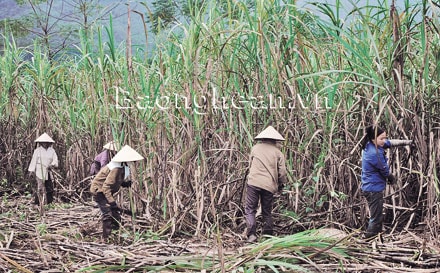
Tan Ky currently has 5,000 hectares of sugarcane, annually supplying raw materials to Song Con Sugarcane Company. However, sugarcane yields are not high, averaging only 45-50 tons/ha. The reason is that, until now, localities have utilized high hilly areas for sugarcane cultivation. Sugarcane is not drought-tolerant, so in drought years, sugarcane yields in hilly areas are low.
;)
;)
Increasing sugarcane productivity is the goal of Tan Ky.
To gradually improve sugarcane productivity, Tan Ky district has planned to gradually convert the area planted with corn and peanuts in lowland areas to sugarcane cultivation. Many localities in the district have identified sugarcane cultivation as highly efficient, and have therefore switched from corn to sugarcane. If planted in favorable conditions and with proper investment, one hectare of sugarcane can yield 80-100 tons. With a factory purchase price of 900 VND/kg, one hectare of sugarcane can generate 70-90 million VND. If planted with corn, the yield would be over 3 tons/ha, with a selling price of 6,000 VND/kg, bringing in nearly 20 million VND. Meanwhile, sugarcane can be ratoonized for 3 years, thus reducing investment costs.
Improve qualityherd of buffalo and cattle
Currently, Tan Ky district has a total cattle population of 18,603 and a buffalo population of 30,843. As a district with many favorable conditions for developing cattle farming, the people have invested heavily in commercial cattle farming in recent years. Alongside increasing the number of cattle, Tan Ky also focuses on improving the quality of the cattle herd by crossbreeding with Zebu cattle. In early 2011, the Tan Ky District People's Committee developed a project to improve the quality of the buffalo and cattle herd for the period 2011-2015. The purpose of the project is to focus on improving the quality of the buffalo and cattle herd towards commercial production, contributing to the shift in the agricultural economic structure, with buffalo and cattle farming as the central focus. The goal is to increase the cattle herd to 22,633 and the buffalo herd to 34,053 by 2015. Specifically, the goal is to artificially inseminate 1,000 to 2,000 doses of crossbred cattle annually, resulting in 600 to 1,800 calves; and to artificially inseminate 50 to 250 doses of Murrah buffalo, yielding 50 to 150 calves. To date, Tan Ky has 7,751 crossbred Sind cattle, accounting for 41% of the total herd.
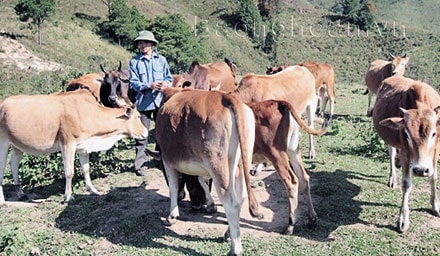
Tan Ky is gradually improving the quality of its cattle herd.
To achieve that goal, in addition to the provincial support policies, Tan Ky provides support in the form of concentrated feed equivalent to 50,000 VND per buffalo or cow undergoing artificial insemination and becoming pregnant; supports F1 Sindhi crossbred bulls for remote mountainous areas and places without conditions suitable for artificial insemination (support level of 60% of the price of the bulls entering the barn); and supports the purchase of nitrogen tanks for artificial insemination. Five models of high-quality Sindhi crossbred cow breeding are being developed... It is projected that over the next five years (2011-2015), Tan Ky will allocate nearly 850 million VND from its budget to support Sindhi crossbred cow breeding. This will help to reduce and gradually eliminate the practice of breeding with inferior or low-quality bulls.
Economic developmentfarm
Developing farm-based economic activities has been a sound policy of Tan Ky district for many years. Therefore, in recent years, the movement to develop farm-based economic activities in localities throughout the district has grown strongly in both quantity and quality. To date, the entire district has more than 300 farms of various types, with the most numerous being integrated farms.
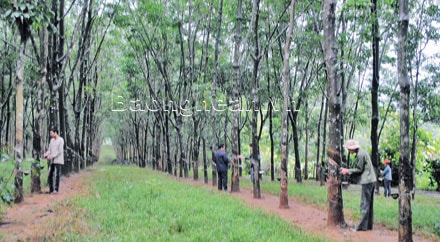
Expanding rubber plantations is Tan Ky's policy for the coming years.
By correctly identifying the role of farm economics, over the years, along with the State's mechanisms, Tan Ky has encouraged and guided people to form specialized and concentrated farm economic zones, such as: rubber plantations in Nghia Hoan, Tan Phu, Tan Xuan, Tan Hop; raw material forest plantations in Nghia Thai, Tan Huong, Giai Xuan, Dong Van, Tien Ky...; raw material sugarcane plantations in Tan Hop, Dong Van, Nghia Phuc, Giai Xuan..., attracting many people to boldly invest in expanding and developing farm economics. Among the more than 300 farms in Tan Ky, the majority of farm owners are farmers, with ethnic minorities accounting for nearly 25%.
Developing farm-based economy is a suitable direction for Tan Ky, truly bringing practical benefits both economically and socially. Through farm-based economy, farmers accumulate capital, experience in management and production, and consolidate land. On the other hand, farm-based economy has also created a new division of labor, narrowed the gap between rich and poor, promoted the industrialization of agriculture and rural areas, and provided farmers with the opportunity to access and apply scientific and technological advancements in livestock farming and production. Therefore, the Provincial People's Committee needs to have mechanisms that are appropriate to the reality so that farm-based economy can develop in both quantity and quality.
With economic development policies and orientations tailored to local conditions, it is hoped that Tan Ky will achieve its socio-economic development goals in the coming years. This will also create favorable conditions for other localities to implement the new rural development roadmap.
Xuan Hoang