
Phát triển các cây, con chủ lực ở tân kỳ
(Baonghean.vn) - In recent years, rubber and sugarcane have been the main crops providing employment for farmers in Tan Ky, contributing significantly to poverty reduction and helping them achieve legitimate wealth. Continuing to capitalize on these advantages, Tan Ky's future plan is to expand rubber plantations, increase sugarcane yields, promote cattle breeding, and boost farm-based economic development.
(Baonghean.vn) - In recent years, rubber and sugarcane have been the main crops providing employment for farmers in Tan Ky, contributing significantly to poverty reduction and helping them achieve legitimate wealth. Continuing to capitalize on these advantages, Tan Ky's future plan is to expand rubber plantations, increase sugarcane yields, promote cattle breeding, and boost farm-based economic development.
Expand rubber plantation area.
Tan Ky district has 20,000 hectares of agricultural land. Over the years, thanks to the active participation of the government and the people, the entire district has planted more than 2,000 hectares of rubber trees, 5,000 hectares of sugarcane, and the rest are other crops such as rice, corn, and cassava. Rubber trees in Tan Ky have proven their role in socio-economic development. Currently, many families in the district have invested in rubber tree plantations, earning over 1 billion VND per year.

Comrade Pham Van Hoa - Vice Chairman of Tan Ky District People's Committee
Mr. Pham Van Hoa, Vice Chairman of the Tan Ky District People's Committee, affirmed: Rubber trees were introduced to Tan Ky district in 2003, mainly concentrated in three plantations: Song Con, Vuc Rong, and An Ngai. By 1999, the entire district had planted 707 hectares. However, from 2000 to 2005, due to various reasons, the rubber area in Tan Ky decreased to only 581 hectares. In the early years of exploitation, latex yield only reached 6-7 quintals/hectare, but after farmers recognized the role of rubber trees and focused on intensive cultivation, the latex yield has now reached 40 quintals/hectare (almost six times higher than in the early period).
Recognizing the benefits of rubber trees, in 2006 Tan Ky district developed a rubber tree development plan for the periods 2006-2010 and 2011-2015. From 2006 to the present, implementing the provincial and district policies supporting rubber tree planting, farmers throughout the district have planted 1,411 hectares of new rubber trees, bringing the total rubber tree area in the district to 1,992 hectares. The goal of the plan is to plant 3,500 hectares of rubber trees in Tan Ky by 2015. To achieve this goal, the district has initially planned three key rubber tree planting areas. Area 1 includes the communes of Tan Hop, Tan Xuan, Giai Xuan, the Youth Volunteer Brigade 4, the Protective Forest Management Board, Tan Phu, and Tan Long (2,800 hectares). Area 2 includes the communes of Dong Van, Nghia Phuc, Huong Son, and Tan An (1,500 hectares). Area 3 is in Phu Son commune (200 hectares).
To facilitate rubber cultivation for farmers, the District People's Committee has a policy of supporting 100% of the cost of seedlings for replanting newly planted areas damaged by natural disasters in the first two years. They also provide bamboo seedlings to households planting rubber trees in the first year with a scale of 1 hectare or more, at a rate of 100 bamboo plants per hectare. Planting bamboo around rubber plantations aims to act as a windbreak, reduce damage during storms, and also allows for harvesting bamboo shoots for food.
The economic benefits of rubber trees are very clear. Compared to other crops on the same land, rubber trees yield the highest net profit. An average annual income of over 74 million VND per hectare of rubber trees, after deducting expenses, results in a net profit of over 53 million VND. Besides its economic benefits, rubber trees also create jobs for producers, reduce social ills, contribute to stabilizing the lives of residents, improve the ecological environment, increase forest cover, prevent soil erosion, and mitigate damage caused by storms and floods. Given the high economic efficiency of rubber trees, the Provincial People's Committee needs to have policies and mechanisms to support the expansion of rubber tree cultivation in the coming years.
Increase sugarcane productivity
Tan Ky currently has 5,000 hectares of sugarcane, annually supplying raw materials to Song Con Sugarcane Company. However, sugarcane yields are not high, averaging only 45-50 tons/ha. The reason is that, until now, localities have utilized high hilly areas for sugarcane cultivation. Sugarcane is not drought-tolerant, so in drought years, sugarcane yields in hilly areas are low.
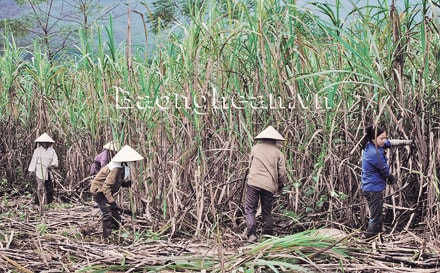
Increasing sugarcane productivity is the goal of Tan Ky.
Để từng bước nâng cao năng suất mía, Tân Kỳ đã có kế hoạch chuyển đổi dần diện tích trồng ngô, lạc ở vùng thấp sang trồng mía. Nhiều địa phương trong huyện đã xác định trồng mía hiệu quả cao, nên chuyển đổi cây ngô sang trồng mía. 1 ha mía nếu trồng ở vùng đất thuận lợi, đầu tư đúng mức, năng suất đạt từ 80 - 100 tấn ha. Giá thu mua của nhà máy 9 trăm đồng/kg, thì 1 ha mía thu về 70 - 90 triệu đồng. Nếu trồng ngô thì năng suất đạt hơn 3 tấn/ha, giá bán 6.000 đồng/kg, thu về gần 20 triệu đồng. Trong khi đó, trồng mía lưu gốc được 3 năm nên giảm được chi phí đầu tư.
Improve qualityherd of buffalo and cattle
Currently, Tan Ky district has a total cattle population of 18,603 and a buffalo population of 30,843. As a district with many favorable conditions for developing cattle farming, the people have invested heavily in commercial cattle farming in recent years. Alongside increasing the number of cattle, Tan Ky also focuses on improving the quality of the cattle herd by crossbreeding with Zebu cattle. In early 2011, the Tan Ky District People's Committee developed a project to improve the quality of the buffalo and cattle herd for the period 2011-2015. The purpose of the project is to focus on improving the quality of the buffalo and cattle herd towards commercial production, contributing to the shift in the agricultural economic structure, with buffalo and cattle farming as the central focus. The goal is to increase the cattle herd to 22,633 and the buffalo herd to 34,053 by 2015. Specifically, the goal is to artificially inseminate 1,000 to 2,000 doses of crossbred cattle annually, resulting in 600 to 1,800 calves; and to artificially inseminate 50 to 250 doses of Murrah buffalo, yielding 50 to 150 calves. To date, Tan Ky has 7,751 crossbred Sind cattle, accounting for 41% of the total herd.
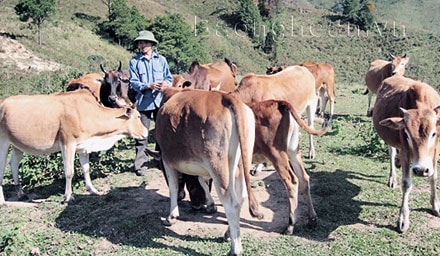
Tan Ky is gradually improving the quality of its cattle herd.
To achieve that goal, in addition to the provincial support policies, Tan Ky provides support in the form of concentrated feed equivalent to 50,000 VND per buffalo or cow undergoing artificial insemination and becoming pregnant; supports F1 Sindhi crossbred bulls for remote mountainous areas and places without conditions suitable for artificial insemination (support level of 60% of the price of the bulls entering the barn); and supports the purchase of nitrogen tanks for artificial insemination. Five models of high-quality Sindhi crossbred cow breeding are being developed... It is projected that over the next five years (2011-2015), Tan Ky will allocate nearly 850 million VND from its budget to support Sindhi crossbred cow breeding. This will help to reduce and gradually eliminate the practice of breeding with inferior or low-quality bulls.
Phát triển kinh tế trang trại
Phát triển kinh tế trang trại là chủ trương đúng đắn của huyện Tân Kỳ từ nhiều năm nay. Do vậy, những năm qua, phong trào làm kinh tế trang trại ở các địa phương trong huyện phát triển mạnh cả về số lượng và chất lượng. Tính đến nay, toàn huyện đã có hơn 300 trang trại các loại, trong đó nhiều nhất là loại hình trang trại tổng hợp.
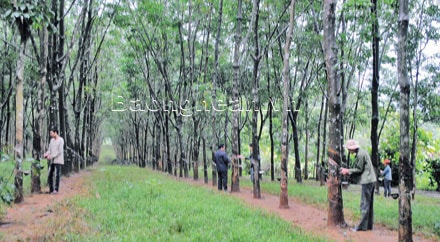
Mở rộng diện tích cao su là chủ trương của Tân Kỳ trong những năm tới.
Từ việc xác định đúng đắn vai trò của kinh tế trang trại, những năm qua, cùng với cơ chế của Nhà nước, Tân Kỳ đã khuyến khích, định hướng cho người dân hình thành những vùng kinh tế trang trại chuyên sâu và tập trung, như: cao su ở Nghĩa Hoàn, Tân Phú, Tân Xuân, Tân Hợp; trồng rừng nguyên liệu ở Nghĩa Thái, Tân Hương, Giai Xuân, Đồng Văn, Tiên Kỳ...; trồng mía nguyên liệu ở Tân Hợp, Đồng Văn, Nghĩa Phúc, Giai Xuân..., thu hút nhiều người dân mạnh dạn đầu tư mở rộng phát triển kinh tế trang trại. Trong số hơn 300 trang trại ở Tân Kỳ thì phần lớn chủ trang trại là nông dân, trong đó người dân tộc thiểu số chiếm gần 25%.
Phát triển kinh tế trang trại là hướng đi phù hợp với Tân Kỳ, thực sự mang lại hiệu quả thiết thực cả về kinh tế và xã hội. Từ kinh tế trang trại, người nông dân tích lũy được vốn, kinh nghiệm trong quản lý, sản xuất, tích tụ được ruộng đất. Mặt khác, cũng từ kinh tế trang trại đã tạo ra sự phân công lao động mới, rút ngắn khoảng cách giàu nghèo, thúc đẩy quá trình công nghiệp hóa nông nghiệp, nông thôn, đồng thời từ kinh tế trang trại người nông dân có điều kiện để tiếp cận, áp dụng các tiến bộ khoa học - kỹ thuật trong chăn nuôi, sản xuất. Từ đó UBND tỉnh cũng cần có cơ chế phù hợp với thực tế để kinh tế trang trại có điều kiện phát triển về số lượng và chất lượng.
Với những chủ trương, định hướng phát triển kinh tế phù hợp với điều kiện của địa phương, hy vọng Tân Kỳ sẽ đạt được các mục tiêu phát triển kinh tế - xã hội trong những năm tới, đồng thời đây cũng là điều kiện thuận lợi để các địa phương thực hiện lộ trình xây dựng nông thôn mới.
Xuân Hoàng




