
Que Phong: Choosing the right advantages for a "breakthrough"
Despite being one of the three poorest districts in the province, Que Phong district has successfully leveraged its local advantages, focusing on restructuring crop and livestock production and applying scientific and technical advancements to create a breakthrough in poverty reduction.
(Baonghean)Despite being one of the three poorest districts in the province, Que Phong district has successfully leveraged its local advantages, focusing on restructuring crop and livestock production and applying scientific and technical advancements to create a breakthrough in poverty reduction.
Beside his stilt house, Mr. Vi Thanh Xuan from Yen Son village, Tri Le commune, excitedly shared his success in the passion fruit harvest: “On an area of over 1,000 square meters, my family planted passion fruit trees, and this year we harvested our second crop with very promising results. The passion fruit harvest season starts from June to November every year. The recent harvest yielded nearly 4 tons of fruit, and selling it to the factory at 8,000 VND/kg brought in a profit of 38 million VND for the family, or almost 30 million VND in cash. Before, my family had to borrow money to pay for our two children's education. But since planting passion fruit, we no longer have to borrow money and have even accumulated savings, allowing the children to go to school with peace of mind.”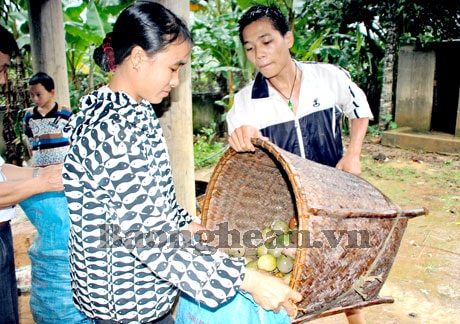
With a bumper passion fruit harvest and stable market demand, passion fruit is proving to be a way out of poverty for the people of Tri Le commune, Que Phong district.
The joy of Mr. Xuan's family is also the joy of many Thai ethnic minority households in Tri Le since passion fruit cultivation "took root" in this land. According to statistics from the Agricultural Service and Passion Fruit Development Cooperative, the entire Tri Le commune has planted 11 hectares across three villages: Yen Son, San, and Minh Chau. Based on current market prices, the second crop of passion fruit only requires an investment of 10 million VND in fertilizer per hectare, while yielding 200 million VND per hectare. This means Tri Le farmers earn billions of VND in profit from their current land. This figure is truly enviable in a region still facing many difficulties in economic and social development. However, the greatest benefit from the passion fruit cultivation model in Tri Le is not just "making the land yield gold," but rather changing the mindset and practices of the local people, shifting from self-sufficient production to commercial production and joint ventures.
Back in Chau Kim – a suburban commune near the district center – farmers are working hard alongside the government to build a new rural area, aiming for a more beautiful and prosperous village in the future. However, a new rural Chau Kim is not only reflected in infrastructure but also in successful livestock farming models that contribute to household economic development.
Mr. Luong Van Trung, from Choi village, Chau Kim commune, has successfully implemented a black chicken farming model. In 2011, his family raised 100 chickens. After 4 months, the average weight of each chicken was 1.2-1.4 kg, and they were sold at 150,000 VND/kg, bringing in a considerable income for his family. This year, he has invested in an additional 200 chicks. In Chau Kim commune, there are 20 households raising black chickens this year, with a total flock of 1,670 chickens. Some households raise at least 50 chickens, while others raise up to 300. Notably, some households have even switched to hatching chicks to supply to households within and outside the commune. Ms. Thuy's household in Muong village sells an average of 30-40 kg of chicks per month, earning a profit of 4-5 million VND per month after deducting expenses.
Fundamental changes in business practices in the localities of Que Phong district originated from the District Party Committee's Resolution on strengthening the application of science and technology and innovating agricultural extension work. In the spirit of the resolution, the District Party Committee focused on directing the implementation in the agricultural sector, such as applying new technologies and new varieties, selecting certain plant and animal varieties with unique characteristics of Que Phong to increase competitiveness in the market, and secondly, prioritizing the innovation of agricultural extension work, from updating materials to methods of selection and guidance.
Specifically, the district adopted a method where each commune selected a suitable crop or livestock variety that matched its soil and climate conditions, creating distinctive and competitive products. For example, Tri Le commune chose passion fruit cultivation, Chau Thon commune chose beekeeping, Chau Kim commune chose raising black chickens and Mong Cai pigs, and Quang Phong, Cam Muon, and Tien Phong communes chose raising Quy Chau Muscovy ducks… Beyond simply formulating policies, the district emphasized the importance of officials staying close to the people when implementing the model. For instance, in the use of compressed fertilizer for rice cultivation, the district assigned three officials to each village to directly guide the people in adopting the practice.
Furthermore, in implementing the resolution, the district has proactively integrated government programs such as 30a, 135/CP… and projects from non-governmental organizations such as the Danish CARE Project and projects from Spain to leverage capital, technology, and experience from these resources to accelerate the poverty reduction process. Mr. Tran Quoc Thanh – Secretary of the Que Phong District Party Committee – said: Based on the success of models implemented by these projects in the district, the district will allocate additional resources to expand their application. In addition, the district is also creating linkages with businesses to address the market for agricultural products for farmers.
Assessing the effectiveness of the resolution's implementation in the district, Mr. Tran Quoc Thanh stated: "The fundamental issue is that people have gradually changed their perceptions and methods, shifting from producing for personal consumption to producing goods for sale. Currently, the district has the advantage of having many support programs and projects implementing economic development models in the area. Secondly, the Que Phong area has a rather unique climate, which helps build highly competitive agricultural production models. However, the difficulty remains in replicating these models; therefore, supportive policies are needed so that people can sustainably develop these models on their own."
Thanh Duy