
Que Phong: Choosing the right advantages for a "breakthrough"
Là 1 trong 3 huyện nghèo của tỉnh nhưng thời gian qua, huyện Quế Phong đã biết cách phát huy lợi thế của địa phương, tập trung chuyển đổi cơ cấu cây trồng, vật nuôi, áp dụng khoa học kỹ thuật vào sản xuất nhằm tạo bước đột phá trong công tác xóa đói giảm nghèo.
(Baonghean)Là 1 trong 3 huyện nghèo của tỉnh nhưng thời gian qua, huyện Quế Phong đã biết cách phát huy lợi thế của địa phương, tập trung chuyển đổi cơ cấu cây trồng, vật nuôi, áp dụng khoa học kỹ thuật vào sản xuất nhằm tạo bước đột phá trong công tác xóa đói giảm nghèo.
Beside his stilt house, Mr. Vi Thanh Xuan from Yen Son village, Tri Le commune, excitedly shared his success in the passion fruit harvest: “On an area of over 1,000 square meters, my family planted passion fruit trees, and this year we harvested our second crop with very promising results. The passion fruit harvest season starts from June to November every year. The recent harvest yielded nearly 4 tons of fruit, and selling it to the factory at 8,000 VND/kg brought in a profit of 38 million VND for the family, or almost 30 million VND in cash. Before, my family had to borrow money to pay for our two children's education. But since planting passion fruit, we no longer have to borrow money and have even accumulated savings, allowing the children to go to school with peace of mind.”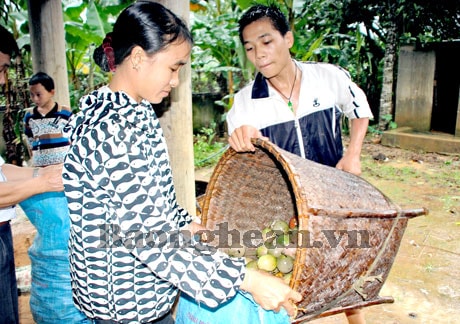
With a bumper passion fruit harvest and stable market demand, passion fruit is proving to be a way out of poverty for the people of Tri Le commune, Que Phong district.
The joy of Mr. Xuan's family is also the joy of many Thai ethnic minority households in Tri Le since passion fruit cultivation "took root" in this land. According to statistics from the Agricultural Service and Passion Fruit Development Cooperative, the entire Tri Le commune has planted 11 hectares across three villages: Yen Son, San, and Minh Chau. Based on current market prices, the second crop of passion fruit only requires an investment of 10 million VND in fertilizer per hectare, while yielding 200 million VND per hectare. This means Tri Le farmers earn billions of VND in profit from their current land. This figure is truly enviable in a region still facing many difficulties in economic and social development. However, the greatest benefit from the passion fruit cultivation model in Tri Le is not just "making the land yield gold," but rather changing the mindset and practices of the local people, shifting from self-sufficient production to commercial production and joint ventures.
Back in Chau Kim – a suburban commune near the district center – farmers are working hard alongside the government to build a new rural area, aiming for a more beautiful and prosperous village in the future. However, a new rural Chau Kim is not only reflected in infrastructure but also in successful livestock farming models that contribute to household economic development.
Mr. Luong Van Trung, from Choi village, Chau Kim commune, has successfully implemented a black chicken farming model. In 2011, his family raised 100 chickens. After 4 months, the average weight of each chicken was 1.2-1.4 kg, and they were sold at 150,000 VND/kg, bringing in a considerable income for his family. This year, he has invested in an additional 200 chicks. In Chau Kim commune, there are 20 households raising black chickens this year, with a total flock of 1,670 chickens. Some households raise at least 50 chickens, while others raise up to 300. Notably, some households have even switched to hatching chicks to supply to households within and outside the commune. Ms. Thuy's household in Muong village sells an average of 30-40 kg of chicks per month, earning a profit of 4-5 million VND per month after deducting expenses.
Fundamental changes in business practices in the localities of Que Phong district originated from the District Party Committee's Resolution on strengthening the application of science and technology and innovating agricultural extension work. In the spirit of the resolution, the District Party Committee focused on directing the implementation in the agricultural sector, such as applying new technologies and new varieties, selecting certain plant and animal varieties with unique characteristics of Que Phong to increase competitiveness in the market, and secondly, prioritizing the innovation of agricultural extension work, from updating materials to methods of selection and guidance.
Cụ thể, huyện đã làm theo phương pháp cứ mỗi xã chọn một giống cây, con phù hợp với điều kiện thổ nhưỡng, khí hậu và tạo ra hàng hóa đặc thù, có sức cạnh tranh như xã Tri Lễ chọn trồng cây chanh leo, xã Châu Thôn lựa chọn nuôi ong, xã Châu Kim chọn nuôi gà đen và lợn Móng Cái, xã Quang Phong, Cắm Muộn và Tiền Phong chọn nuôi vịt bầu Quỳ Châu… Không chỉ đơn thuần đề ra chủ trương chính sách, khi áp dụng mô hình vào thực tiễn, huyện đã xác định cán bộ phải bám dân, đơn cử như việc sử dụng phân nén bón cho lúa. Cứ mỗi bản, huyện cử 3 cán bộ xuống trực tiếp hướng dẫn cho nhân dân làm theo.
Ngoài ra, thực hiện nghị quyết, huyện cũng đã chủ động lồng ghép các chương trình của Chính phủ như 30a, 135/CP… và các dự án của các tổ chức phi chính phủ như Dự án CARE của Đan Mạch, dự án của Tây Ban Nha để tận dụng vốn, kỹ thuật, kinh nghiệm của các nguồn lực nhằm đẩy nhanh tiến trình xóa đói giảm nghèo. Ông Trần Quốc Thành – Bí thư Huyện ủy Quế Phong cho biết: Trên cơ sở thành công của các mô hình do những dự án triển khai trên địa bàn, huyện sẽ bổ sung thêm nguồn lực nhằm nhân rộng. Bên cạnh đó, huyện còn tạo liên kết với doanh nghiệp để giải quyết đầu ra cho sản phẩm nông nghiệp cho nông dân.
Đánh giá về hiệu quả triển khai nghị quyết tại địa bàn huyện, ông Trần Quốc Thành cho biết: Cái cơ bản là người dân đã dần thay đổi nhận thức, cách làm, từ làm để ăn nay chuyển sang làm hàng hóa để bán. Hiện nay, huyện gặp thuận lợi là có nhiều chương trình, dự án hỗ trợ đang thực hiện các mô hình phát triển kinh tế trên địa bàn, thứ hai là khu vực Quế Phong có khí hậu khá đặc thù, giúp xây dựng các mô hình sản xuất nông nghiệp có tính cạnh tranh cao. Tuy nhiên, khó khăn vẫn là việc nhân rộng các mô hình, vì vậy, cần có chính sách hỗ trợ để người dân có thể tự làm được một cách bền vững.
Thanh Duy